Pancreas-sparing duodenectomy for duodenal polyposis

“Pancreas-sparing duodenectomy, although technically demanding, eliminates the need for pancreatic resection. Pancreas-sparing duodenectomy is associated with good absorptive capacity, weight gain, and quality of life. Furthermore, it may reduce the risk of subsequent malignancy. Long-term surveillance, however, is still required. Pancreas-sparing duodenectomy is contraindicated in the setting of malignancy.”

Continue reading

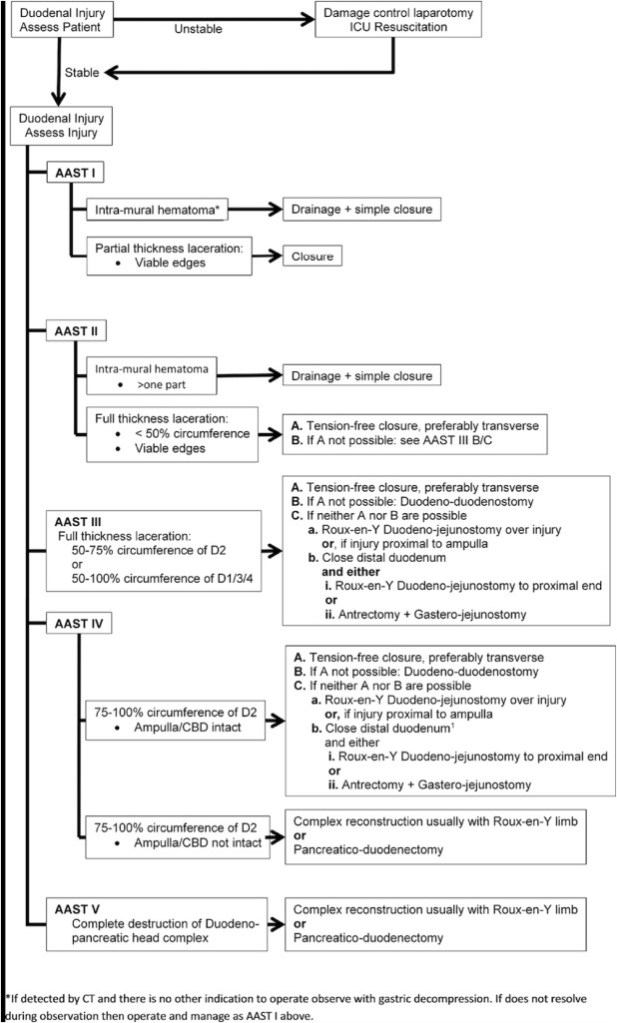
Management of the complex duodenal injury

“Duodenal trauma is a rare occurrence existing in 1–4.7% of all abdominal trauma. Its posterior and partially retroperitoneal location shields it from most traumatic mechanisms. Colloquially referred to as the ‘surgical soul’, its proximity to complex regional anatomy makes duodenal trauma particularly at risk for biliary, pancreatic and major vascular injury with 68–86.5% of patients sustaining an associated injury.”

Continue reading

Damage control in penetrating duodenal trauma

“The overall incidence of duodenal injuries in severely injured trauma patients is between 0.2 to 0.6% and the overall prevalence in those suffering from abdominal trauma is 3 to 5% 1,2. Approximately 80% of these cases are secondary to penetrating trauma, commonly associated with vascular and adjacent organ injuries. These associated injuries create a significant challenge towards the early diagnosis and appropriate management. Therefore, defining the best surgical treatment algorithm remains controversial. Mild to moderate duodenal trauma is currently manage via primary repair and simple surgical techniques. However, severe injuries have required complex surgical techniques (duodenal diverticulization, pyloric exclusion with or without gastrojejunostomy and pancreatoduodenectomy) without significant favorable outcomes and consequential increase in the rates of mortality.”

Continue reading

Pancreas-preserving duodenectomy

Di Saverio S, et al. Pancreas-sparing, ampulla-preserving duodenectomy for major duodenal (D1-D2) perforations. Br J Surg. 2018 Oct;105(11):1487-1492.

Results: Ten patients were treated with this technique; seven had perforated or bleeding peptic ulcers, two had iatrogenic perforations and one blunt abdominal trauma. Their mean age was 78 (range 65-84) years. Four patients were haemodynamically unstable. The location of the duodenal injury was always D1 and/or D2, above or in close proximity to the ampulla of Vater. The surgical approach was open in nine patients and laparoscopic in one. The mean duration of surgery was 264 (range 170-377) min. All patients were transferred to the ICU after surgery (mean ICU stay 4·4 (range 1-11) days), and the overall mean hospital stay was 17·8 (range 10-32) days. Six patients developed major postoperative complications: cardiorespiratory failure in five and gastrointestinal complications in four. Surgical reoperation was needed in one patient for postoperative necrotizing and bleeding pancreatitis. Two patients died from their complications.

Continue reading

The anatomy of peripancreatic arteries and pancreaticoduodenal arterial arcades

Kumar KH, et al. Anatomy of peripancreatic arteries and pancreaticoduodenal arterial arcades in the human pancreas: a cadaveric study. Surg Radiol Anat. 2021 Mar;43(3):367-375.

Full-text for Emory users.

Results: The gastroduodenal (GDA), anterior superior pancreaticoduodenal (ASPD), and anterior inferior pancreaticoduodenal (AIPD) artery was found in all the cases, whereas the posterior superior pancreaticoduodenal (PSPD) and posterior inferior pancreaticoduodenal (PIPD) artery was present in 93.34% cases. The ASPD artery originated from GDA in all the cases. Two types of variations were observed in the origin of PSPD artery and four types each in the origin of AIPD and PIPD artery. Anatomical and numerical variations were observed in both anterior and posterior arches, posterior arch being absent in 20% cases.

Continue reading

Article of interest: Management of the difficult duodenal stump in penetrating duodenal ulcer disease: a comparative analysis of duodenojejunostomy with “classical” stump closure (Nissen-Bsteh)

Vashist YK, et al. Management of the difficult duodenal stump in penetrating duodenal ulcer disease: a comparative analysis of duodenojejunostomy with “classical” stump closure (Nissen-Bsteh). Langenbecks Arch Surg. 2012 Dec;397(8):1243-9.

Full-text for Emory users.

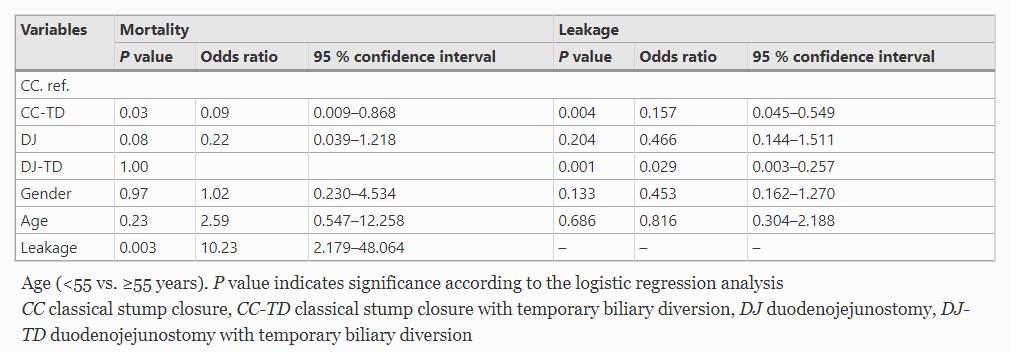
Table 4. Multivariable Analysis for Perioperative Mortality and Leakage in All 124 Patients

Background: Duodenal stump insufficiency after surgery for penetrating gastroduodenal ulcer is associated with substantial mortality. “Classical” technique of closing a difficult duodenal stump (Nissen-Bsteh) has, up to now, not been compared with duodenojejunostomy (DJ) in larger patient sets. This also refers to the potential benefit of a gastric and biliary diversion under such conditions. The aim of the present study was to compare classical duodenal closure (CC) with DJ and to evaluate the impact of gastric and biliary diversion on postoperative outcome after surgery for penetrating, high-risk duodenal ulcer in a matched control study.

Continue reading