
Comparing Outcomes Between “Pull” Versus “Push” Percutaneous Endoscopic Gastrostomy in Acute Care Surgery: Under-Reported Pull Percutaneous Endoscopic Gastrostomy Incidence of Tube Dislodgement

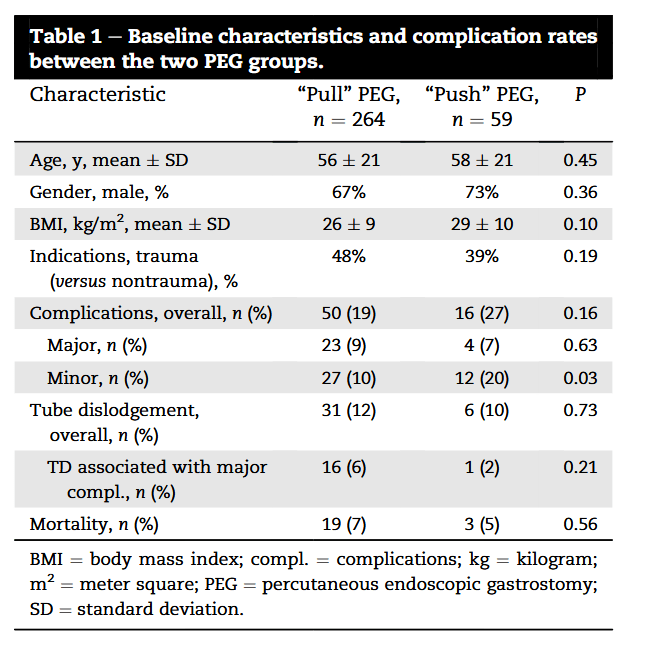
“Percutaneous endoscopic gastrostomy (PEG) tube placement is a commonly performed procedure in trauma patients.Since the establishment of the acute care surgery (ACS)
model, the role of ACS in PEG tube placement in many institutions has expanded. The incidence of PEG tube complications has been under-reported in the literature and varies
widely among the patient populations studied and the definition of complications utilized. Major and minor complications may range from 3% to 26%. Our institution, under an ACS model, has previously reported an overall 25% complication rate with 10% major and 14% minor complications associated with pull PEG.”
Continue reading

Risk factors for postoperative bleeding and early death in percutaneous endoscopic gastrostomy

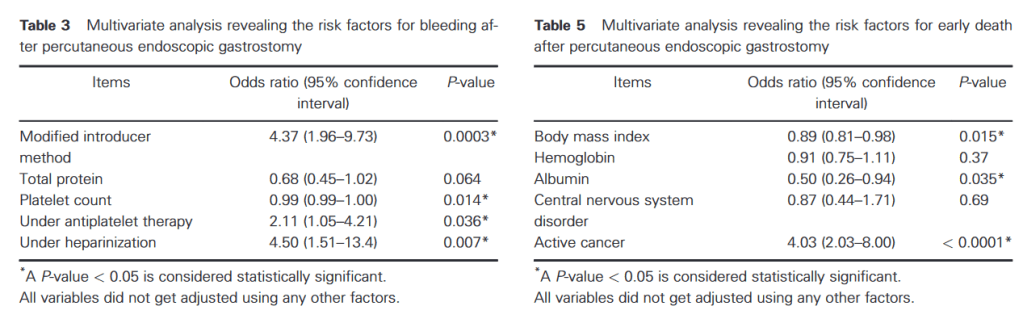
“Gastrostomy is a method of tube feeding for patients incapable of oral intake. Percutaneous endoscopic gastrostomy (PEG) is performed in many hospitals in Japan. However, reports of postoperative bleeding or early postoperative death after PEG are limited.
Compared with nasogastric tube feeding, gastrostomy feeding has a favorable outcome, decreases treatment failure, decreases the frequency of gastrointestinal bleeding, and leads to increased serum albumin levels. However, as PEG is an invasive procedure, adverse events such as bleeding, local infection, peritonitis, and pulmonary aspiration may occur, thus worsening patient prognosis. Aspiration pneumonia has long been recognized as the
most common cause of death after PEG. However, there are no recent large-scale studies investigating the association between postoperative adverse events and early postoperative death in PEG.”

Continue reading

Article of interest: Comparison of open gastrostomy tube to percutaneous endoscopic gastrostomy tube in lung transplant patients.

Taghavi S, et al. Comparison of open gastrostomy tube to percutaneous endoscopic gastrostomy tube in lung transplant patients. Ann Med Surg (Lond). 2015 Dec 23;5 :76-80.

Introduction: Lung transplant patients require a high degree of immunosuppression, which can impair wound healing when surgical procedures are required. We hypothesized that because of impaired healing, lung transplant patients requiring gastrostomy tubes would have better outcomes with open gastrostomy tube (OGT) as compared to percutaneous endoscopic gastrostomy tube (PEG).

Continue reading

Janeway Gastrostomy

Gastrostomy. Ellison E, & Zollinger R.M., Jr.(Eds.), (2016). Zollinger’s Atlas of Surgical Operations, 10e. McGraw-Hill. Emory login required.

“As a temporary gastrostomy, the Witzel or the Stamm procedure is used frequently and is easily performed. A permanent type of gastrostomy, such as the Janeway and its variations, is best adapted to patients in whom it is essential to have an opening into the stomach for a prolonged period of time. Under these circumstances, the gastric mucosa must be anchored to the skin to ensure long-term patency of the opening. Furthermore, the construction of a mucosa-lined tube with valve-like control at the gastric end tends to prevent the regurgitation of the irritating gastric contents. This allows periodic intubation and frees the patient from the irritation of a constant indwelling tube.”

Continue reading