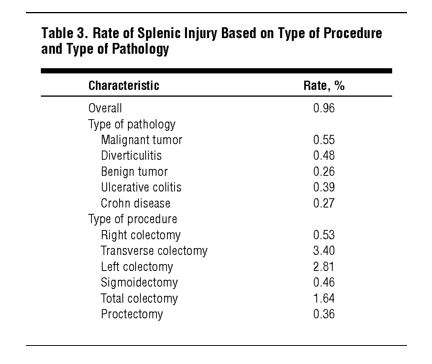
Predictive factors of splenic injury in colorectal surgery

“Splenic injury is a major intraoperative complication of abdominal surgery and places patients at a higher risk of morbidity and mortality, of longer operating time, and of longer hospital stay. Splenic injuries may be managed nonoperatively or by splenorrhaphy, partial splenectomy, or complete splenectomy. Because splenectomy is reported to have higher mortality rates than splenorrhaphy, great effort is taken to preserve the spleen; however, excessive blood loss can mandate splenectomy.”

Continue reading

Iatrogenic urologic injuries 

Ferrara M, Kann BR. Urological injuries during colorectal surgery. Clin Colon Rectal Surg. 2019 May;32(3):196-203.

“A recent retrospective population-based study of patients in the United States undergoing colorectal surgery found the overall incidence of ureteral injury to be 0.28%. The incidence was found to be significantly higher in patients with stage 3 or 4 cancer, malnutrition, steroid use, and in operations done at teaching hospitals. Rectal cancer cases were found to have the highest rates of ureteral injuries (7.1/1,000), followed by Crohn’s disease and diverticular disease (2.9/1,000 each). In this review, laparoscopic surgery was associated with a lower incidence of ureteral injuries when compared with open (1.1 vs. 2.8/1,000, p  < 0.001). Of the specific operations reviewed, abdominoperineal resection (APR) was found to have the highest rate of ureteral injury at 7.1/1,000 cases.” (Ferrara, 2019, p. 196)

Continue reading

Iatrogenic bladder injury and prevention of catheter-related bacteriuria

Literature review conducted and presented by Dr. Clara Farley

EUA guidelines on iatrogenic bladder trauma:

  • Repair in two layers with absorbable sutures
  • Postop bladder drainage is required for 7-14 days
  • Cystoscopy is advised

Bacteriuria in patients with indwelling catheters occurs at a rate of approx. 3-10% per day of catheterization:

  • Of those with bacteriuria, approx. 10-25% develop UTI (GU or systemic symptoms)
  • 4% of less develop catheter related bacteremia

Association between the rate of UTI and duration of catheterization:

  • 15% at 3 days
  • 68% at 8 days

Continue reading

Iatrogenic ureteral injury in colorectal cancer surgery

Andersen P, et al. Iatrogenic ureteral injury in colorectal cancer surgery: a nationwide study comparing laparoscopic and open approaches. Surg Endosc. 2015 Jun;29(6): 1406-12.

Full-text for Emory users.

Results: A total of 18,474 patients had a resection for colorectal cancer. Eighty-two ureteral injuries were related to colorectal surgery. The rate of ureteral injuries in the entire cohort was 0.44 %, with 37 (0.59 %) injuries in the laparoscopic group (n = 6,291) and 45 (0.37 %) injuries in the open group (n = 12,183), (P = 0.03). No difference in ureteral injury was found in relation to surgical approach in colon cancer patients. In rectum cancer patients (n = 5,959), the laparoscopic approach was used in 1,899 patients, and 19 (1.00 %) had ureteral injuries, whereas 17 (0.42 %) of 4,060 patients who underwent an open resection had a ureteral injury. In multivariate analysis adjusted for age, gender, ASA score, BMI, tumor stage, preoperative chemo-radiation, calendar year, and specialty of the surgeon, the laparoscopic approach was associated with an increased risk of ureteral injury, OR = 2.67; 95 % CI 1.26-5.65.

Conclusion: In this nationwide study laparoscopic surgery for rectal cancer with curative intent was associated with a significantly increased risk of iatrogenic ureteral injury compared to open surgery.

Continue reading