
Utilization and Delivery of Specialty Palliative Care in the ICU

“Palliative care (PC) interventions in the critically ill have been associated with reduced subsequent ICU admissions and reduced ICU length of stay. Barriers to PC integration
and utilization in the ICU include unrealistic expectations of ICU interventions by patients and families, barriers related to ICU culture as well as cultural attributes of patients and families, insufficient training in PC principles for ICU clinicians, PC workforce shortages,
and inability of patients to participate in treatment discussions. Overcoming these barriers and assessing patient and provider needs for specialty PC depends on the availability and capabilities of PC services at the institutional level, the bandwidth of providers and characteristics of the patient population.”
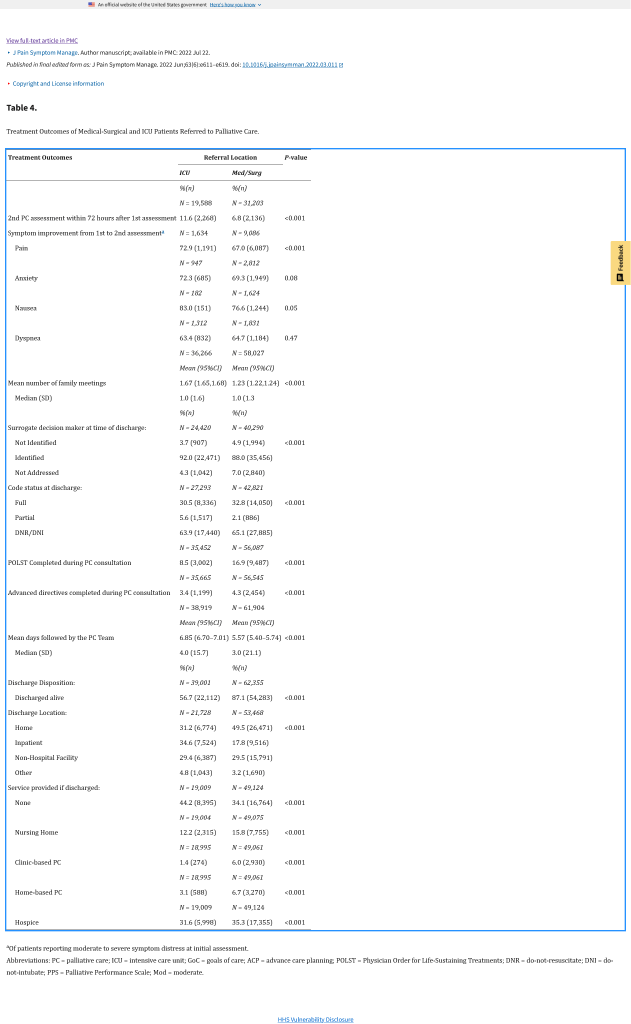
Continue reading

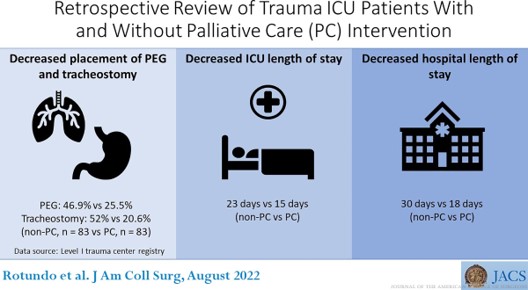
Palliative Care in Trauma Patients

“Older trauma patients present with poor preinjury functional status and more comorbidities. Advances in care have increased the chance of survival from previously fatal injuries with many left debilitated with chronic critical illness and severe disability. Palliative care (PC) is ideally suited to address the goals of care and symptom management in this critically ill population. A retrospective chart review was done to identify the impact of PC consults on hospital length of stay (LOS), ICU LOS, and surgical decisions.”

Continue reading

The Confusion Assessment Method (CAM) for the ICU-7 Delirium Severity Scale

Khan BA, et al. The Confusion Assessment Method for the ICU-7 Delirium Severity
Scale: A Novel Delirium Severity Instrument for Use in the ICU
. Crit Care Med. 2017 May;45(5):851-857.

Measurements and Main Results: Patients received the CAM-ICU, Richmond Agitation-Sedation Scale (RASS), and Delirium Rating Scale-Revised (DRS-R)-98 assessments. A 7-point scale (0-7) was derived from responses to the CAM-ICU and RASS items. CAM-ICU-7 showed high internal consistency (Cronbach’s alpha=0.85) and good correlation with DRS-R-98 scores (correlation coefficient=0.64). Known-groups validity was supported by the separation of mechanically ventilated and non-ventilated assessments. Median CAM-ICU-7 scores demonstrated good predictive validity with higher odds (OR=1.47; 95% CI=1.30-1.66) of inhospital mortality, and lower odds (OR=0.8; 95% CI=0.72-0.9) of being discharged home after adjusting for age, race, gender, severity of illness, and chronic comorbidities. Higher CAM-ICU-7 scores were also associated with increased length of ICU stay (p=0.001).

Continue reading

The safety of enteral and parenteral nutrition in ICU patients receiving vasopressors

Patel JJ, et al. Phase 3 Pilot Randomized Controlled Trial Comparing Early Trophic Enteral Nutrition With “No Enteral Nutrition” in Mechanically Ventilated Patients With Septic Shock. JPEN J Parenter Enteral Nutr. 2020 Jul;44(5):866-873.

Full-text for Emory users.

Results: One hundred thirty-one patients were eligible for enrollment, and 49 were available for consent. Thirty-one (86%) consented and were randomized and 100% of patients in the early EN arm and 94% in the “no EN” arm completed their protocols. While on vasopressors, early EN group received median 384 kcal, and the “no EN” group received median 0 kcal. Contamination rate was 0 in the early trophic EN arm and 6% in the “no EN” arm. The early EN group had median 25 intensive care unit-free days, as compared with 12 in the “no EN” arm (P = .014). The early EN arm had median 27 ventilator-free days, compared with 14 in “no EN” arm (P = .009).

Conclusion: Our protocol comparing early trophic EN with “no EN” in septic shock was feasible. Early trophic EN may be beneficial, but a larger multicenter trial is warranted to confirm the observed clinical benefits seen in this trial.

Continue reading