
Relationship Between the Number of Intersections of Staple Lines and Anastomotic Leakage

“The number of intersections of staple lines is associated with anastomotic leakage, and the inversion technique is a useful method for avoiding anastomotic leakage. Using an appropriate technique by skilled operator, double stapling technique for laparoscopic
anterior resection is safe and feasible.”

Laparoscopic intracorporeal colorectal anastomosis with double stapling technique is difficult because of the unsuitable cutting angle associated with using a linear stapler in the narrow pelvic cavity. Consequently, we sometimes have used multiple stapler firings during division of the rectum. Because of the long and tilted linear staple line placed on the rectal stump, a circular anastomotic plane can create multiple intersections of staple lines and dog-ears. Anastomotic leakage is a major problem in patients with colorectal cancer who have
undergo laparoscopic surgery. Despite technical improvements in laparoscopic surgery, recent studies have reported that the anastomotic leakage rate remains at 6.3% to 13.7%.” (Lee)

Lee
Continue reading

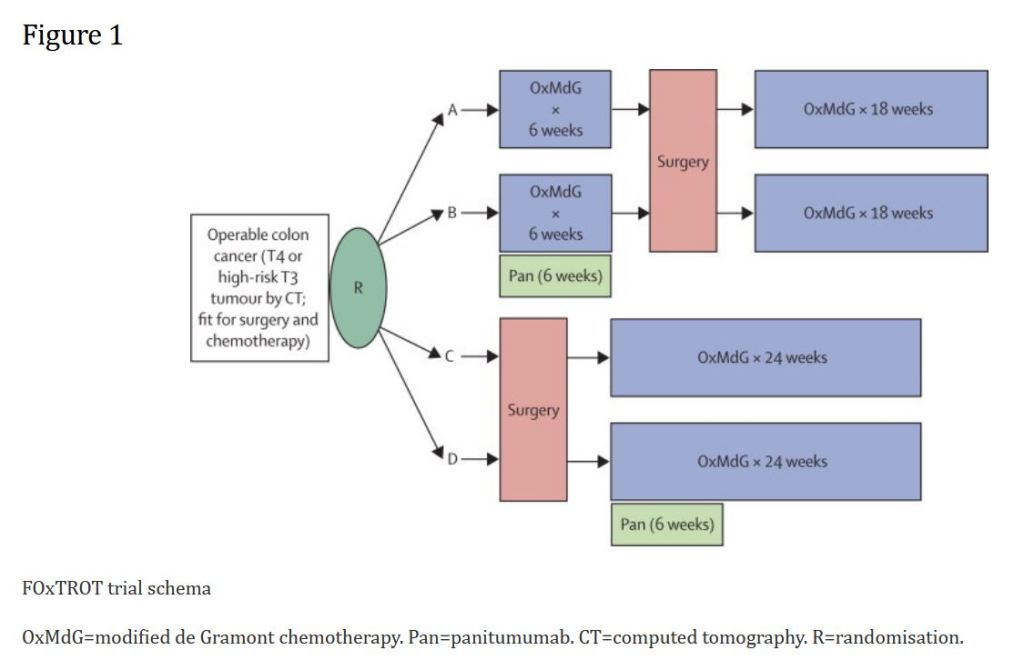
Feasibility of preoperative chemotherapy for locally advanced, operable colon cancer: Foxtrot Study

“Preoperative (neoadjuvant) chemotherapy and radiotherapy are substantially more effective than similar postoperative therapy in oesophageal, gastric, and rectal cancer. Earlier treatment might be more effective at eradicating micrometastatic disease than the same treatment 3 months later, the typical period between diagnosis and starting postoperative chemotherapy, particularly because surgery increases growth factor activity in the early postoperative period, promoting more rapid tumour progression.”

Continue reading

Total neoadjuvant therapy in rectal cancer

Petrelli F, et al. Total Neoadjuvant Therapy in Rectal Cancer: A Systematic Review and Meta-analysis of Treatment Outcomes. Ann Surg. 2020 Mar;271(3):440-448.

Full-text for Emory users.

Results: A total of 28 studies (3 retrospective and 25 prospective for a total of 3579 patients) were included in the final analysis (n = 2688 treated with TNT and n = 891 with neoadjuvant chemoradiotherapy therapy). The pooled pCR rate was 22.4% (95% CI 19.4%-25.7%) in all patients treated with TNT (n = 27 studies with data available). In n = 10 comparative studies with data available, TNT was found to increase the odds of pCR by 39% (1.40, 95% CI 1.08-1.81, P = 0.01).

Conclusions: The addition of induction or consolidation chemotherapy to standard neoadjuvant chemoradiotherapy results in a higher pCR rate. Given that the comparative analysis was derived from few randomized publications, large confirmatory trials should be carried out before a strong recommendation is made in favor of TNT.

Continue reading