Optimal timing for surgical reconstruction of bile duct injury

“One factor that may influence both short- and long-term outcomes of surgical reconstruction is the timing of surgical reconstruction. Delaying surgical reconstruction allows for optimization of the clinical condition of the patient as adequate sepsis control is achieved. In this period, percutaneous drainage of biloma and diversion of bile is
necessary to stop intra-abdominal leakage and to treat intra-abdominal sepsis. Immediate or early reconstruction, however, may reduce the burden for the patient and may prevent a decline in the clinical condition in the first place. Early reconstruction may also lead to shorter duration of hospital stay and thus reduce costs5 . Bile duct ischaemia, however, may still be developing at the time of an early repair, eventually causing strictures proximal to the level of the anastomosis. This is especially the case when there is concomitant vascular injury.”
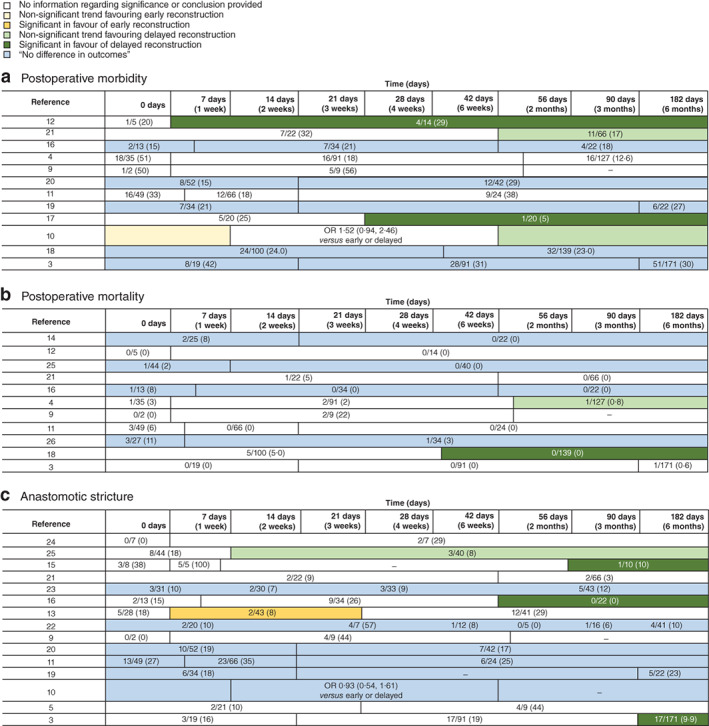
Data for primary outcomes according to time intervals, as provided by the studies a Postoperative morbidity; b postoperative mortality; c anastomotic stricture. Values in parentheses are percentages. OR, odds ratio. The key indicates the conclusion as provided by the studies.
Continue reading

Standardized Algorithms for Management of Anastomotic Leaks and Related Abdominal and Pelvic Abscesses After Colorectal Surgery

“The risk factors and incidence of anastomotic leak following colorectal surgery are well reported in the literature. However, the management of the multiple clinical scenarios that may be encountered has not been standardized.”
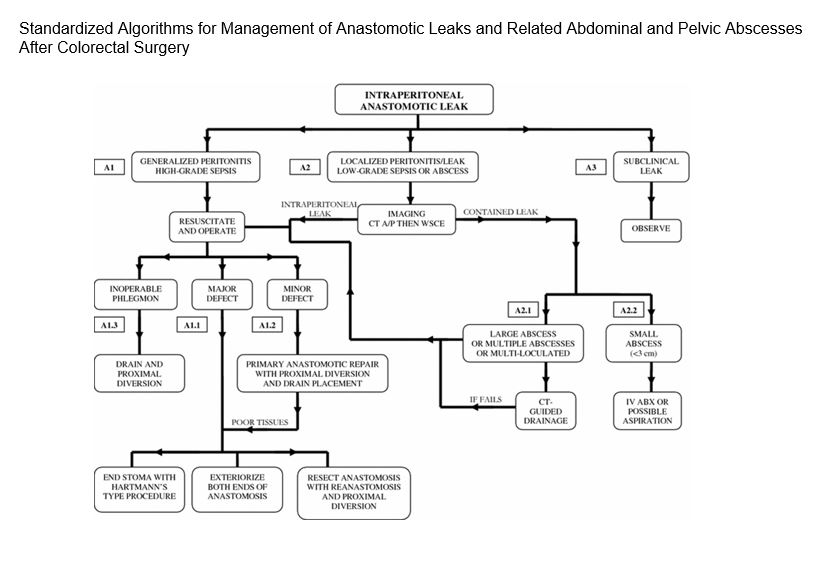
In this study, “management scenarios were divided into those for intraperitoneal anastomoses, extraperitoneal (low pelvic) anastomoses, and anastomoses with proximal diverting stomas. Management options were then based on the clinical presentation and radiographic findings and organized into three interconnected algorithms.”

Recommendations for the management of intraperitoneal anastomotic leak with references to the pertinent sections of this article for more information. KEY: IV ABX=intravenous antibiotics; CT=computed tomographic; WSCE=water soluble contrast enema; CT A/P=computed tomographic scan of the abdomen and pelvis
Continue reading

Management of the difficult duodenal stump

Burch JM, Cox CL, Feliciano DV, Richardson RJ, Martin RR. Management of the difficult duodenal stump. Am J Surg. 1991 Dec;162(6):522-6.

Full-text for Emory users.

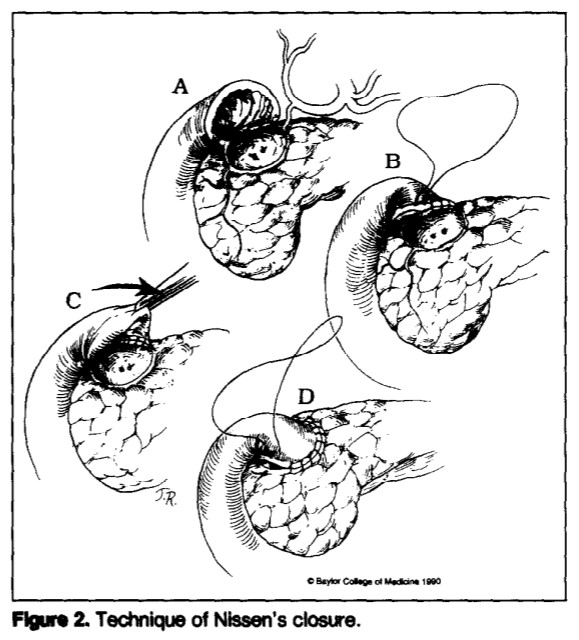
Abstract: Leakage from the duodenal stump has been the most feared complication of the Billroth II reconstruction following gastric resection. The purpose of our study was to evaluate four methods of duodenal stump closure in 200 patients. One hundred and forty-seven (74%) patients had duodenal ulcers; 28 (14%) had gastric ulcers; and 25 (13%) had a variety of other inflammatory conditions. The most common indication for operation was acute hemorrhage (51%), followed by perforation (24%), intractability (15%), and obstruction (10%). Conventional duodenal closures were performed in 160 (80%) patients, Nissen’s closure in 25 (13%), Bancroft’s closure in 6 (3%), and tube duodenostomy in 9 (5%). Duodenal leaks occurred in four (2.5%) patients with conventional closures and in three (33%) patients with tube duodenostomies. No leaks occurred in patients with Nissen’s or Bancroft’s closures. The hospital mortality rate for the series was 9.5%; however, no patient who developed a duodenal leak died. We conclude that Nissen’s and Bancroft’s closures were safe and effective, but that tube duodenostomy did not reliably prevent uncontrolled leakage.

Continue reading

Histological Margin Positivity in the Prediction of Recurrence After Crohn’s Resection

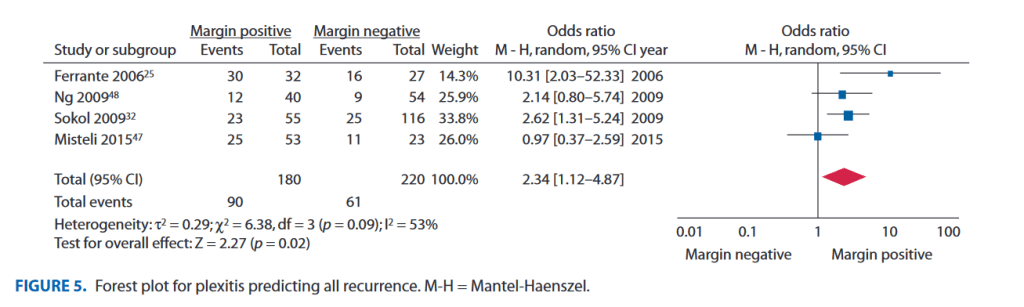
The presence of involved histological margins at the time of index resection in Crohn’s disease is associated with recurrence, and plexitis shows promise as a marker of more aggressive disease. Further studies with homogeneity of histopathological and recurrence reporting are required.“”The presence of involved histological margins at the time of index resection in Crohn’s disease is associated with recurrence, and plexitis shows promise as a marker of more aggressive disease. Further studies with homogeneity of histopathological and recurrence reporting are required.

Continue reading

Stapled versus handsewn intestinal anastomosis in emergency laparotomy

“This study hypothesized that there may be additional differences between trauma surgery (TS) and emergency general surgery (EGS) patients, because the physiologic conditions are typically dominated by hemodynamic instability from hemorrhage in the former, whereas the latter is predominantly complicated by sepsis. The 2 groups may also have different patient demographics, with TS patients being younger and more likely to be male than EGS patients.”

Continue reading

Comparison of stapled versus handsewn loop ileostomy closure

“The purpose of this study was to compare the rates of small bowel obstruction, anastomotic complications, and wound infections between stapled and handsewn closures of loop ileostomies. The diverting loop ileostomy is a commonly used stoma, often employed to diminish the consequences of an anastomotic leak in low colorectal anastomoses, ileal pouch-anal anastomoses, and in situations where reversible patient factors increase the risk of an anastomotic dehiscence. They are also used to divert the fecal stream in the event of an anastomotic leak and, occasionally, in severe fistulizing perianal disease.”

Continue reading

Handsewn vs. stapled anastomoses in colon and rectal surgery

“Trials comparing handsewn with stapled anastomoses in colon and rectal surgery have not found statistical differences. Despite this, authors have differed in their conclusions as to which technique is superior. To help determine whether differences in patient outcomes are present, a meta-analysis of all trials was performed.”

Continue reading