“The purpose of this study was to compare the rates of small bowel obstruction, anastomotic complications, and wound infections between stapled and handsewn closures of loop ileostomies. The diverting loop ileostomy is a commonly used stoma, often employed to diminish the consequences of an anastomotic leak in low colorectal anastomoses, ileal pouch-anal anastomoses, and in situations where reversible patient factors increase the risk of an anastomotic dehiscence. They are also used to divert the fecal stream in the event of an anastomotic leak and, occasionally, in severe fistulizing perianal disease.”
Continue readingTag Archives: Surgical Anastomosis
Handsewn vs. stapled anastomoses in colon and rectal surgery
“Trials comparing handsewn with stapled anastomoses in colon and rectal surgery have not found statistical differences. Despite this, authors have differed in their conclusions as to which technique is superior. To help determine whether differences in patient outcomes are present, a meta-analysis of all trials was performed.”
Continue readingIntraoperative perfusion assessment in mesenteric ischemia
Bryski MG, et al. Techniques for intraoperative evaluation of bowel viability in mesenteric ischemia: A review. Am J Surg. 2020 Aug;220(2):309-315. Full-text for Emory users.
“Comparison studies in animal models and clinical experience featuring fluorescein flowmetry have consistently demonstrated the superiority of dye-based perfusion monitoring for intraoperative bowel assessment as compared to standard clinical criteria, DUS, and pulse oximetry/PPG. (45,46,47,53,54) However, these results are not universal, with some large animal models demonstrating no difference between fluorescein, DUS, and PPG, and an additional study showing that DUS actually outperforms fluorescein for intraoperative bowel assessment. (13,18,43)” (p. 312)
Continue readingArticle of interest: Endoscopy in the early postoperative setting after primary gastrointestinal anastomosis
Amr MA, et al. Endoscopy in the early postoperative setting after primary gastrointestinal anastomosis. J Gastrointest Surg. 2014 Nov;18(11):1911-6. Full-text for Emory users.
Methods: Review of patients from 2002 to 2013 who underwent flexible endoscopy within 6 weeks of creation of gastrointestinal anastomosis. Exclusion criteria included intraoperative endoscopy, anastomotic perforation prior to endoscopy, and endoscopy remote from the anastomotic site. Data are presented as median (interquartile range; IQR) or percentages as appropriate.
Continue readingThe utility of intraoperative perfusion assessment during resection of colorectal cancer
De Nardi P, et al. Intraoperative angiography with indocyanine green to assess anastomosis perfusion in patients undergoing laparoscopic colorectal resection: results of a multicenter randomized controlled trial. Surg Endosc. 2020 Jan;34(1):53-60.
Full-text for Emory users.
Results: After randomization, 12 patients were excluded. Accordingly, 240 patients were included in the analysis; 118 were in the study group, and 122 in the control group. ICG angiography showed insufficient perfusion of the colic stump, which led to extended bowel resection in 13 cases (11%). An anastomotic leak developed in 11 patients (9%) in the control group and in 6 patients (5%) in the study group (p = n.s.).
Conclusions: Intraoperative ICG fluorescent angiography can effectively assess vascularization of the colic stump and anastomosis in patients undergoing colorectal resection. This method led to further proximal bowel resection in 13 cases, however, there was no statistically significant reduction of anastomotic leak rate in the ICG arm.
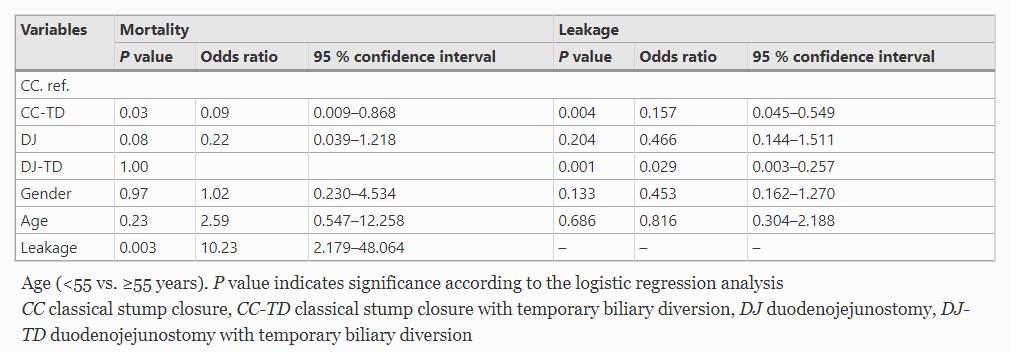
Continue readingArticle of interest: Management of the difficult duodenal stump in penetrating duodenal ulcer disease: a comparative analysis of duodenojejunostomy with “classical” stump closure (Nissen-Bsteh)
Vashist YK, et al. Management of the difficult duodenal stump in penetrating duodenal ulcer disease: a comparative analysis of duodenojejunostomy with “classical” stump closure (Nissen-Bsteh). Langenbecks Arch Surg. 2012 Dec;397(8):1243-9.
Full-text for Emory users.
Background: Duodenal stump insufficiency after surgery for penetrating gastroduodenal ulcer is associated with substantial mortality. “Classical” technique of closing a difficult duodenal stump (Nissen-Bsteh) has, up to now, not been compared with duodenojejunostomy (DJ) in larger patient sets. This also refers to the potential benefit of a gastric and biliary diversion under such conditions. The aim of the present study was to compare classical duodenal closure (CC) with DJ and to evaluate the impact of gastric and biliary diversion on postoperative outcome after surgery for penetrating, high-risk duodenal ulcer in a matched control study.
The surgical management of purulent peritonitis from perforated diverticulitis
Oberkofler CE, et al. A multicenter randomized clinical trial of primary anastomosis or Hartmann’s procedure for perforated left colonic diverticulitis with purulent or fecal peritonitis. Ann Surg. 2012 Nov; 256(5):819-26; discussion 826-7.
Full-text for Emory users.
Results: Patient demographics were equally distributed in both groups (Hinchey III: 76% vs 75% and Hinchey IV: 24% vs 25%, for HP vs PA, respectively). The overall complication rate for both resection and stoma reversal operations was comparable (80% vs 84%, P = 0.813). Although the outcome after the initial colon resection did not show any significant differences (mortality 13% vs 9% and morbidity 67% vs 75% in HP vs PA), the stoma reversal rate after PA with diverting ileostomy was higher (90% vs 57%, P = 0.005) and serious complications (Grades IIIb-IV: 0% vs 20%, P = 0.046), operating time (73 minutes vs 183 minutes, P < 0.001), hospital stay (6 days vs 9 days, P = 0.016), and lower in-hospital costs (US $16,717 vs US $24,014) were significantly reduced in the PA group.
Conclusions: This is the first randomized clinical trial favoring PA with diverting ileostomy over HP in patients with perforated diverticulitis.
Thornell A, et al. Laparoscopic Lavage for Perforated Diverticulitis With Purulent Peritonitis: A Randomized Trial. Ann Intern Med. 2016 Feb 2;164(3):137-45.
Full-text for Emory users.