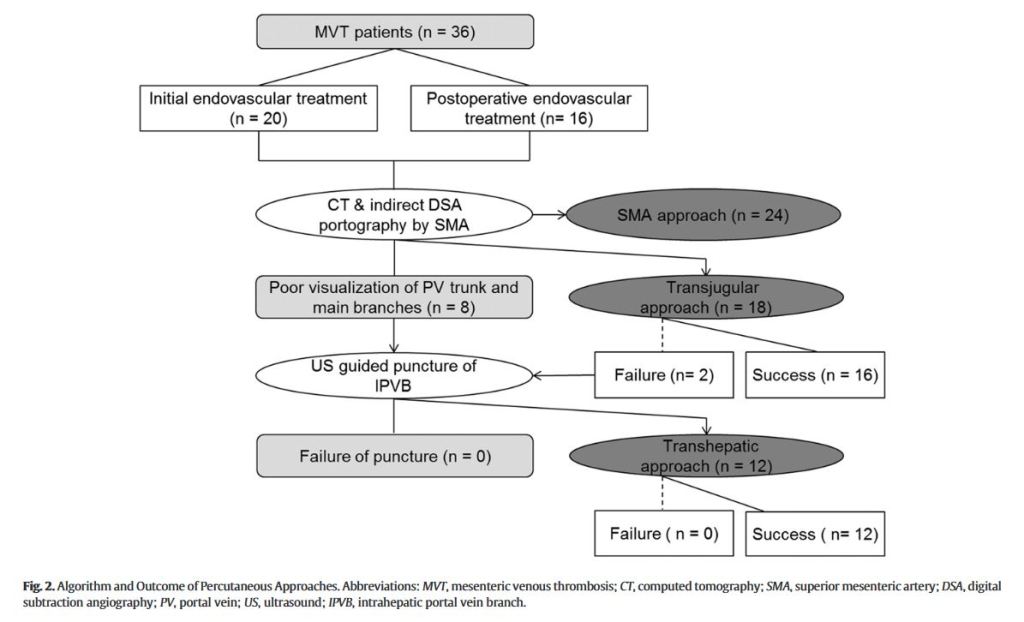
Multidisciplinary Stepwise Management Strategy for Acute Superior Mesenteric Venous Thrombosis

“Acute mesenteric ischemia (AMI) is a rare but catastrophic abdominal vascular emergency associated with a daunting mortality comparable to myocardial infarction or cerebral stroke. Mesenteric vein thrombosis (MVT) is the least common form, accounting for 6% to 9%, of AMI, mainly involving the superior mesenteric vein (SMV). Despite the lack of specific biomarker and insidious symptomatology profile, incidence of acute superior mesenteric venous thrombosis (ASMVT) has been increasing worldwide due to the raised awareness
as well as widespread use of contrast-enhanced computed tomography (CT) portography, which facilitates early diagnosis with sensitivity of over 90%.”

Continue reading

Risk of postoperative deep vein thrombosis and pulmonary embolism in patients with inflammatory bowel disease

“An increased risk of DVT and PE in patients with IBD has been evident for the past 75 years. Most work in this area has not looked specifically at patients undergoing surgery. Patients with IBD frequently require surgical intervention, and an understanding of their risk of venous thromboembolism is therefore an important issue. This study aimed to examine rates of DVT and PE in patients with IBD undergoing surgery using data from the NSQIP.”

Continue reading

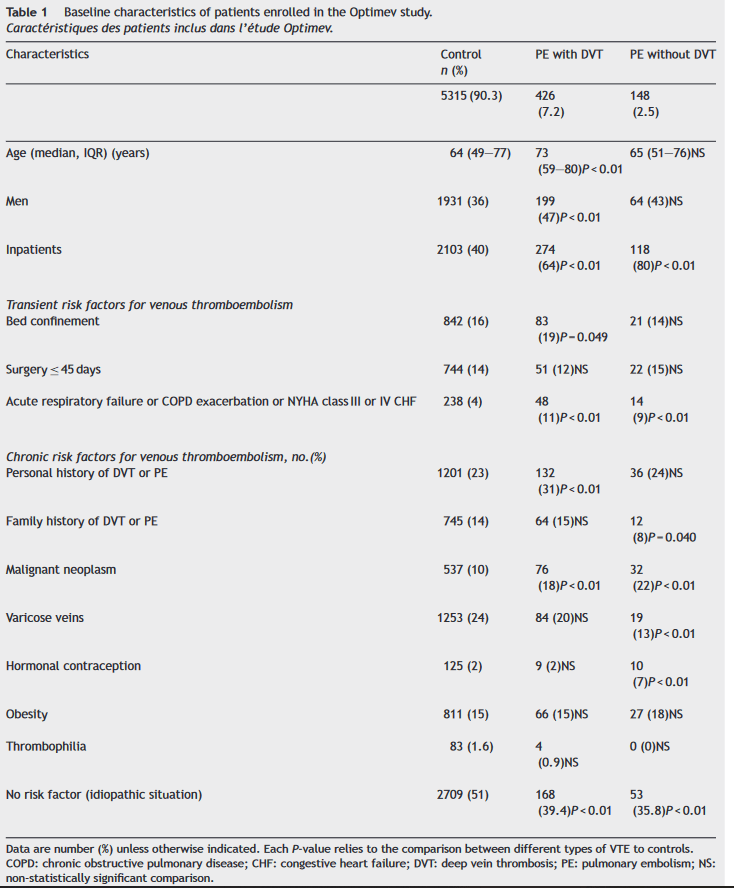
Optimev study. Clinical presentation and mortality in pulmonary embolism

“Venous thromboembolism (VTE), including deep vein thrombosis (DVT) and pulmonary embolism (PE), is a common clinical problem associated with significant mortality and life-long morbidity among hospitalized patients and outpatients. The diagnosis of VTE is challenging because of the non specific signs and symptoms of this disease.”

“The aim of this study was to investigate the clinical presentation and 3-month mortality associated with some forms of VTE: PE with DVT, and PE without DVT.”

Continue reading

Extended-duration thromboprophylaxis after ventral hernia repair

“Forty-eight percent of VTEs after ventral hernia repair occur after discharge, particularly in older, male, obese patients undergoing longer and complex operations that require hospitalization > 1 day. Post-discharge thromboprophylaxis should be considered in these patients, particularly when risk of VTE exceeds 0.3%.”

Continue reading

The Acute Venous Thrombosis: Thrombus Removal with Adjunctive Catheter-Directed Thrombolysis (ATTRACT) trial

Vedantham S, et al.; ATTRACT Trial Investigators. Pharmacomechanical Catheter-Directed Thrombolysis for Deep-Vein Thrombosis. N Engl J Med. 2017 Dec 7;377(23):2240-2252. Free full-text.

Summary: The ATTRACT trial sought to “determine whether pharmacomechanical thrombolysis prevents the post-thrombotic syndrome in patients with proximal deep-vein thrombosis” (p.2241). A total of 692 patients were enrolled at 56 centers in the US from December 2009 through December 2014. They were between the ages of 16 and 75, and had symptomatic proximal deep-vein thrombosis involving the femoral, common femoral, or iliac vein (p. 2241).

Continue reading

Caprini Risk Assessment Model for DVTs

Cronin M, Dengler N, Krauss ES, et al. Completion of the Updated Caprini Risk Assessment Model (2013 Version). Clin Appl Thromb Hemost. 2019 Jan-Dec;25:1076029619838052.

Abstract: The Caprini risk assessment model (RAM) has been validated in over 250,000 patients in more than 100 clinical trials worldwide. Ultimately, appropriate treatment options are dependent on precise completion of the Caprini RAM. As the numerical score increases, the clinical venous thromboembolism rate rises exponentially in every patient group where it has been properly tested. The 2013 Caprini RAM was completed by specially trained medical students via review of the presurgical assessment history, medical clearances, and medical consults. The Caprini RAM was completed for every participant both preoperatively and predischarge to ensure that any changes in the patient’s postoperative course were captured by the tool. This process led to the development of completion guidelines to ensure consistency and accuracy of scoring. The 2013 Caprini scoring system provides a consistent, thorough, and efficacious method for risk stratification and selection of prophylaxis for the prevention of venous thrombosis.

D-dimer testing to determine the duration of anticoagulation therapy

Palareti G, Cosmi B, Legnani C, et al.; DULCIS Investigators. D-dimer to guide the duration of anticoagulation in patients with venous thromboembolism: a management study. Blood. 2014 Jul 10;124(2):196-203.

Full-text for Emory users.

The optimal duration of anticoagulation in patients with venous thromboembolism (VTE) is uncertain. We investigated whether persistently negative D-dimers in patients with vein recanalization or stable thrombotic burden can identify subjects at low recurrence risk. Outpatients with a first VTE (unprovoked or associated with weak risk factors) were eligible after at least 3 months (12 in those with residual thrombosis) of anticoagulation. They received serial D-dimer measurements using commercial assays with predefined age/sex-specific cutoffs and were followed for up to 2 years. Of 1010 patients, anticoagulation was stopped in 528 (52.3%) with persistently negative D-dimer who subsequently experienced 25 recurrences (3.0% pt-y; 95% confidence interval [CI], 2.0-4.4%). Of the remaining 482 patients, 373 resumed anticoagulation and 109 refused it. Recurrent VTE developed in 15 patients (8.8% pt-y; 95% CI, 5.0-14.1) of the latter group and in 4 of the former (0.7% pt-y; 95% CI, 0.2-1.7; hazard ratio = 2.92; 95% CI, 1.87-9.72; P = .0006). Major bleeding occurred in 14 patients (2.3% pt-y; 95% CI, 1.3-3.9) who resumed anticoagulation. Serial D-dimer measurement is suitable in clinical practice for the identification of VTE patients in whom anticoagulation can be safely discontinued. This study was registered at clinicaltrials.gov as #NCT00954395.

Continue reading