Signet-ring cell carcinoma: a look at the rare colorectal cancer

A discussion this week included signet ring cell carcinoma.


Reference: Nitsche U, et al. Mucinous and signet-ring cell colorectal cancers differ from classical adenocarcinomas in tumor biology and prognosis. Annals of Surgery. 2013 Nov;258(5):775-782; discussion 782-783. doi:10.1097/SLA.0b013e3182a69f7e

Additional Reading: Korphaisarn K, et al. Signet ring cell colorectal cancer: genomic insights into a rare subpopulation of colorectal adenocarcinoma. British Journal of Cancer. 2019 Sep;121(6):505-510. doi:10.1038/s41416-019-0548-9

Summary: In a study analyzing clinical, histopathological, and survival data of 3479 patients undergoing surgery for primary colorectal cancer between 1982 and 2012, Nitsche et al (2013) compared the characteristics of classical adenocarcinomas (AC) to the less common mucinous adenocarcinomas (MAC) and to the rare signet-ring cell carcinomas (SC).
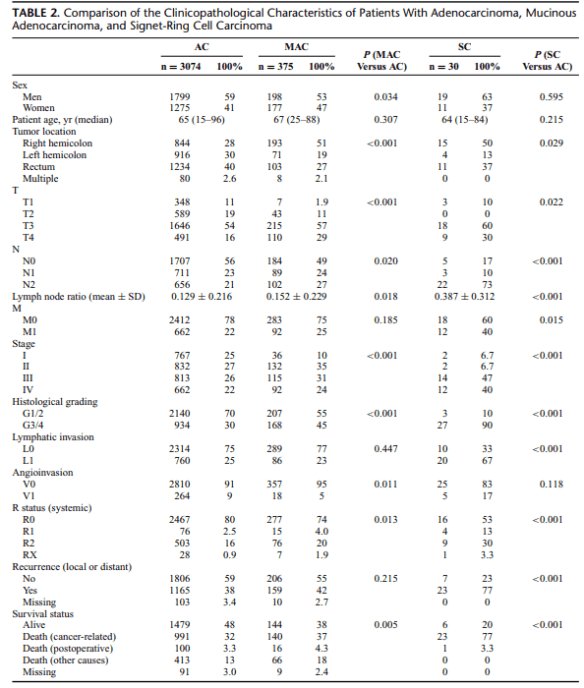
SC

Approximately 10% of all colorectal cancers are MAC, and about 1% are SC. Because of their relatively rare occurrence, in particular, the evaluation of the clinical impact of SC is difficult. However, compared with AC, both MAC and SC have been shown to be associated with young age, advanced tumor stage, accumulation in female patients, and distinct molecular patterns, such as microsatellite instability and activating mutations of the BRAF gene. Although ambiguous, recent data and meta-analyses suggest that the
histological subtype MAC may be associated with worse outcome compared with AC. Poor prognosis of SC is more evident, mainly due to high rates of synchronous and metachronous distant organ metastasis associated with this histological subtype.

In describing SC, the authors state: “SC have been described as being positive for intestinal trefoil factor and MUC2, 2 peptides that are usually produced only by goblet cells. Thus, SC could arise from different cells of origin than AC. Although they can be localized in the colorectum, SC may be genetically more related to signet-ring cell cancers of other organs (eg, gastric cancer) than to AC or MAC of the colorectum. The
absence of E-cadherin/β-catenin and amplification of Bcl-2 are features typically shared with signet-ring cell cancer of the stomach but not with classical colorectal adenocarcinomas” (p.781).

The authors conclude that patients with MAC and SC could profit from closer follow-up or even intensified adjuvant therapy because of their high rates of local and distant recurrence. The biological behavior of SC differs in specific, and these patients require special awareness, despite the relatively rare prevalence.
D1 vs D2 resection for gastric cancer

One discussion this week included a trial out of Denmark comparing D1 and D2 lymph-node dissection for gastric cancer.

Reference: Bonenkamp JJ, et al. Extended lymph-node dissection for gastric cancer. NEJM. 1999 Mar 25;340(12):908-914.

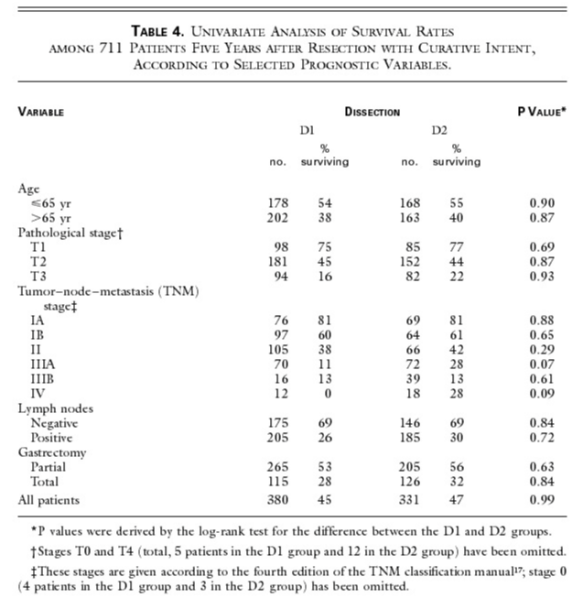
Summary: Curative resection is the treatment of choice for gastric cancer, but it is unclear whether this operation should include an extended (D2) lymph-node dissection or a limited (D1) dissection. The authors conducted a randomized trial in 80 Dutch hospitals in which they compared D1 with D2 lymph-node dissection for gastric cancer in terms of morbidity, postoperative mortality, long-term survival, and cumulative risk of relapse after surgery.

Between August 1989 and July 1993, 996 patients were enrolled. Of these, 711 underwent randomly assigned treatment (D1 = 380, D2 = 331) and 285 received palliative treatment.

General findings:

  • Complications: 43% in D2, 25% in D1
  • Postoperative deaths: 10% in D2, 4% in D1
  • Length of stay: 16 median days in D2, 14 days in D1
  • 5-year survival rates: 47% in D2, 45% in D1


d1 v d2

One of the arguments for D2 dissection is its ability to reduce rates of local recurrence, thereby increasing the quality of life. The distressing finding of local recurrence, usually in a terminal phase of the disease, often leads to second operations to restore gastrointestinal continuity. In this trial, there was a tendency toward a reduced cumulative risk of relapse after D2 dissection, but the rate of relapse remained high and the difference from D1 dissection was not significant. A subgroup analysis indicated a significant or marginally significant difference for patients with disease in UICC stages II and IIIA, but this difference was attributable largely to stage migration.

The MAGIC Trial: Does perioperative ECF improve outcomes for gastric cancer patients?

One discussion this week included the Medical Research Council Adjuvant Gastric Infusional Chemotherapy (MAGIC) Trial. [Current Controlled Trials number: ISRCTN93793971.]

Reference: Cunningham D, et al. Perioperative chemotherapy versus surgery alone for resectable gastroesophageal cancer. NEJM. 2006 Jul 6;355(1):11-20.

Summary: A regimen of epirubicin, cisplatin, and infused fluorouracil (ECF) improves survival among patients with incurable locally advanced or metastatic gastric adenocarcinoma. The MAGIC Trial assessed whether the addition of a perioperative regimen of ECF to surgery improves outcomes among patients with potentially curable gastric cancer.

METHODS: We randomly assigned patients with resectable adenocarcinoma of the stomach, esophagogastric junction, or lower esophagus to either perioperative  chemotherapy and surgery (250 patients) or surgery alone (253 patients). Chemotherapy consisted of three preoperative and three postoperative cycles of intravenous epirubicin (50 mg per square meter of body-surface area) and cisplatin (60 mg per square meter) on day 1, and a continuous intravenous infusion of fluorouracil (200 mg per square meter per day) for 21 days. The primary end point was overall survival.

CONCLUSIONS: In patients with operable gastric or lower esophageal adenocarcinomas, a perioperative regimen of ECF decreased tumor size and stage and significantly improved progression-free and overall survival.

MAGIC

(p.16)

Additional Reading: Cunningham D, et al. Perio-operative chemoterhapy with or without bevacizumab in operable oesophagogastric adenocarcinoma (UK Medical Research Council ST03): primary analysis results of a multicentre, open-label, randomised phase 2-3 trial. Lancet Oncology. 2017 Mar;18(3):357-370.  doi: 10.1016/S1470-2045(17)30043-8.

[ClinicalTrials.gov, number NCT00450203.]

The timing and accuracy of SLNB for nodal management after NAC

One discussion this week included nodal management after neoadjuvant chemotherapy (NAC).


Reference: Pilewskie M and Morrow M. Axillary nodal management following neoadjuvant chemotherapy. JAMA Oncology. 2017 Apr 1;3(4):549-555.

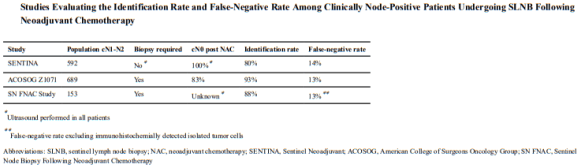
Summary: The increasing use of NAC has raised questions about the optimal approach to the axilla, including accuracy and timing of sentinel lymph node biopsy (SLNB) in patients who are clinically node negative (cN0) at presentation, use of NAC to avoid axillary lymph node dissection (ALND) in patients presenting with node-positive disease, and the relative importance of pre-and post-NAC stage in predicting the risk of locoregional recurrence (LRR).

The decrease in nodal metastases in cN0 patients undergoing post-NAC axillary staging and the increasing rates of pCR in the breast in patients treated with current chemotherapy regimens led to the study of SLNB among patients presenting with cN+ disease. Table 3 (below) summarizes data from three prospective, multi-institutional trials assessing the accuracy of SLNB after NAC among node-positive patients.

SLNB

The authors conclude: NAC reduces the need for ALND, and SLNB is an accurate
method of determining nodal status post NAC. The demonstration that SLNB accurately stages the axilla after NAC regardless of the presenting nodal stage (cN0, cN1) provides an important rationale for the use of NAC for axillary downstaging in patients who are candidates for breast-conserving surgery at presentation or who desire mastectomy. SLN identification rates and FNRs in those who are cN0 are similar to those seen with initial SLN surgery, and nodal recurrence after a negative SLNB is uncommon.


Additional Reading: Boughey JC, et al. Sentinel lymph node surgery after neoadjuvant chemotherapy in patients with node-positive breast cancer: the ACOSOG Z1071 (Alliance) clinical trial. JAMA. 2013 Oct 9;310(14):1455-1461. doi:10.1001/jama.2013.278932.

Graft reconstruction in pancreaticoduodenectomy: outcomes and survival

One discussion this week included use of prosthetic graft reconstruction …


Reference: Chu CK, et al. Prosthetic graft reconstruction after portal vein resection in pancreaticoduodenectomy: a multicenter analysis. Journal of the American College of Surgeons. 2010 Sep;211(3):316-324. doi: 10.1016/j.jamcollsurg.2010.04.005

Summary: Use of prosthetic grafts for reconstruction after portal vein (PV) resection during pancreaticoduodenectomy is controversial. This paper (by Emory authors) review 33 patients who underwent pancreaticoduodenectomy (PD) with vein resection and reconstruction using PTFE grafts between 1994 and 2009. Patient, operative, and outcomes variables were studied. Graft patency and survival were assessed using the Kaplan-Meier technique.

Continue reading

Is TNT a viable treatment strategy for rectal cancer?

One discussion this week included total neoadjuvant therapy (TNT) for rectal cancer.

Reference: Cercek A, et al. Adoption of total neoadjuvant therapy for locally advanced rectal cancer. JAMA Oncology. 2018 Jun 14;4(6):e180071. doi:10.1001/jamaoncol.2018.0071.

Summary: Treatment of locally advanced rectal (LARC) cancer involves chemoradiation, surgery, and chemotherapy. The concept of total neoadjuvant therapy (TNT), in which chemoradiation and chemotherapy are administered prior to surgery, has been developed to optimize delivery of effective systemic therapy aimed at micrometastases.

OBJECTIVE: To compare the traditional approach of preoperative chemoradiation (chemoRT) followed by postoperative adjuvantchemotherapy with the more recent TNT approach for LARC.

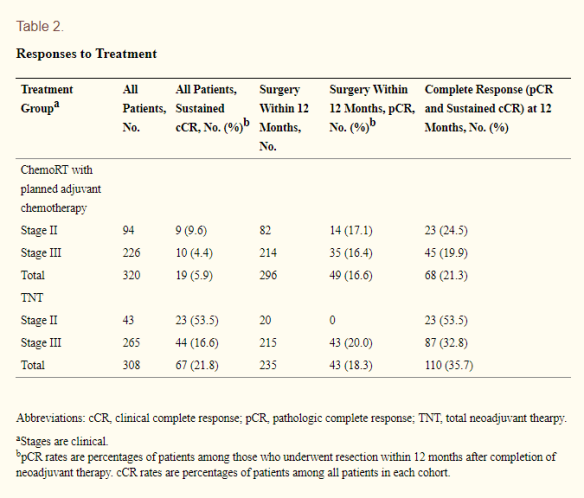
METHODS: A retrospective cohort analysis using Memorial Sloan Kettering Cancer Center (MSK) records from 2009 to 2015 was carried out. A total of 811 patients who presented with LARC (T3/4 or node-positive) were identified; 320 received chemoRT with planned adjuvant chemotherapy and 308 received TNT (induction fluorouracil- and oxaliplatin-based chemotherapy followed by chemoRT). Of the 628 patients, 373 (59%) were men, 255 (41%) were women, and the mean age was 56.7 years.

RESULTS: Patients in the TNT cohort received greater percentages of the planned oxaliplatin and fluorouracil prescribed dose than those in the chemoRT with plannned adjuvant chemotherapy cohort. The complete response (CR) rate, including both pathologic CR (pCR) in those who underwent surgery and sustained clinical CR (cCR) for at least 12 months posttreatment in those who did not undergo surgery, was 36% in the TNT cohort compared with 21% in the chemoRT with planned adjuvant chemotherapy cohort. TNT(Cerek et al, 2018)

CONCLUSIONS: Total neoadjuvant therapy was associated with improved delivery of systemic therapy and increased response to treatment, and it provides a promising platform for nonoperative watch-and-wait protocols. Long-term follow-up is necessary to determine if early systemic chemotherapy improves overall outcome

The authors conclude their findings provide additional support for the National Comprehensive Cancer Network (NCCN) guidelines that categorize TNT as a viable treatment strategy for rectal cancer.

Adjuvant chemotherapy for rectal cancer: The PROCTOR-SCRIPT trial

A discussion this week included adjuvant chemotherapy for rectal cancer after neoadjuvant and surgery.

Reference: Breugom AJ, et al. Adjuvant chemotherapy for rectal cancer patients treated with preoperative (chemo)radiotherapy and total mesorectal excision: a Dutch Colorectal Cancer Group (DCCG) randomized phase III trial. Annals of Oncology. 2015 Apr;26(4):696-701. doi:10.1093/annonc/mdu560.

Summary: Locoregional recurrence rates and survival have significantly
improved with the introduction of total mesorectal excision (TME) for patients with rectal cancer. The addition of preoperative radiotherapy to TME surgery resulted in a more than 50% decrease in locoregional recurrences. However, the combination of preoperative (chemo)radiotherapy and TME surgery did not improve overall or disease-free survival.  Up to 30% of all patients treated with curative intent for localized rectal cancer will develop distant metastases, and distant metastases are still the main cause
of death after rectal cancer.

A multicentre, randomized phase III trial, PROCTOR-SCRIPT, was conducted to investigate the value of adjuvant chemotherapy with fluoropyrimidine monotherapy after preoperative (chemo)radiotherapy and TME surgery. The primary outcome was overall survival. Secondary outcomes were disease-free survival, overall recurrence rate, and locoregional and distant recurrence rate separately.

METHODS: Patients from 52 hospitals were recruited. Those with histologically proven stage II or III rectal adenocarcinoma were randomly assigned to observation (n=221) or adjuvant chemotherapy (n=216) after preoperative (chemo)radiotherapy and TME. Radiotherapy consisted of 5 × 5 Gy. Chemoradiotherapy consisted of 25 × 1.8-2 Gy combined with 5-FU-based chemotherapyAdjuvant chemotherapy consisted of 5-FU/LV (PROCTOR) or eight courses capecitabine (SCRIPT). Randomization was based on permuted blocks of six, stratified according to centre, residual tumour, time between last irradiation and surgery, and preoperative treatment. The primary end point was overall survival.

RESULTS: Between 1 March 2000 and 1 January 2013, 470 patients were included, of whom 33 were incorrectly randomized. Therefore, 437 patients (309 Dutch and 128 Swedish patients) were eligible for analyses. The trial was finally closed due to poor patient accrual without reaching the intended inclusion.

  • Survival: A total of 95 patients died. Five-year overall survival was 79.2% in the observation group and 80.4% in the chemotherapy group.
  • Disease-free survival: No statistically significant difference in disease-free survival was
    observed. Five-year disease-free survival was 55.4% for the observation group and 62.7% for the chemotherapy group.
  • Recurrences: In total, there were 157 recurrences. At 5 years, the cumulative incidence for overall recurrences was 40.3% in the observation group and 36.2% in the chemotherapy group.
  • Locoregional recurrences: The 5-year cumulative incidence for locoregional recurrences was 7.8% in the observation group versus 7.8% in the chemotherapy group. This amounted to 38.5% and 34.7%, respectively, for distant recurrences.

CONCLUSION: The PROCTOR-SCRIPT trial could not demonstrate a significant benefit of adjuvant chemotherapy with fluoropyrimidine monotherapy regarding overall survival, disease-free survival, and recurrence rates after preoperative (chemo)radiotherapy and TME surgery in ypTNM stage II and III rectal cancer patients. However, this trial did not complete planned accrual.