Is TNT a viable treatment strategy for rectal cancer?

One discussion this week included total neoadjuvant therapy (TNT) for rectal cancer.

Reference: Cercek A, et al. Adoption of total neoadjuvant therapy for locally advanced rectal cancer. JAMA Oncology. 2018 Jun 14;4(6):e180071. doi:10.1001/jamaoncol.2018.0071.

Summary: Treatment of locally advanced rectal (LARC) cancer involves chemoradiation, surgery, and chemotherapy. The concept of total neoadjuvant therapy (TNT), in which chemoradiation and chemotherapy are administered prior to surgery, has been developed to optimize delivery of effective systemic therapy aimed at micrometastases.

OBJECTIVE: To compare the traditional approach of preoperative chemoradiation (chemoRT) followed by postoperative adjuvantchemotherapy with the more recent TNT approach for LARC.

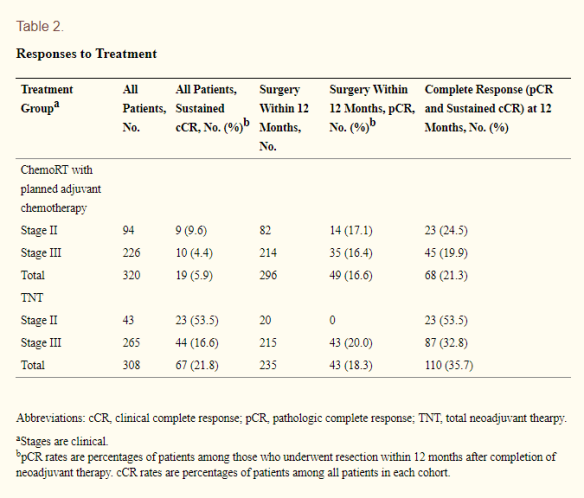
METHODS: A retrospective cohort analysis using Memorial Sloan Kettering Cancer Center (MSK) records from 2009 to 2015 was carried out. A total of 811 patients who presented with LARC (T3/4 or node-positive) were identified; 320 received chemoRT with planned adjuvant chemotherapy and 308 received TNT (induction fluorouracil- and oxaliplatin-based chemotherapy followed by chemoRT). Of the 628 patients, 373 (59%) were men, 255 (41%) were women, and the mean age was 56.7 years.

RESULTS: Patients in the TNT cohort received greater percentages of the planned oxaliplatin and fluorouracil prescribed dose than those in the chemoRT with plannned adjuvant chemotherapy cohort. The complete response (CR) rate, including both pathologic CR (pCR) in those who underwent surgery and sustained clinical CR (cCR) for at least 12 months posttreatment in those who did not undergo surgery, was 36% in the TNT cohort compared with 21% in the chemoRT with planned adjuvant chemotherapy cohort. TNT(Cerek et al, 2018)

CONCLUSIONS: Total neoadjuvant therapy was associated with improved delivery of systemic therapy and increased response to treatment, and it provides a promising platform for nonoperative watch-and-wait protocols. Long-term follow-up is necessary to determine if early systemic chemotherapy improves overall outcome

The authors conclude their findings provide additional support for the National Comprehensive Cancer Network (NCCN) guidelines that categorize TNT as a viable treatment strategy for rectal cancer.

Adjuvant chemotherapy for rectal cancer: The PROCTOR-SCRIPT trial

A discussion this week included adjuvant chemotherapy for rectal cancer after neoadjuvant and surgery.

Reference: Breugom AJ, et al. Adjuvant chemotherapy for rectal cancer patients treated with preoperative (chemo)radiotherapy and total mesorectal excision: a Dutch Colorectal Cancer Group (DCCG) randomized phase III trial. Annals of Oncology. 2015 Apr;26(4):696-701. doi:10.1093/annonc/mdu560.

Summary: Locoregional recurrence rates and survival have significantly
improved with the introduction of total mesorectal excision (TME) for patients with rectal cancer. The addition of preoperative radiotherapy to TME surgery resulted in a more than 50% decrease in locoregional recurrences. However, the combination of preoperative (chemo)radiotherapy and TME surgery did not improve overall or disease-free survival.  Up to 30% of all patients treated with curative intent for localized rectal cancer will develop distant metastases, and distant metastases are still the main cause
of death after rectal cancer.

A multicentre, randomized phase III trial, PROCTOR-SCRIPT, was conducted to investigate the value of adjuvant chemotherapy with fluoropyrimidine monotherapy after preoperative (chemo)radiotherapy and TME surgery. The primary outcome was overall survival. Secondary outcomes were disease-free survival, overall recurrence rate, and locoregional and distant recurrence rate separately.

METHODS: Patients from 52 hospitals were recruited. Those with histologically proven stage II or III rectal adenocarcinoma were randomly assigned to observation (n=221) or adjuvant chemotherapy (n=216) after preoperative (chemo)radiotherapy and TME. Radiotherapy consisted of 5 × 5 Gy. Chemoradiotherapy consisted of 25 × 1.8-2 Gy combined with 5-FU-based chemotherapyAdjuvant chemotherapy consisted of 5-FU/LV (PROCTOR) or eight courses capecitabine (SCRIPT). Randomization was based on permuted blocks of six, stratified according to centre, residual tumour, time between last irradiation and surgery, and preoperative treatment. The primary end point was overall survival.

RESULTS: Between 1 March 2000 and 1 January 2013, 470 patients were included, of whom 33 were incorrectly randomized. Therefore, 437 patients (309 Dutch and 128 Swedish patients) were eligible for analyses. The trial was finally closed due to poor patient accrual without reaching the intended inclusion.

  • Survival: A total of 95 patients died. Five-year overall survival was 79.2% in the observation group and 80.4% in the chemotherapy group.
  • Disease-free survival: No statistically significant difference in disease-free survival was
    observed. Five-year disease-free survival was 55.4% for the observation group and 62.7% for the chemotherapy group.
  • Recurrences: In total, there were 157 recurrences. At 5 years, the cumulative incidence for overall recurrences was 40.3% in the observation group and 36.2% in the chemotherapy group.
  • Locoregional recurrences: The 5-year cumulative incidence for locoregional recurrences was 7.8% in the observation group versus 7.8% in the chemotherapy group. This amounted to 38.5% and 34.7%, respectively, for distant recurrences.

CONCLUSION: The PROCTOR-SCRIPT trial could not demonstrate a significant benefit of adjuvant chemotherapy with fluoropyrimidine monotherapy regarding overall survival, disease-free survival, and recurrence rates after preoperative (chemo)radiotherapy and TME surgery in ypTNM stage II and III rectal cancer patients. However, this trial did not complete planned accrual.

ONCOTYPE IQ for DCIS: A 12-year update on the ECOG-ACRIN E5194 study

One discussion last week included Dr. Wood’s ONCOTYPE IQ for DICS, Trial E5194.

Reference: Solin LJ, et al. Surgical excision without radiation for ductal carcinoma in situ of the breast: 12-year results from the ECOG-ACRIN E5194 study. Journal of Clinical Oncology. 2015 Nov 20;33(33):3938-3944. doi: 10.1200/JCO.2015.60.8588

ClinicalTrials.gov NCT00002934.

Summary: The Eastern Cooperative Oncology Group–American College of Radiology Imaging Network (ECOG-ACRIN; formerly the Eastern Cooperative Oncology Group) Cancer Research Group E5194 study (a nonrandomized clinical trial) prospectively enrolled patients for whom surgical excision alone (without radiation) was thought to be a reasonable treatment option on the basis of low-risk clinical and pathologic characteristics. This report provides updated results from the ECOG-ACRIN E5194 study, including 10- and 12-year outcomes.

Continue reading

The ACOSOG Z0011 Randomized Control Trial

One discussion last week included the ACOSOG Z0011 RCT.

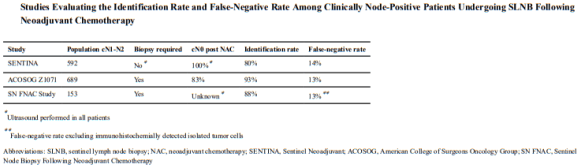
Reference: Giuliano AE, et al. Effect of axillary dissection vs no axillary dissection on 10-year overall survival among women with invasive breast cancer and sentinel node metastasis: the ACOSOG Z0011 (Alliance) randomized control trial. JAMA. 2017 Sep 12;318(10):918-926. doi: 10.1001/jama.2017.11470.

Summary: The results of the American College of Surgeons Oncology Group Z0011 (ACOSOG Z0011) trial were first reported in 2005 with a median follow-up of 6.3 years. Longer follow-up was necessary because the majority of the patients had estrogen receptor-positive tumors that may recur later in the disease course. In this follow-up study, the authors sought to determine whether the 10-year overall survival of patients with 2 or fewer sentinel lymph node metastases treated with breast-conserving therapy and sentinel lymph node dissection (SLND) alone without axillary lymph node dissection (ALND) is noninferior to that of women treated with axillary dissection.

Compared with ALND, SLND alone was found to be noninferior for overall survival. The 10-year overall survival rate was 86.3% in the SLND alone group and 83.6% in the ALND group. The unadjusted HR comparing overall survival between the SLND alone group and the ALND group was 0.85 (1-sided 95% CI, 0–1.16), which did not cross the prespecified noninferiority HR margin of 1.3. The HR for overall survival adjusting for adjuvant therapy (chemotherapy, endocrine therapy, radiation, or a combination of these 3) and age for the SLND alone group compared with the ALND group was 0.93 (1-sided 95% CI, 0–1.28) (Table 2).

10yr survival

CONCLUSION: In this randomized clinical trial including 856 women, after median follow-up of 9.3 years, overall survival for patients treated with sentinel lymph node dissection alone was not inferior to those treated with completion axillary lymph node dissection (86.3% vs 83.6%, respectively; noninferiority hazard ratio margin of 1.3). These findings do not support the use of axillary lymph node dissection when 2 or fewer metastases are found with sentinel lymph node sampling in women with cT1-2M0 breast cancer.

Lobectomy vs total thyroidectomy for intermediate-size papillary thyroid cancer

One discussion last week included the extent of surgery for intermediate-size papillary thyroid cancer: lobectomy vs total thyroidectomy.


Reference: Adam MA, et al. Extent of surgery for papillary thyroid cancer is not associated with survival: an analysis of 61,775 patients. Annals of Surgery. 2014 Oct;260(4):601-605. doi:10.1097/SLA.0000000000000925.

Summary: Guidelines recommend total thyroidectomy for PTC tumors >1 cm, based on older data demonstrating an overall survival advantage for total thyroidectomy over lobectomy.

Adult patients with PTC tumors 1.0-4.0 cm undergoing thyroidectomy in the National Cancer Database between 1998-2006 were included, totaling 61,775 patients. Median follow-up was 82 months (range, 60-179 months).

Lobectomy (n=6849)

Total thyroidectomy (n=54,926)

Nodal disease

7%

27%

Extrathyroidal disease

5%

16%

Multifocual disease

29%

44%

After multivariable adjustment, overall survival was similar in patients undergoing total thyroidectomy versus lobectomy for tumors 1.0-4.0 cm and when stratified by tumor size: 1.0-2.0 cm and 2.1-4.0 cm. Older age, male sex, black race, lower income, tumor size, and presence of nodal or distant metastases were independently associated with compromised survival (P < 0.0001).

Adam et al (2014) conclude that although current guidelines suggest total thyroidectomy for PTC tumors >1 cm, they did not observe a survival advantage associated with total thyroidectomy compared with lobectomy. These findings call into question whether tumor size should be an absolute indication for total thyroidectomy.

Early vs late drain removal after pancreatectomy

One discussion this week included early vs late drain removal in pancreatectomy.


References: Beane JD, et al. Variation of drain management after pancreatoduodenectomy: early versus delayed removal. Annals of Surgery. 2017 Oct. doi: 10.1097/SLA.0000000000002570

Deminski J, et al. Early removal of intraperitoneal drainage after pancreatoduodenectomy in patients without postoperative fistula at POD3: results of a randomized clinical trial. Journal of Visceral Surgery. 2019 Jan 31. pii: S1878-7886(18)30084-5. doi: 10.1016/j.jviscsurg.2018.06.006

Summary:  Early drain removal after pancreatoduodenectomy, when guided by postoperative day (POD) 1 drain fluid amylase (DFA-1), is associated with reduced rates of clinically relevant postoperative pancreatic fistula (CR-POPF).

Continue reading

What is the composition of seroma fluid?

One discussion this week included the composition of post-surgical seroma fluid.


Reference: Valeta-Magara A, et al. Pro-oncogenic cytokines and growth factors are differently expressed in the post-surgical wound fluid from malignant compared to benign breast lesions. SpringerPlus. 2015 Sep 5;4:483. doi:10.1186/s40064-015-1260-8.

Summary: Post-operative accumulation of seroma in the surgical cavity following breast cancer surgery varies in incidence from 2.5 to 51 % of patients. Analysis of seroma has shown that it is an inflammatory exudate, classically seen in the first phase of wound repair. Given that seroma is derived from the wound-healing response of tumor-adjacent stroma, Valeta-Magara et al (2015) explored “whether seroma derived from the excision of benign tumors differs from that of malignant tumors, as malignant and benign tumors may activate or influence the adjacent stroma and infiltrating immune cells differently.”

Post-surgical seroma fluids from 59 patients who had undergone either lumpectomy or mastectomy breast surgery were collected at week 1 or 2 post-surgery by percutaneous aspiration.

It was found that surgical cavity seroma from breast cancer patients has ahigher expression of certain tumorpromoting cytokines, including GRO, ENA-78/CXCL5 and TIMP-2, and lower expression of tumor-inhibiting cytokines IGFBP-1, IL-16, IFN-γ, IL-3 and FGF-9, when compared to seroma from non-cancer patients (p.2). Patients with high body mass index also had higher levels of leptin regardless of malignancy.

In conclusion, breast post-surgical tumor cavity contains factors that are pro-inflammatory regardless of malignant or benign disease, but in malignant disease there is significant enrichment of additional pro-oncogenic chemokines, cytokines and growth factors, and reduction in tumor-inhibiting factors. These results are consistent with tumor conditioning of surrounding normal stromal tissue and creation of a pro-oncogenic environment that persists long after surgical removal of the tumor.

The authors also note that a differential expression of the eight factors between benign and malignant seroma fluid offers research hypotheses to be explored further to determine their role in breast tumor progression, local recurrence and metastasis.