Surgeon’s choice: TEP or TAPP for recurrent inguinal hernia repair?

One discussion involved the comparison of outcomes for TEP and TAPP for hernia repair.


Reference: Kockerling F, et al. TEP or TAPP for recurrent inguinal hernia repair-registered-based comparison of the outcome. Surgical Endoscopy. 2017 Oct;31(10):3872-3882. doi: 10.1007/s00464-017-5416-1

Summary: To date, no randomized trials have been conducted to compare the TEP vs TAPP outcome for recurrent inguinal hernia repair. Between September 1, 2009 and August 31, 2013 data were entered into the Herniamed Registry on a total of 2246 patients with recurrent inguinal hernia repair following previous open primary operation in either TAPP (n = 1,464) or TEP technique (n = 782).

  • TAPP group: recurrent repair was performed for n=974/1,464 (66.5%) patients after suture and n=490/1,464 (33.5%) after mesh repair.
  • TEP group: recurrent repair was performed for n=554/782 (70.8%) patients following previous suture repair and for n=228/782 (29.2%) after mesh repair.

No significant differences were found between the recurrent operations in TEP vs TAPP technique with regard to the intraoperative complications, complication-related reoperations, re-recurrence rates, rates of pain at rest, pain on exertion, or chronic pain requiring treatment. Unfavorable results were identified only with regard to the higher seroma rates associated with TAPP; these responded to conservative treatment.

In summary, both TEP and TAPP can be recommended as effective techniques for treatment of recurrent inguinal hernia following previous open primary operation. The decision to use one or the other technique should be based solely on the surgeon’s expertise. The registry study presented here thus confirms the recommendations in the guidelines on laparo-endoscopic treatment of recurrent inguinal hernia following previous open primary operation.
 

What is the effect of abdominal insufflation on deep vein flow?

One discussion this week involved the effect of abdominal insufflation on deep vein flow.


Reference: Yang C, Zhu L. Coagulation and deep vein flow changes following laparascopic total extraperitoneal inguinal hernia repair: a single-center, prospective cohort study. Surgical Endoscopy. 2019 Feb 11. doi: 10.1007/s00464-019-06700-6.

Summary: The authors observed morphologic change of the iliac vein during TEP procedure. The iliac vein was almost completely collapsed, which not only impaired venous return from the lower extremities but also caused vein distention. The acute distention caused vessel wall damage due to mechanical disruption of the endothelial lining. Vessel wall damage is one of Virchow’s triad in the pathogenesis of thrombosis.

In this study, activated coagulation and impaired deep venous flow implied that the TEP procedure had a certain degree of potential risk for DVT during the early postoperative period.

What is the risk of rupture for type II endoleaks?

One discussion last week included the risk of rupture with type II endoleaks.

Reference: Brown A, et al. Type II endoleaks: challenges and solutions. Vascular Health Risk Management. 2016;12:53-63.

Summary:  Although type II endoleak appears to be associated with sac expansion (volume changes), the significance of this expansion on risk of aneurysm rupture remains unclear.

Wyss et al found a significant association between sac expansion and rupture.Twenty-seven ruptures occurred in an EVAR population of 848 patients, with an average follow-up of 4.8 years. Sixty-three percent of these ruptures occurred more than 30 days post-repair and were associated with prior complications detected on follow-up imaging. Five of these 17 ruptures demonstrated evidence of type II endoleak with associated sac expansion (four were isolated type II endoleaks and one was associated with a concomitant type Ib endoleak).

Conversely, other authors have shown no correlation. Van Marrewijk et al demonstrated that sac expansion was significantly associated with type II endoleaks; however, there was no correlation with rupture or increase in aneurysm-associated mortality. A recent systematic review reported a low incidence of rupture in patients with isolated type II endoleaks (under 1%) of which 57% were associated with sac expansion.

Sac expansion may therefore be a poor marker of risk in this population of patients; however, we do not currently have a more sensitive way of monitoring risk of rupture. As such, some authors suggest that consideration should be given to prevention of/or treatment for type II endoleak.

Pro vs Con: thrombolysis for submassive PE

One discussion this week included thrombolysis for submassive PE.

References: Howard LS. Thrombolytic therapy for submassive pulmonary embolus? PRO viewpoint. Thorax. 2014 Feb;69(2):103-105.

Simpson AJ. Thrombolysis for acute submassive pulmonary embolism: CON viewpoint. Thorax. 2014 Feb;69(2):105-107.

Summary:  The normotensive patient with confirmed pulmonary embolism (PE) and right ventricular (RV) dilatation presents a significant dilemma to clinicians. On one hand, a string of publications have demonstrated that RV dysfunction is associated with adverse outcomes in patients with PE; on the other, thrombolysis carries a significant risk of bleeding. The real problem of course (and part of the reason for having this important debate) is that we have no reliable and accurate tools to pinpoint the important minority of patients with submassive PE who genuinely might benefit from thrombolysis or perhaps from surgical embolectomy

PRO: In proposing the argument that submassive PE should be treated with thrombolysis, we must first accept that direct mortality due to the PE itself, not confounding conditions, remains unacceptably high with anticoagulation alone. A more aggressive strategy is required. As long as the benefits of thrombolysis outweigh the risks, then thrombolysis offers the best currently available approach. When this is coupled with the further benefits of likely reduction in CTEPH, the case becomes even stronger.

Outcomes in patients with true submassive PE remain unacceptably high and thrombolysis has been shown to improve surrogate outcomes for mortality as well as long-term complications. The risks from thrombolysis are low, and when reduced doses are used, evidence so far suggests no decrease in benefit, but a further reduction in bleeding.

CON: The emerging picture is that, at the point of presentation, patients with submassive PE are highly likely to survive if treated with heparin alone and that the associated RV dilatation is likely to resolve spontaneously in the significant majority. The nagging doubt, of course, surrounds the small proportion of patients who will have persistent RV dysfunction, particularly as this group seems vulnerable to recurrent venous thromboembolism (VTE).

However attractive it may be theoretically, we have no strong evidence to inform whether early thrombolysis can reduce VTE recurrence—we know that longer-term anticoagulation does. Similarly, we have no evidence that early thrombolysis reduces the risk of CTEPH, yet modern treatments significantly improve outcomes for this important
complication. So, instead of early thrombolysis, why not repeat echocardiography at 3 months, prolong anticoagulation in those with persistent RV impairment and assess carefully for evidence of CTEPH in the ensuing period?

Please see the full text of these editorials (linked above in references) for the full argument and citations. 

Have you heard of the PESI score?

One discussion this week included the application of the Pulmonary Embolism Severity Index (PESI) score.

Reference: Aujesky D. Pulmonary Embolism Severity Index (PESI) [online calculator]. Retrieved from https://www.mdcalc.com/pulmonary-embolism-severity-index-pesi

Summary: WHEN TO USE: In the setting of a patient diagnosed with PE, the PESI can be utilized to determine mortality and long term morbidity.

PESI2

PEARLS/PITFALLS: PESI is a risk stratification tool that has been externally validated to determine the mortality and outcome of patients with newly diagnosed pulmonary embolism (PE).

In the setting of a patient with renal failure or severe comorbidities, clinical judgement should be used over the PESI, as these patients were excluded in the validation study.

  • The PESI score determines risk of mortality and severity of complications.
  • The score does not require laboratory variables.
  • It is meant to aid in decision making, not replace it. Clinical judgement should always take precedence.
  • The PESI score determines clinical severity and can influence treatment setting for management of PE.
    • Class I and II patients may possibly be safely treated as outpatients in the right clinical setting.

Go to MD Calc for the calculator below:

PESI


Additional Reading: Aujesky D, et al. Derivation and validation of a prognostic model for pulmonary embolism. American Journal of Respiratory and Critical Care Medicine. 2005 Oct 15;172(8):1041-1046.

D1 vs D2 resection for gastric cancer

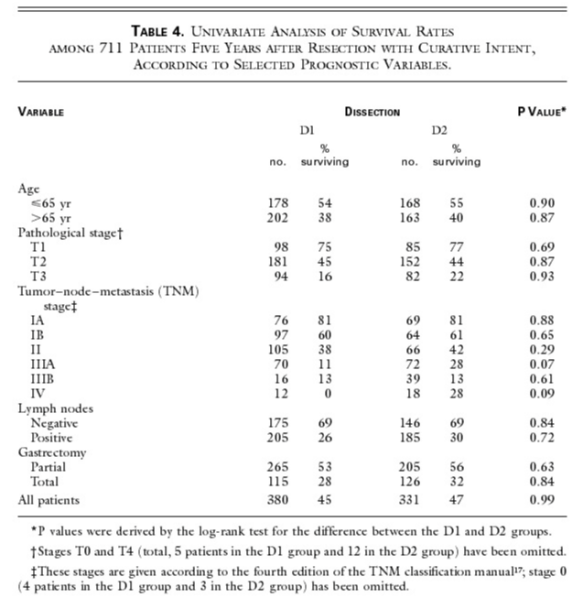
One discussion this week included a trial out of Denmark comparing D1 and D2 lymph-node dissection for gastric cancer.

Reference: Bonenkamp JJ, et al. Extended lymph-node dissection for gastric cancer. NEJM. 1999 Mar 25;340(12):908-914.

Summary: Curative resection is the treatment of choice for gastric cancer, but it is unclear whether this operation should include an extended (D2) lymph-node dissection or a limited (D1) dissection. The authors conducted a randomized trial in 80 Dutch hospitals in which they compared D1 with D2 lymph-node dissection for gastric cancer in terms of morbidity, postoperative mortality, long-term survival, and cumulative risk of relapse after surgery.

Between August 1989 and July 1993, 996 patients were enrolled. Of these, 711 underwent randomly assigned treatment (D1 = 380, D2 = 331) and 285 received palliative treatment.

General findings:

  • Complications: 43% in D2, 25% in D1
  • Postoperative deaths: 10% in D2, 4% in D1
  • Length of stay: 16 median days in D2, 14 days in D1
  • 5-year survival rates: 47% in D2, 45% in D1


d1 v d2

One of the arguments for D2 dissection is its ability to reduce rates of local recurrence, thereby increasing the quality of life. The distressing finding of local recurrence, usually in a terminal phase of the disease, often leads to second operations to restore gastrointestinal continuity. In this trial, there was a tendency toward a reduced cumulative risk of relapse after D2 dissection, but the rate of relapse remained high and the difference from D1 dissection was not significant. A subgroup analysis indicated a significant or marginally significant difference for patients with disease in UICC stages II and IIIA, but this difference was attributable largely to stage migration.