ACR Appropriateness Criteria® Suspected Small-Bowel Obstruction

“Small-bowel obstruction (SBO) is responsible for up to 16% of hospital admissions for abdominal pain with mortality ranging between 2% and 8% overall, and as high as 25%
when associated with bowel ischemia. Radiologic imaging plays the key role in the diagnosis and management of SBO because neither patient presentation, the clinical examination, nor laboratory testing are sufficiently sensitive or specific enough to diagnose or guide management. Imaging not only diagnoses the presence of SBO but also can aid in the differentiation of high-grade from low-grade obstruction. This differentiation helps to guide referring physicians between surgical treatment for high-grade or complicated SBO versus conservative management with enteric tube decompression.”

Continue reading

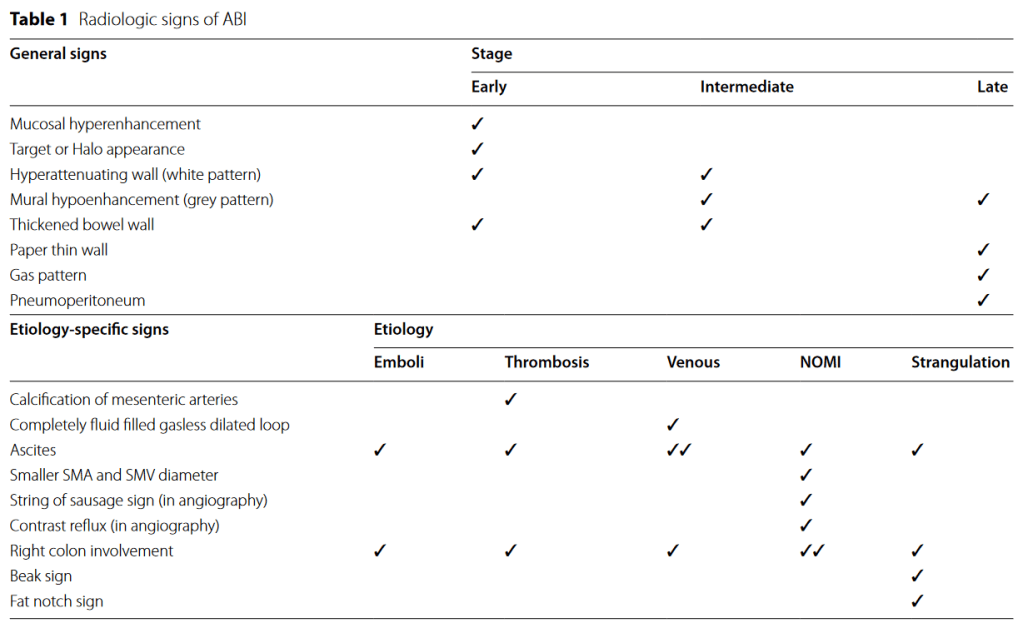
ABI staging for acute bowel ischemia: Imaging findings

“Acute bowel ischemia (ABI) can be life threatening with high mortality rate. The radiologist plays a central role in the initial diagnosis and preventing progression to irreversible intestinal ischemic injury or bowel necrosis. The most single imaging findings described in the literature are either non-specific or only present in the late stages of ABI, urging the use of a constellation of features to reach a more confident diagnosis”

Continue reading

Early diagnosis and risk factors of necrotizing soft tissue infection

Fernando SM, Tran A, Cheng W, et al. Necrotizing Soft Tissue Infection: Diagnostic Accuracy of Physical Examination, Imaging, and LRINEC Score: A Systematic Review and Meta-Analysis. Ann Surg. 2019 Jan;269(1):58-65. doi: 10.1097/SLA.0000000000002774. Full-text for Emory users.

Conclusion: “Our systematic review found that individual physical examination signs (fever, hemorrhagic bullae, and hypotension) were poorly sensitive for diagnosis of NSTI. CT had superior sensitivity and specificity to plain radiography in diagnosing NSTI, but may not be readily available in all centers, and may not be suitable for unstable patients. Finally, the LRINEC score was poorly sensitive for diagnosis of NSTI, suggesting that a low score is not sufficient to rule out the diagnosis.”


See also:

Abu El Hawa AA, Dekker PK, et al. Early Diagnosis and Surgical Management of Necrotizing Fasciitis of the Lower Extremities: Risk Factors for Mortality and Amputation. Adv Wound Care (New Rochelle). 2022 May;11(5):217-225.

Harasawa T, et al. Accurate and quick predictor of necrotizing soft tissue infection: Usefulness of the LRINEC score and NSTI assessment score. J Infect Chemother. 2020 Apr;26(4):331-334.

Continue reading