
The evaluation of risk factors in fascia dehiscence after abdominal surgeries

“Fascial dehiscence (FD), a serious complication of open surgical procedures, is regarded as a significant concern after abdominal surgeries. Its prevalence is reported to be 0.4–1.2% in elective laparotomies and up to 12% in emergency laparotomies. The mortality rate associated with it exceeds 21%. FD leads to an increase in hospitalization costs, prolonged hospital stays, a higher likelihood of re-operation, and an increase in subsequent
medical visits.
FD is described as the separation of sutured edges of the abdominal fascia following surgery. Four main mechanisms lead to FD, suture breakage, knot failure, suture loosening, or fascial disruption due to a hematoma. The latter is considered the most common. FD can be subclinical, and detectable only through radiology.”

able 1.

Frequency of studied variables in patients with and without fascia dehiscence.

The group without fascia dehiscence (control group), n (%)Group with fascia dehiscence (case group), n (%)
Variables(n=40)(n=20)P
Age
 40–6519 (47.5)14 (70)0.09
 65–8021 (52.2)6 (30)
Sex
 Male22 (55)11 (55)1
 Female18 (45)9 (45)
CRP>10 at the beginning of hospitalization8 (20)3 (15)0.6
Hb <10 (anemia)9 (22.5)3 (15)0.4
Pr<61 (2.5)2 (10)0.2
Smoking
 Type of surgery
  Elective22 (55)8 (40)0.2
  Emergency18 (45)12 (60)
History of abdominal surgery8 (20)5 (25)0.6
History of cancer20 (50)8 (40)0.4
Chemotherapy, immunodeficiency and corten use10 (25)8 (40)0.2
Pack cell injection before surgery10 (25)2 (10)0.1
Death6 (15)14 (70)<0.001
Surgery more than 3 h4 (10)4 (20)0.2
Bleeding more than 200 ml1 (2.5)2 (10)0.2
history of diabetes5 (12.5)2 (10)0.7
Chronic lung disease1 (2.5)1 (5)0.6
Stoma10 (25)7 (35)0.4
Drain installation16 (40)14 (70)0.02
Anastomosis30 (75)12 (60)0.2
Using stapler7 (17.5)6 (30)0.2
Preoperative preparation
 Yes22 (55)7 (35)0.14
 No18 (45)13 (65)
Alb
 3>2 (5)13 (65)<0.001
 3<38 (95)7 (35)
Type of surgery
 Small intestine10 (25)5 (25)1
 Colon and rectom30 (75)15 (75)

Alb, albumin; CRP, C-reactive protein; Hb, hemoglobin; Pr, platelet count.

Continue reading
Mesh Suture and Mesh Strips to Prevent Incisional Hernia Following Abdominal Wall Closure or Ventral Hernia Repair

“Incisional hernias are an increasingly common complication encountered by surgeons and their patients, as survival rates from major abdominal surgery continue to improve. The
incidence of incisional hernia after midline laparotomy is estimated to be 9%–20% after 1 year, resulting in approximately 8000 UK repairs annually. While patient factors such as obesity, smoking and diabetes certainly contribute, excessive suture tension during the critical wound healing period causes local ischaemia at the suture-tissue interface and may initiate incisional hernia. Subsequent suture “cheese-wiring” through fascia creates small linear defects that enlarge over time with repeated abdominal wall straining. The clinical
and economic implications of incisional hernia have precipitated preventative research, including Jenkins rule, small-bite closure, and prophylactic mesh implantation which are
discussed in recent high-profile international guidelines. However, many surgeons continue to adopt suture closure over prophylactic planar mesh since this prolongs surgery and risks
infection in a contaminated field.”

Nip, Lawrence et al. “Mesh Suture and Mesh Strips to Prevent Incisional Hernia Following Abdominal Wall Closure or Ventral Hernia Repair: Systematic Review.” Journal of abdominal wall surgery : JAWS vol. 4 14573. 14 May. 2025 Free Full Text

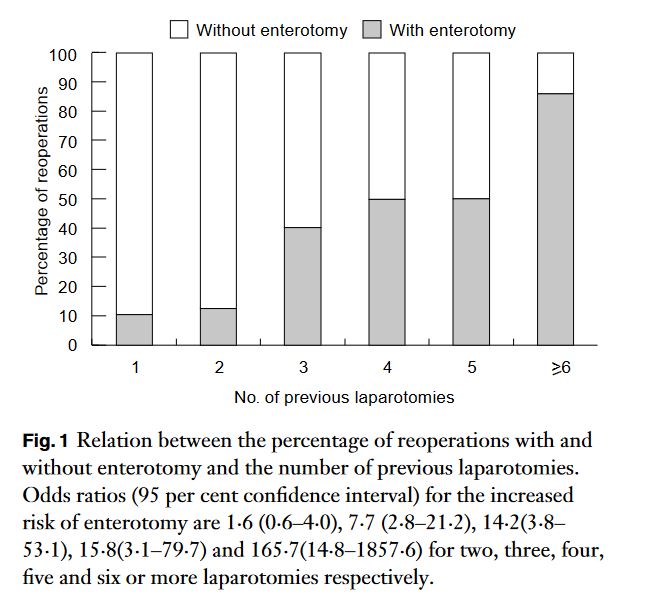
Morbidity and mortality of inadvertent enterotomy during adhesiotomy

“Postoperative intra-abdominal adhesions are a major concern in modern surgery. Intestinal obstruction is an important and well known clinical consequence of adhesions, resulting in significant morbidity and mortality rates, and high financial costs. Secondary infertility in women and chronic abdominal and pelvic pain are other, frequently cited, adhesion-related problems. Furthermore, intraabdominal adhesions render reoperation dif®cult and may
increase the complication rate of the intended surgical procedure. Prolonged operating time, unfeasibility of the laparoscopic approach and inadvertent enterotomy are known drawbacks of reoperative abdominal surgery, directly related to adhesions.”

Continue reading

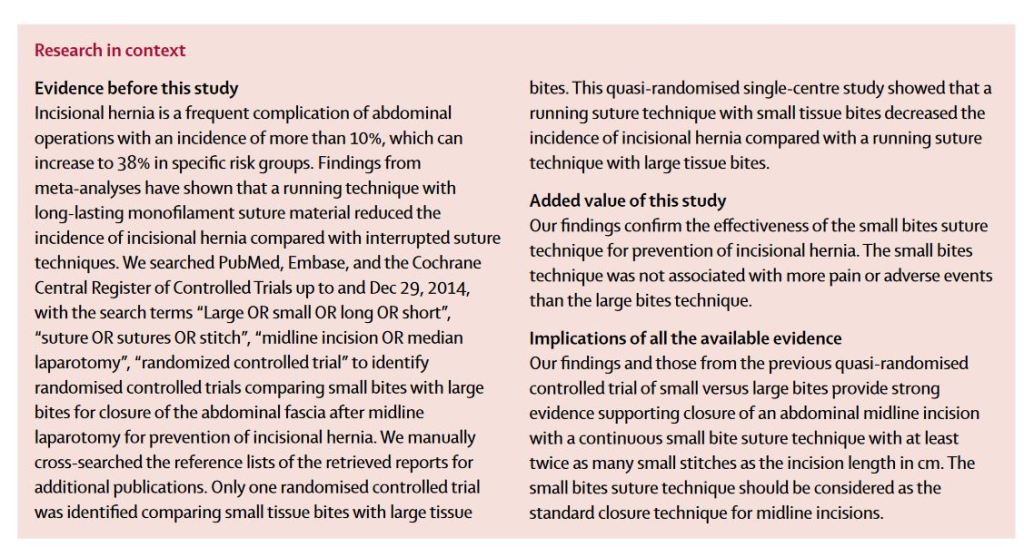
The STITCH Trial. Small bites versus large bites for closure of abdominal midline incisions.

“Incisional hernia is a frequent complication of abdominal operations with an incidence of 10–23%, which can increase to 38% in specific risk groups. In the USA 4 million to 5 million laparotomies are done annually, suggesting that at least 400 000–500 000 incisional hernias can be expected to occur every year. Incisional hernia is associated with pain and discomfort, resulting in a decreased quality of life. Moreover, incarceration and strangulation of abdominal contents can take place, for which emergency surgery is indicated, with associated morbidity and mortality. About 348 000 operations for incisional hernia are done every year in the USA with US$3·2 billion in annual associated costs. Prevention of
incisional hernia is therefore of paramount importance.”

Continue reading

Postpancreatectomy hemorrhages: risk factors and outcomes

One discussion this week involved etiologies of postpancreatectomy hemorrhage.


Reference: Yekebas EF, et al. Postpancreatectomy hemorrhage: diagnosis and treatment: an analysis in 1669 consecutive pancreatic resections. Annals of Surgery. 2007 Aug;246(2):269-280. doi:10.1097/01.sla.0000262953.77735.db

Summary: With the purpose of creating algorithms for managing postpancreatectomy hemorrhage (PPH), Yekebas et al (2007) restrospectively analyzed more than 1669 pancreatic resections conducted between 1992 and 2006.  They concluded that the prognosis of postpancreatectomy hemorrhage (PPH) is primarily dependent on the presence of “preceding pancreatic fistula” (p.269).

Continue reading

Mesenteric Venous Thrombosis

“Mesenteric venous thrombosis is caused by impairment of venous return of the bowel due to local blood coagulation. Primary mesenteric venous thrombosis is considered spontaneous and idiopathic, whereas secondary mesenteric venous thrombosis is due to an underlying condition. Mesenteric venous thrombosis can lead to venous engorgement and mesenteric ischemia and accounts for 5 to 15 percent of mesenteric ischemic events.”

Continue reading

The impact of abdominal incisional closure techniques on rates of fascial dehiscence

Tolstrup MB, Watt SK, Gögenur I. Reduced Rate of Dehiscence After Implementation of a Standardized Fascial Closure Technique in Patients Undergoing Emergency Laparotomy. Ann Surg. 2017 Apr;265(4):821-826.

Full-text for Emory users.

RESULTS: We included 494 patients from 2014 to 2015 and 1079 patients from our historical cohort for comparison. All patients had a midline laparotomy in an emergency setting. The rate of dehiscence was reduced from 6.6% to 3.8%, P = 0.03 comparing year 2009 to 2013 with 2014 to 2015. Factors associated with dehiscence were male gender [hazard ratio (HR) 2.8, 95% confidence interval (95% CI) (1.8-4.4), P < 0.001], performance status ≥3 [HR 2.1, 95% CI (1.2-3.7), P = 0.006], cirrhosis [HR 3.8, 95% CI (1.5-9.5), P = 0.004], and retention sutures [HR 2.8, 95% CI (1.6-4.9), P < 0.000]. The 30-day mortality rate was 18.4% in the standardized group vs 22.4% in 2009 to 2013, P = 0.057 and 90-day mortality 24.2% vs 30.4%, P = 0.008.

CONCLUSION: The standardized procedure of closing the midline laparotomy by using a “small steps” technique of continuous suturing with a slowly absorbable (polydioxanone) suture material reduces the rate of fascial dehiscence.

Continue reading