Management of the difficult duodenal stump

Burch JM, Cox CL, Feliciano DV, Richardson RJ, Martin RR. Management of the difficult duodenal stump. Am J Surg. 1991 Dec;162(6):522-6.

Full-text for Emory users.

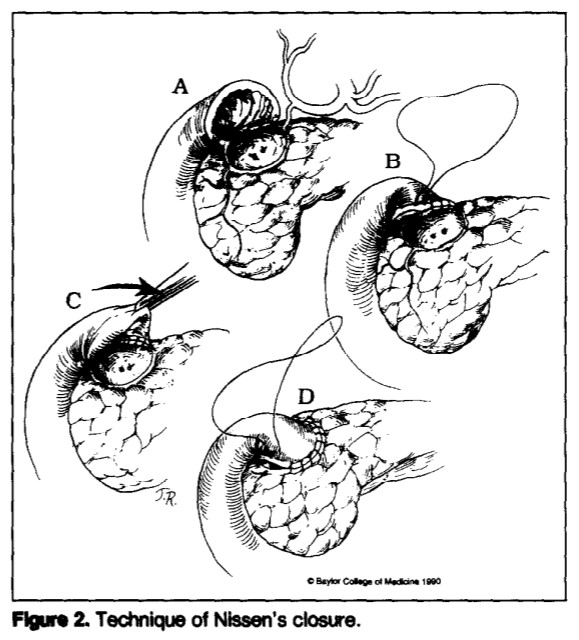
Abstract: Leakage from the duodenal stump has been the most feared complication of the Billroth II reconstruction following gastric resection. The purpose of our study was to evaluate four methods of duodenal stump closure in 200 patients. One hundred and forty-seven (74%) patients had duodenal ulcers; 28 (14%) had gastric ulcers; and 25 (13%) had a variety of other inflammatory conditions. The most common indication for operation was acute hemorrhage (51%), followed by perforation (24%), intractability (15%), and obstruction (10%). Conventional duodenal closures were performed in 160 (80%) patients, Nissen’s closure in 25 (13%), Bancroft’s closure in 6 (3%), and tube duodenostomy in 9 (5%). Duodenal leaks occurred in four (2.5%) patients with conventional closures and in three (33%) patients with tube duodenostomies. No leaks occurred in patients with Nissen’s or Bancroft’s closures. The hospital mortality rate for the series was 9.5%; however, no patient who developed a duodenal leak died. We conclude that Nissen’s and Bancroft’s closures were safe and effective, but that tube duodenostomy did not reliably prevent uncontrolled leakage.
Continue reading

Article of interest: A randomized trial comparing antibiotics with appendectomy for appendicitis

CODA Collaborative, Flum DR, Davidson GH, et al. A Randomized Trial Comparing Antibiotics with Appendectomy for Appendicitis. N Engl J Med. 2020 Nov 12;383(20): 1907-1919.

Full-text for Emory users.

Figure 2. Cumulative Incidence of Appendectomy in the Antibiotics Group. Plus signs indicate censoring because the participant withdrew or was lost to follow-up.

Background: Antibiotic therapy has been proposed as an alternative to surgery for the treatment of appendicitis.

Methods: We conducted a pragmatic, nonblinded, noninferiority, randomized trial comparing antibiotic therapy (10-day course) with appendectomy in patients with appendicitis at 25 U.S. centers. The primary outcome was 30-day health status, as assessed with the European Quality of Life-5 Dimensions (EQ-5D) questionnaire (scores range from 0 to 1, with higher scores indicating better health status; noninferiority margin, 0.05 points). Secondary outcomes included appendectomy in the antibiotics group and complications through 90 days; analyses were prespecified in subgroups defined according to the presence or absence of an appendicolith.

Continue reading

Article of interest: A randomized trial comparing antibiotics with appendectomy for appendicitis.

CODA Collaborative, Flum DR, et al. A randomized trial comparing antibiotics with appendectomy for appendicitis. N Engl J Med. 2020 Oct 5. [Epub ahead of print.]

Full-text for Emory users.

Results: In total, 1552 adults (414 with an appendicolith) underwent randomization; 776 were assigned to receive antibiotics (47% of whom were not hospitalized for the index treatment) and 776 to undergo appendectomy (96% of whom underwent a laparoscopic procedure). Antibiotics were noninferior to appendectomy on the basis of 30-day EQ-5D scores (mean difference, 0.01 points; 95% confidence interval [CI], -0.001 to 0.03). In the antibiotics group, 29% had undergone appendectomy by 90 days, including 41% of those with an appendicolith and 25% of those without an appendicolith. Complications were more common in the antibiotics group than in the appendectomy group (8.1 vs. 3.5 per 100 participants; rate ratio, 2.28; 95% CI, 1.30 to 3.98); the higher rate in the antibiotics group could be attributed to those with an appendicolith (20.2 vs. 3.6 per 100 participants; rate ratio, 5.69; 95% CI, 2.11 to 15.38) and not to those without an appendicolith (3.7 vs. 3.5 per 100 participants; rate ratio, 1.05; 95% CI, 0.45 to 2.43). The rate of serious adverse events was 4.0 per 100 participants in the antibiotics group and 3.0 per 100 participants in the appendectomy group (rate ratio, 1.29; 95% CI, 0.67 to 2.50).

Continue reading

Management of enterocutaneous fistulas

Owen RM, Love TP, Perez SD, Srinivasan JK, Sharma J, Pollock JD, Haack CI, Sweeney JF, Galloway JR. Definitive surgical treatment of enterocutaneous fistula: outcomes of a 23-year experience. JAMA Surg. 2013 Feb;148(2):118-26.

Full-text for Emory users.

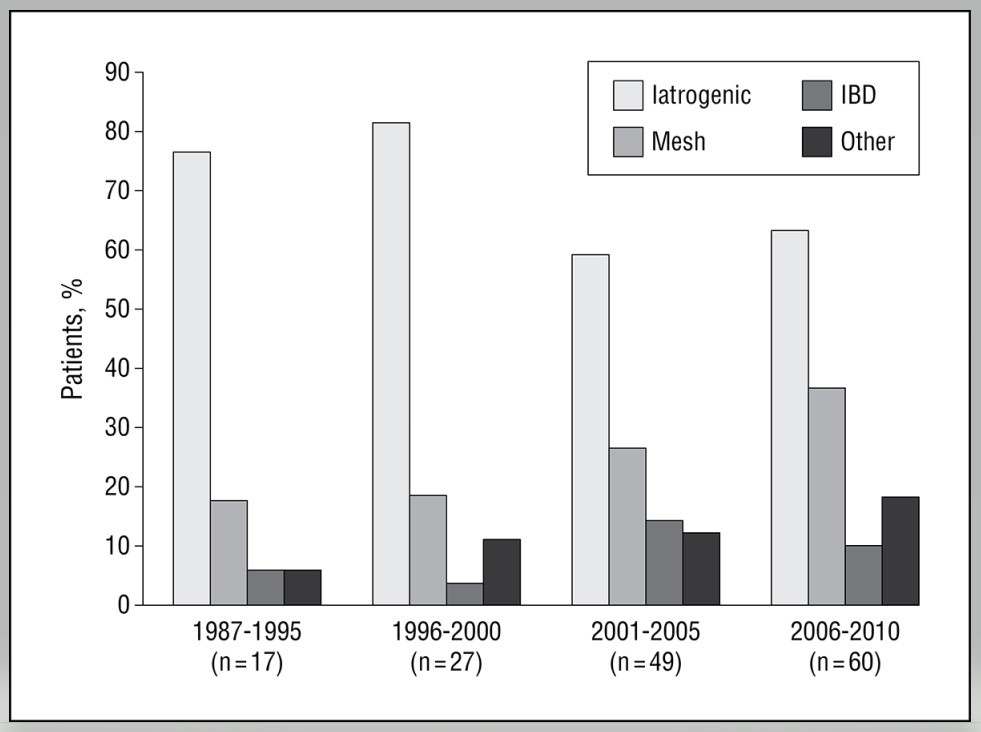
Figure 1. Causes of enterocutaneous fistula between 1987 and 2010. IBD indicates inflammatory bowel disease; other includes radiation, neoplasm, and trauma. Percentages may total more than 100% owing to the fact that some patients’ ECFs were secondary to multiple causes.

Continue reading

Simultaneous resection of primary colorectal cancer and synchronous liver metastases

Kleive D, et al. Simultaneous Resection of Primary Colorectal Cancer and Synchronous Liver Metastases: Contemporary Practice, Evidence and Knowledge Gaps. Oncol Ther. 2021 Jun;9(1):111-120. Free full-text.

Key Summary Points

  • High-level evidence in simultaneous resection of colorectal cancer and colorectal liver metastasis remains scarce.
  • Simultaneous resections may be considered in patients with good performance status and limited liver tumour burden.
  • Simultaneous resections should be avoided when requiring major liver resection and major colorectal resection.
  • Treatment strategies should be made by a multidisciplinary team.
  • Simultaneous resections should be performed as part of a clinical trial.
Continue reading

Postoperative pancreatic fistula

This week’s discussion included risk scoring and management of postoperative pancreatic fistula.


Nahm CB, Connor SJ, Samra JS, Mittal A. Postoperative pancreatic fistula: a
review of traditional and emerging concepts. Clin Exp Gastroenterol. 2018 Mar
15;11:105-118.

Prediction: “Biochemical markers of POP after pancreatic resection are evident from the first postoperative day. These include serum amylase and lipase, and urinary trypsinogen-2. In an observational study of 61 patients undergoing pancreatic resection, the presence of POP on the first postoperative day as determined by these markers was found to be a strong predictor of the development of POPF (OR 17.81, 95% CI 2.17–145.9) [128]

Continue reading

2020 WSES updated guidelines for the diagnosis and treatment of acute calculus cholecystitis

Pisano M, Allievi N, Gurusamy K, et al. 2020 World Society of Emergency Surgery updated guidelines for the diagnosis and treatment of acute calculus cholecystitis. World J Emerg Surg. 2020 Nov 5;15(1):61. Free full-text.

Conclusions, knowledge gaps and research recommendations: “ELC has a central role in the management of patients with ACC. The value of surgical treatment for high-risk patients should lead to a distinction between high-risk patients and patients who are not suitable for surgery. Further evidence on the role of clinical judgement and the use of clinical scores as adjunctive tools to guide treatment of high-risk patients and patients who are not suitable for surgery is required. The development of local policies for safe laparoscopic cholecystectomy is recommended.”

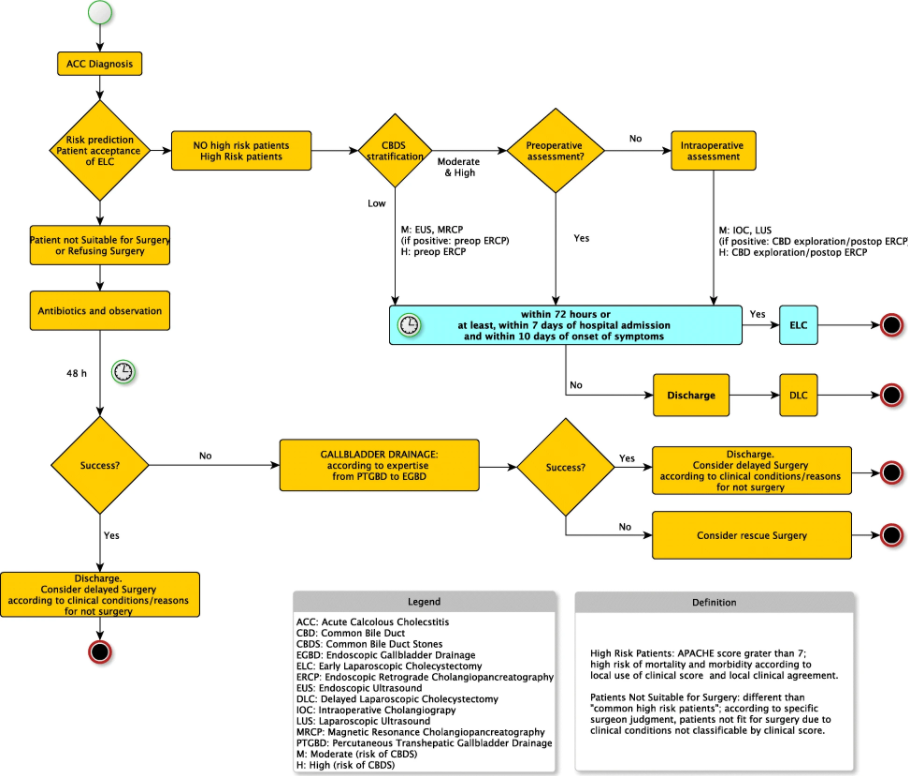
2020 WSES Flowchart for the management of patients with acute calcolus cholecystitis.
Continue reading