Aspiration versus peritoneal lavage in appendicitis

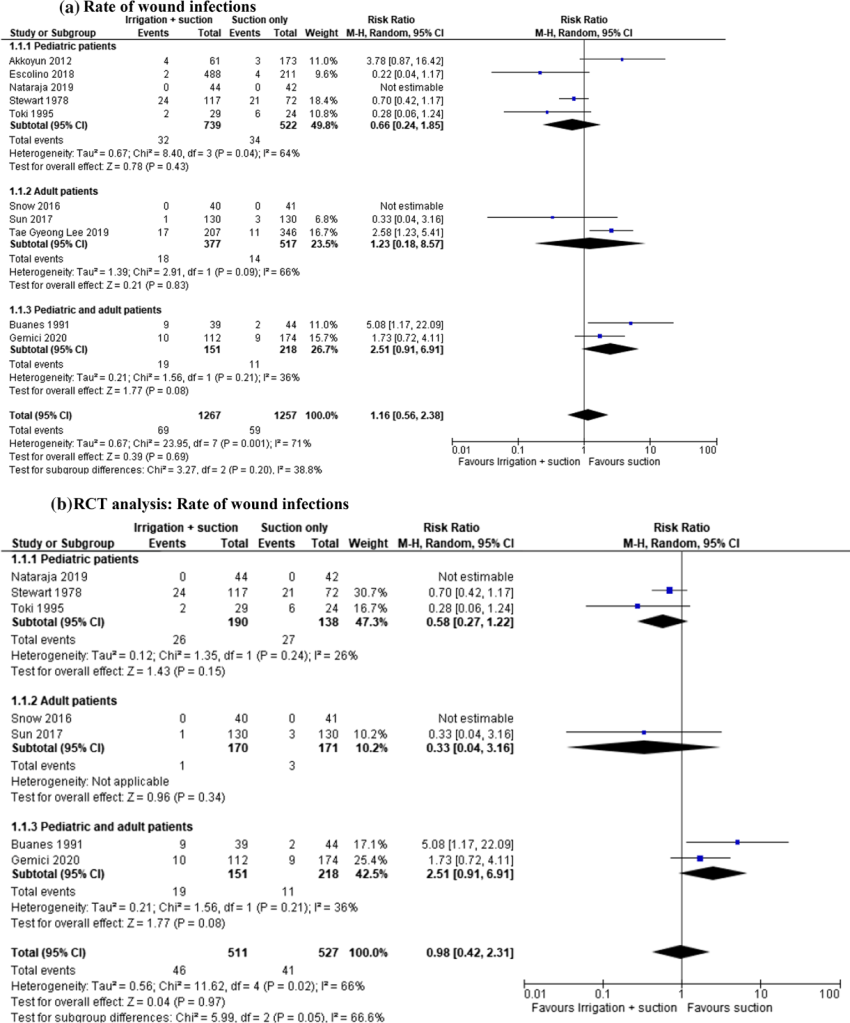
“The management of IAA remains controversial with different strategies suggested to decrease its incidence: antibiotic prophylaxis, post-operative antibiotic therapy, peritoneal irrigation with saline solution or suction only of the abscess/purulent liquid without irrigation of the cavity during appendectomy. In the literature, many studies address this topic; however, currently there is no evidence to clearly demonstrate the effectiveness of peritoneal irrigation over suction only. Italian guidelines recommend thorough peritoneal lavage (6–8 L of warm saline) and aspiration to minimize the IAA rate in complicated appendicitis. The recent WSES (World Society of Emergency Surgery) guidelines report that “Peritoneal irrigation does not have any advantage over suction alone in complicated appendicitis in both adults and children. The performance of irrigation during laparoscopic appendectomy does not seem to prevent the development of IAA and wound infections
in neither adults nor paediatric patients”. WSES recommendation is “to perform suction only in complicated appendicitis patients with intra-abdominal collections undergoing laparoscopic appendectomy” [QoE: Moderate; Strength of recommendation: Strong; 1B]). The concern regarding irrigation and lavage is that these procedures might help spread the infectious material.”

Continue reading

Article of interest: A randomized trial comparing antibiotics with appendectomy for appendicitis.

CODA Collaborative, Flum DR, et al. A randomized trial comparing antibiotics with appendectomy for appendicitis. N Engl J Med. 2020 Oct 5. [Epub ahead of print.]

Full-text for Emory users.

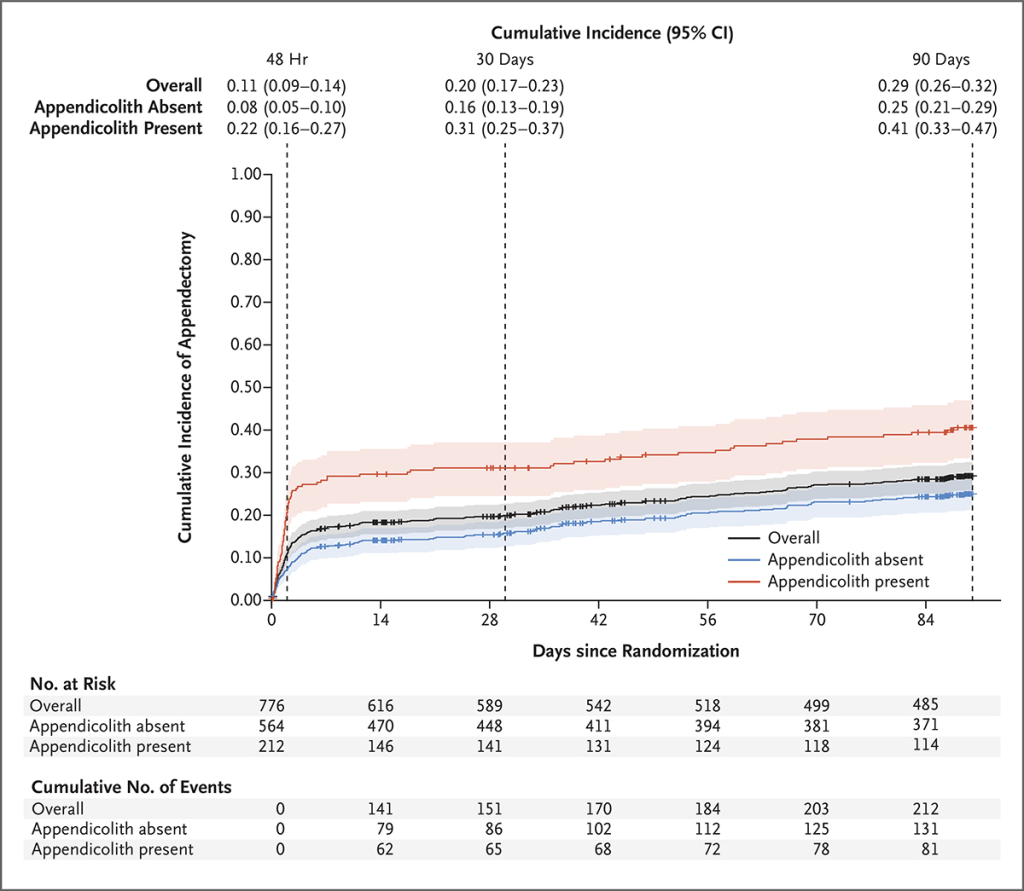
Results: In total, 1552 adults (414 with an appendicolith) underwent randomization; 776 were assigned to receive antibiotics (47% of whom were not hospitalized for the index treatment) and 776 to undergo appendectomy (96% of whom underwent a laparoscopic procedure). Antibiotics were noninferior to appendectomy on the basis of 30-day EQ-5D scores (mean difference, 0.01 points; 95% confidence interval [CI], -0.001 to 0.03). In the antibiotics group, 29% had undergone appendectomy by 90 days, including 41% of those with an appendicolith and 25% of those without an appendicolith. Complications were more common in the antibiotics group than in the appendectomy group (8.1 vs. 3.5 per 100 participants; rate ratio, 2.28; 95% CI, 1.30 to 3.98); the higher rate in the antibiotics group could be attributed to those with an appendicolith (20.2 vs. 3.6 per 100 participants; rate ratio, 5.69; 95% CI, 2.11 to 15.38) and not to those without an appendicolith (3.7 vs. 3.5 per 100 participants; rate ratio, 1.05; 95% CI, 0.45 to 2.43). The rate of serious adverse events was 4.0 per 100 participants in the antibiotics group and 3.0 per 100 participants in the appendectomy group (rate ratio, 1.29; 95% CI, 0.67 to 2.50).

Continue reading

Article of interest: A randomized trial comparing antibiotics with appendectomy for appendicitis

CODA Collaborative, Flum DR, Davidson GH, et al. A Randomized Trial Comparing Antibiotics with Appendectomy for Appendicitis. N Engl J Med. 2020 Nov 12;383(20): 1907-1919.

Full-text for Emory users.

Figure 2. Cumulative Incidence of Appendectomy in the Antibiotics Group. Plus signs indicate censoring because the participant withdrew or was lost to follow-up.

Background: Antibiotic therapy has been proposed as an alternative to surgery for the treatment of appendicitis.

Methods: We conducted a pragmatic, nonblinded, noninferiority, randomized trial comparing antibiotic therapy (10-day course) with appendectomy in patients with appendicitis at 25 U.S. centers. The primary outcome was 30-day health status, as assessed with the European Quality of Life-5 Dimensions (EQ-5D) questionnaire (scores range from 0 to 1, with higher scores indicating better health status; noninferiority margin, 0.05 points). Secondary outcomes included appendectomy in the antibiotics group and complications through 90 days; analyses were prespecified in subgroups defined according to the presence or absence of an appendicolith.

Continue reading

The negative appendectomy rate: who benefits from preoperative CT?

“Preoperative CT quite consistently has been shown to lower the negative appendectomy rate among women. Relatively few studies, however, have shown a lower negative appendectomy rate with preoperative CT for both sexes. Furthermore, any suggested utility of preoperative CT in men is contradicted by a number of studies that have shown that men derive no benefit from preoperative CT when there is clinical suspicion of acute appendicitis. Nevertheless, CT is used routinely among men with suspected appendicitis at our institution and has been assumed by both surgeons and radiologists to be a useful practice. Therefore, we performed this study to determine the negative appendectomy rates of patients who did and did not undergo preoperative CT and to determine, more specifically, whether men benefit from preoperative CT.”

Negative Appendectomy Rates for Patients Who Did and Did Not Undergo Preoperative Imaging
Continue reading