Kao LS, Flowers C, Flum DR. Prophylactic cholecystectomy in transplant patients: a decision analysis. J Gastrointest Surg. 2005 Sep-Oct;9(7):965-72.
Full-text for Emory users.
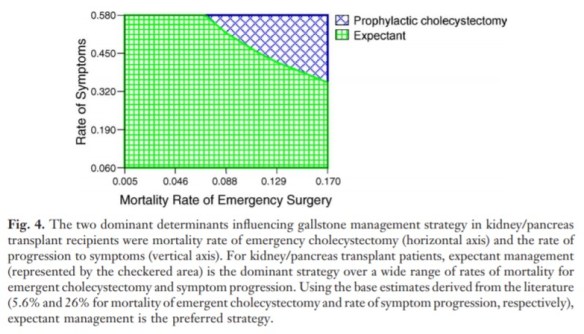

Kao LS, Flowers C, Flum DR. Prophylactic cholecystectomy in transplant patients: a decision analysis. J Gastrointest Surg. 2005 Sep-Oct;9(7):965-72.
Full-text for Emory users.
Master VA, Ethun CG, Kooby DA, Staley CA 3rd, Maithel SK. The value of a cross-discipline team-based approach for resection of renal cell carcinoma with IVC tumor thrombus: A report of a large, contemporary, single-institution experience. J Surg Oncol. 2018 Dec; 118(8):1219-1226.
Full-text for Emory users.
Introduction: We report the evolution of the largest, contemporary, single-institution experience with this complex procedure to highlight the value of a cross-discipline, team-based approach.
Methods: Patients from a prospectively maintained database who underwent resection of renal cell carcinoma (RCC) with inferior vena cava (IVC) tumor thrombus from 2005 to 2016 at a single-institution were included for analysis.
Maier CL, Truong AD, Auld SC, Polly DM, Tanksley CL, Duncan A. COVID-19 associated hyperviscosity: a link between inflammation and thrombophilia? Lancet. 2020 May 25:S0140-6736(20)31209-5. Epub ahead of print.
“The 15 patients had plasma viscosity exceeding 95% of normal, as determined by traditional capillary viscometry, ranging from 1·9–4·2 centipoise (cP; normal range 1·4–1·8). Notably, the four patients with plasma viscosity above 3·5 cP had a documented thrombotic complication: one patient had pulmonary embolism, one patient had limb ischaemia and suspected pulmonary embolism, and two patients had CRRT-related clotting. Plasma viscosity and Sequential Organ Failure Assessment scores, a measure of illness severity, were strongly correlated (Pearson’s r=0·841, R2=0·7072, p<0·001; appendix).”
Emory doctors study link between thickness of blood, clotting and inflammation in COVID-19 patients.
Yadav D, Hawes RH, Brand RE, et al. Alcohol consumption, cigarette smoking, and the risk of recurrent acute and chronic pancreatitis. Arch Intern Med. 2009 Jun 8; 169(11):1035-45.
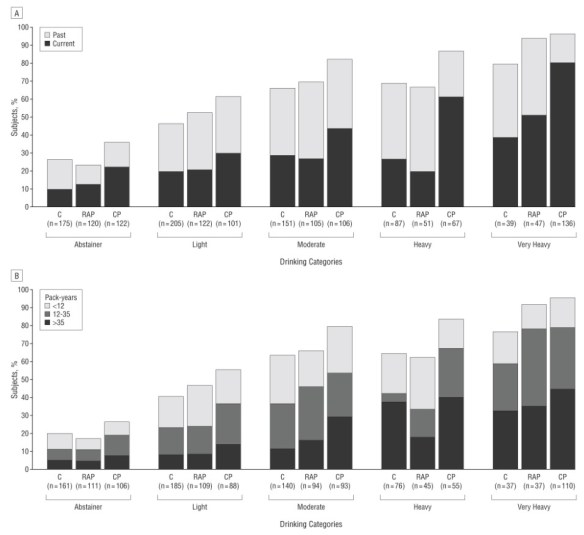
Figure 3. Distribution of self-reported smoking status (A) and amount (B) stratified by drinking categories. All proportions are based on effective numbers, and never smokers account for the proportions not reflected in the graphs. C indicates control group; CP, chronic pancreatitis group; RAP, recurrent acute pancreatitis group.
Issa Y, Kempeneers MA, Bruno MJ, et al. Effect of Early Surgery vs Endoscopy-First Approach on Pain in Patients With Chronic Pancreatitis: The ESCAPE Randomized Clinical Trial. JAMA. 2020 Jan 21;323(3):237-247.
Full-text for Emory users.
Results: Among 88 patients who were randomized (mean age, 52 years; 21 (24%) women), 85 (97%) completed the trial. During 18 months of follow-up, patients in the early surgery group had a lower Izbicki pain score than patients in the group randomized to receive the endoscopy-first approach group (37 vs 49; between-group difference, -12 points [95% CI, -22 to -2]; P = .02). Complete or partial pain relief at end of follow-up was achieved in 23 of 40 patients (58%) in the early surgery vs 16 of 41 (39%)in the endoscopy-first approach group (P = .10). The total number of interventions was lower in the early surgery group (median, 1 vs 3; P < .001). Treatment complications (27% vs 25%), mortality (0% vs 0%), hospital admissions, pancreatic function, and quality of life were not significantly different between early surgery and the endoscopy-first approach.
Conclusions and relevance: Among patients with chronic pancreatitis, early surgery compared with an endoscopy-first approach resulted in lower pain scores when integrated over 18 months. However, further research is needed to assess persistence of differences over time and to replicate the study findings.
Lau C, et al. A retrospective study to determine the cefepime-induced neurotoxicity threshold in hospitalized patients. J Antimicrob Chemother. 2020 Mar 1;75(3):718-725.
Full-text for Emory users.
Results: In total, 206 patients were administered 259 courses of cefepime, with an overall CIN incidence of 6% (16/259 courses). A total of 64 courses had a cefepime trough concentration measured (24.7%). A cefepime trough concentration of 36 mg/L provided the best differentiation between patients who experienced neurotoxicity and those who did not. No other patient covariates were identified to be significantly associated with neurotoxicity occurring.
Conclusions: A cefepime trough plasma concentration ≥36 mg/L appears to be the most sensitive and specific cut-off to predict CIN occurring. No patient factors were associated with the development of CIN when accounting for cefepime trough plasma concentrations.

 Surgical Focus