Prophylactic nasogastric decompression after abdominal surgery

“The prophylactic use of nasogastric tubes after abdominal operations, flexible tubes inserted through the nose, pharynx, oesophagus and into the stomach, has happened only in the last century, becoming so prevalent that it has been variously described as “the standard of care” (Montgomery 1996), “traditionally used by most surgeons” (Lee 2002), “common practice” (Cunningham 1992, Sakadamis 1999, Manning 2001), “unquestioned” (Savassi-Rocha 1992), and “routine” (Wolff 1989). What is to be achieved by this prophylaxis is gastric decompression, decreased likelihood of nausea and vomiting, decreased distention, less chance of pulmonary aspiration and pneumonia, less chance of wound separation and infection, less chance of fascial dehiscence and hernia, earlier return of bowel function, and earlier hospital discharge.”

Continue reading

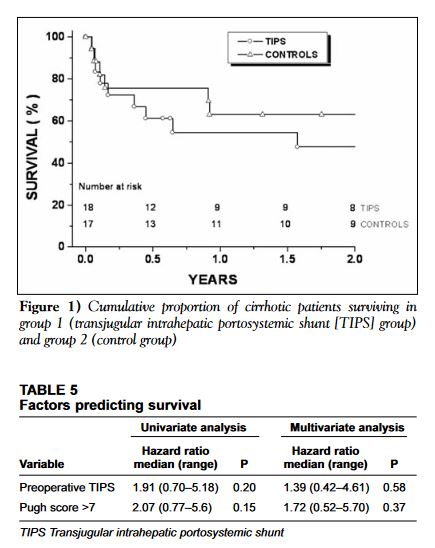
Transjugular intrahepatic portosystemic shunt before abdominal surgery in cirrhotic patients

“Abdominal surgery is occasionally needed in cirrhotic patients and is associated with high morbidity and mortality rates. It has been suggested that the main determinant of short- and long-term survival is the degree of liver failure, as evaluated by the presence of ascites, low serum albumin level and coagulation disorders. In addition, the degree of portal
hypertension may be an independent predictor for operative bleeding, postoperative ascites leakage or variceal rupture; this may also influence survival. Transjugular intrahepatic portosystemic shunt (TIPS) placement is much less invasive than surgical shunts and can be performed in patients with a significant degree of liver insufficiency. Therefore, it has been suggested that preoperative TIPS placement may improve the prognosis of cirrhotic patients, submitted to abdominal surgery.”

Continue reading

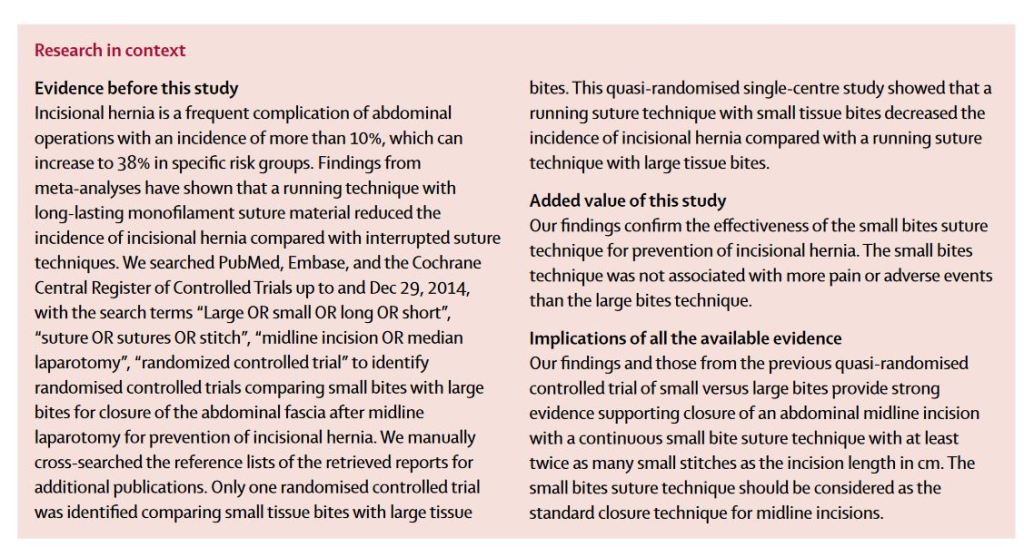
The STITCH Trial. Small bites versus large bites for closure of abdominal midline incisions.

“Incisional hernia is a frequent complication of abdominal operations with an incidence of 10–23%, which can increase to 38% in specific risk groups. In the USA 4 million to 5 million laparotomies are done annually, suggesting that at least 400 000–500 000 incisional hernias can be expected to occur every year. Incisional hernia is associated with pain and discomfort, resulting in a decreased quality of life. Moreover, incarceration and strangulation of abdominal contents can take place, for which emergency surgery is indicated, with associated morbidity and mortality. About 348 000 operations for incisional hernia are done every year in the USA with US$3·2 billion in annual associated costs. Prevention of
incisional hernia is therefore of paramount importance.”

Continue reading

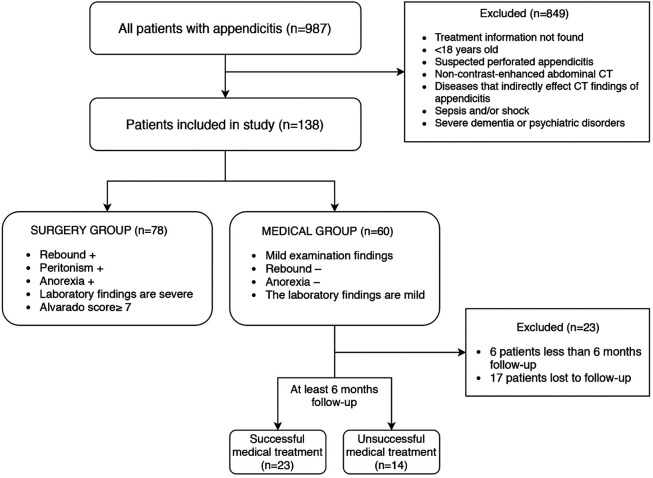
The role of CT in decision for acute appendicitis treatment

“Although medical treatment has proven to be a successful method of treatment of uncomplicated acute appendicitis, there is still controversy over which treatment to apply. It is intended that the computed tomography (CT) appendicitis score, which carries the information of all CT parameters, gives us an idea about the severity of acute appendicitis, such as the Alvarado score.”

“A retrospective analysis was conducted on 138 patients with acute appendicitis who underwent CT between 2015 and 2019. In this study, medical treatment group (n = 60) versus surgical treatment group (n = 78) and successful antibiotic treatment group (n = 23) versus unsuccessful antibiotic treatment group (n = 14) were compared.”

Continue reading

The negative appendectomy rate: who benefits from preoperative CT?

“Preoperative CT quite consistently has been shown to lower the negative appendectomy rate among women. Relatively few studies, however, have shown a lower negative appendectomy rate with preoperative CT for both sexes. Furthermore, any suggested utility of preoperative CT in men is contradicted by a number of studies that have shown that men derive no benefit from preoperative CT when there is clinical suspicion of acute appendicitis. Nevertheless, CT is used routinely among men with suspected appendicitis at our institution and has been assumed by both surgeons and radiologists to be a useful practice. Therefore, we performed this study to determine the negative appendectomy rates of patients who did and did not undergo preoperative CT and to determine, more specifically, whether men benefit from preoperative CT.”

Negative Appendectomy Rates for Patients Who Did and Did Not Undergo Preoperative Imaging
Continue reading

Laparoscopic Entry Techniques and Injuries

“Recent reports by the Australian Safety and Efficacy Register for New interventions and Procedures (ASERNIP-S) and the Royal Australian and New Zealand College of Obstetricians and Gynaecologists (RANZCOG) concluded that insufficient evidence is available to assess the safety of the open versus closed laparoscopy in regard to major vascular and visceral injuries.” (Larobina & Nottle)

Major Vascular Injuries in Closed vs. Open Laparoscopy (Larobina & Nottle)

“Our case series shows that open laparoscopy can vastly reduce the incidence of access-related morbidity and mortality. Only a single visceral injury occurred in 5900 cases, and no major vascular injuries were reported.These figures are consistent with those of other reported series of open laparoscopy, which also show a zero rate of vascular injury and low rates of visceral injury.The literature review showed a rate of 1 injury to major retroperitoneal vessels per 2272 cases of closed laparoscopy procedures. This compares with a major vascular injury rate of 0 for the open technique. This difference is both statistically significant ( P = 0.003) and highly clinically significant.” (Larobina & Nottle)

Continue reading

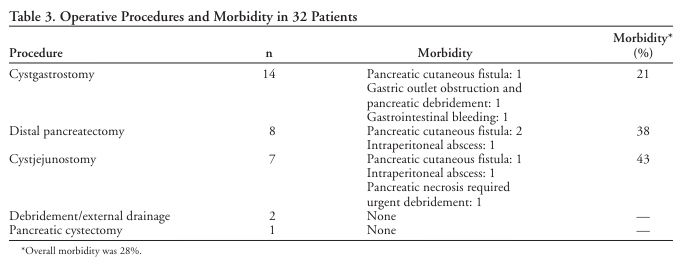
Management of pancreatic pseudocysts

“Operative internal drainage has been standard treatment for chronic unresolved pancreatic pseudocysts (PPs). Recently, percutaneous external drainage (PED) has become the primary mode of treatment at many medical centers.”

“ Operative management for PPs appears to be superior to CT-guided PED. Although the later was often successful, it required major salvage procedures in one third of the patients. An expectant management protocol may be suitable for selected patients.”

Continue reading