Management of afferent loop obstruction

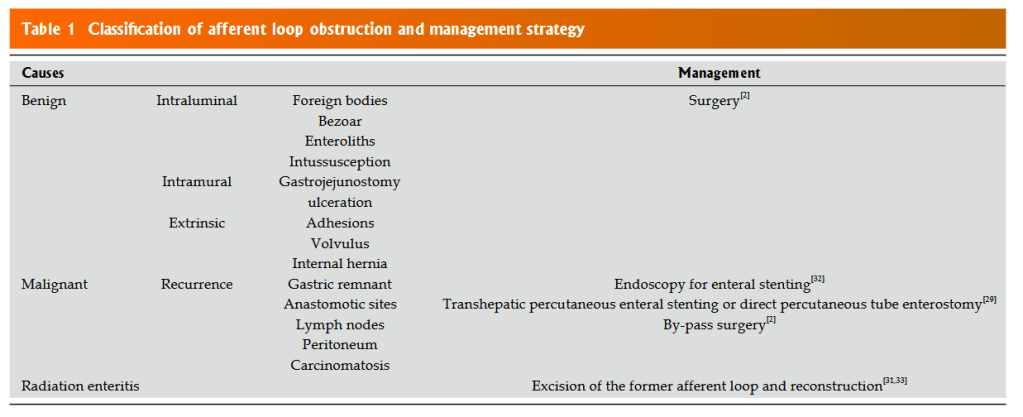
“Afferent loop obstruction is a purely mechanical complication that infrequently occurs following construction of a gastrojejunostomy. The operations most commonly associated with this complication are gastrectomy with Billroth II or Roux-en-Y reconstruction, and
pancreaticoduodenectomy with conventional loop or Roux-en-Y reconstruction. Etiology of afferent loop obstruction includes:
(1) entrapment, compression and kinking by postoperative adhesions
(2) internal herniation, volvulus and intussusception
(3) stenosis due to ulceration at the gastrojejunostomy site and radiation enteritis of the afferent loop
(4) cancer recurrence
(5) enteroliths, bezoars and foreign bodies.

Continue reading

Patient Complexity and Bile Duct Injury After Robotic-Assisted vs Laparoscopic Cholecystectomy

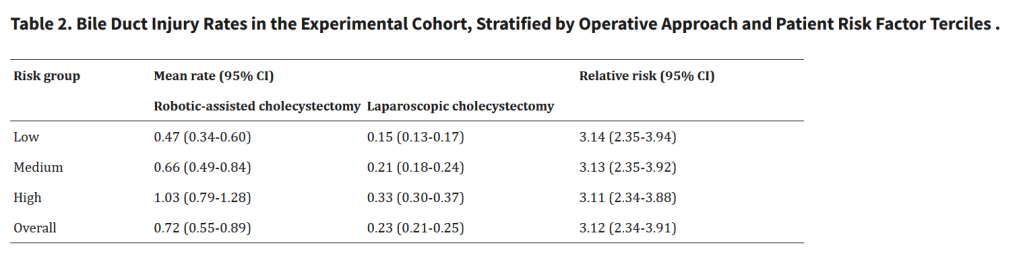
“Whether robotic-assisted cholecystectomy offers an advantage over laparoscopic cholecystectomy for higher-risk cases remains unclear. On one hand, there may be fundamental differences in the complexity of patients undergoing robotic-assisted cholecystectomy, which may be responsible for the higher observed rates of bile duct injury. On the other hand, differences in bile duct injury could be secondary to other factors, such as surgeons working their way up the learning curve using the robot, especially given the large number of robotic-assisted cholecystectomies surgeons must perform to achieve bile duct injury rates equivalent to those of laparoscopic approaches. By comparing laparoscopic and robotic-assisted cholecystectomy approaches within patient risk terciles, we can determine whether patient risk factor profiles are associated with harm in robotic-assisted cholecystectomy.”

Continue reading

Impact of the robotic platform and surgeon variation on cholecystectomy disposable costs

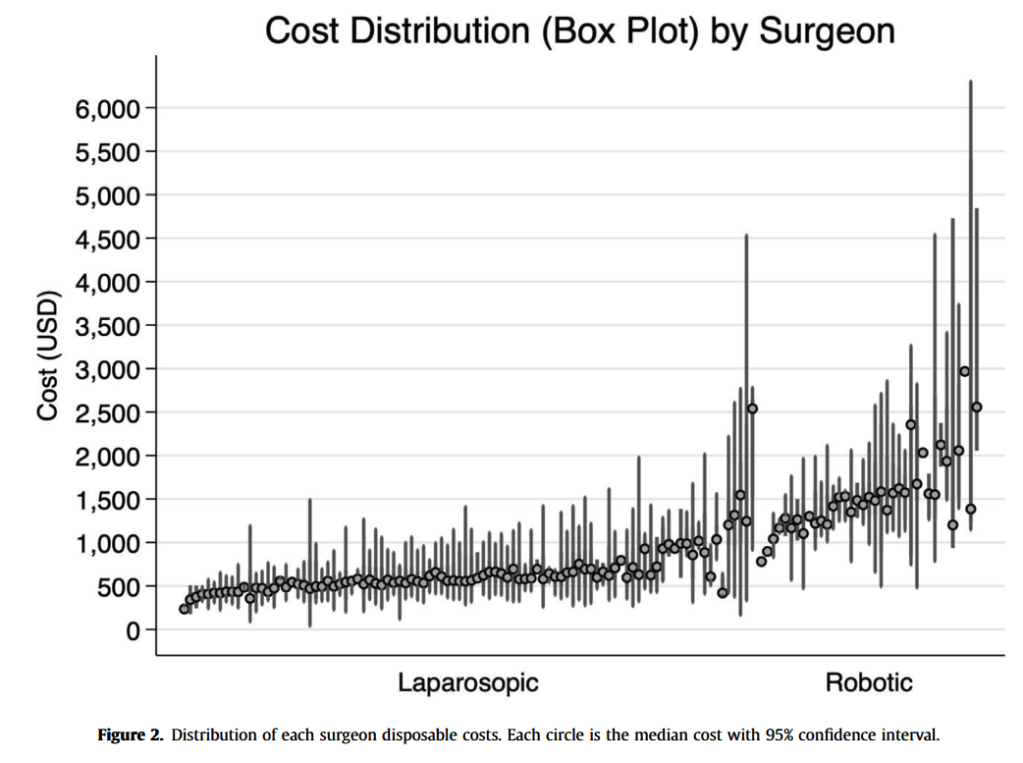
“Cholecystectomy is the seventh most common operation in the United States, with 605,000 minimally invasive ambulatory, 280,000 minimally invasive inpatient, and 49,000 inpatient open procedures annually. It is ranked 10th of all principal operative procedures in aggregate annual cost ($4.3 billion). As such, managing the cost of cholecystectomy has the potential to impact health care finances. RC consistently has been shown to be more costly than LC. 5 Despite this, the percentage of RC in the United States has increased rapidly as the robotic platform becomes more accessible in hospitals, surgeon interest grows, and marketing has increased. Because third-party reimbursement is not dependent on the platform, additional costs burden hospitals and should be theoretically offset by improved patient outcomes or other indirect benefits.”

Continue reading

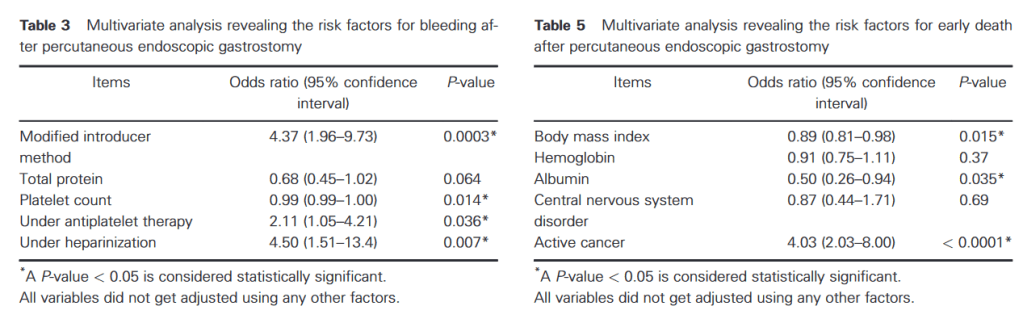
Risk factors for postoperative bleeding and early death in percutaneous endoscopic gastrostomy

“Gastrostomy is a method of tube feeding for patients incapable of oral intake. Percutaneous endoscopic gastrostomy (PEG) is performed in many hospitals in Japan. However, reports of postoperative bleeding or early postoperative death after PEG are limited.
Compared with nasogastric tube feeding, gastrostomy feeding has a favorable outcome, decreases treatment failure, decreases the frequency of gastrointestinal bleeding, and leads to increased serum albumin levels. However, as PEG is an invasive procedure, adverse events such as bleeding, local infection, peritonitis, and pulmonary aspiration may occur, thus worsening patient prognosis. Aspiration pneumonia has long been recognized as the
most common cause of death after PEG. However, there are no recent large-scale studies investigating the association between postoperative adverse events and early postoperative death in PEG.”

Continue reading

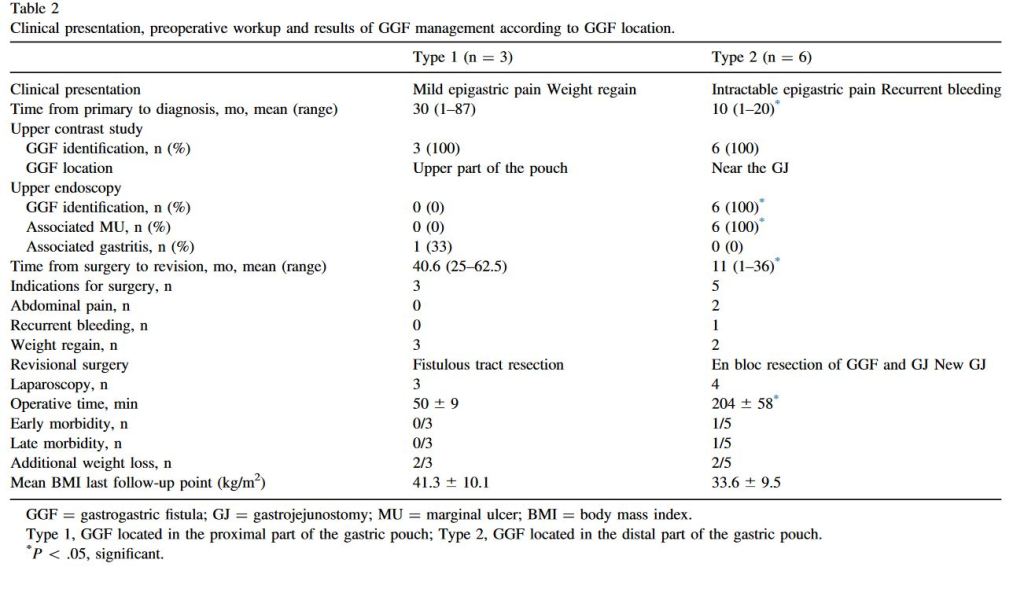
Classification, surgical management and outcomes of patients with gastrogastric fistula after Roux-En-Y gastric bypass

“Gastrogastric fistula (GGF) was a well-described complication after nondivided Roux-en-Y gastric bypass (RYGB), with a documented rate of up to 50%. Gastric transection with isolation of the gastric pouch (divided RYGB) reduces but does not eliminate this complication, which still occurs with a reported incidence ranging from 0% to 6%. Weight regain, epigastric pain, and marginal ulcer (MU) are the most common symptoms. Some GGF can be managed conservatively or by endoscopic approach, but surgery remains the standard of care.”

Continue reading

Decreasing Hospital Readmission in Ileostomy Patients

“Nearly 30% of patients with newly formed ileostomies require hospital readmission from severe dehydration or associated complications. This contributes to significant morbidity and rising healthcare costs associated with this procedure. The aim of this study was to design and pilot a novel program to decrease readmissions in this patient population.”

“Implementation of a novel program reduced the 30-day readmission rate by 58% and cost of readmissions per patient by >80% in a high risk for readmission patient population with newly created ileostomies. Future efforts will expand this program to a greater number of patients, both institutionally and systemically, to reduce the readmission-rate and healthcare
costs for this high-risk patient population.”

Continue reading

Morbidity and mortality of inadvertent enterotomy during adhesiotomy

“Postoperative intra-abdominal adhesions are a major concern in modern surgery. Intestinal obstruction is an important and well known clinical consequence of adhesions, resulting in significant morbidity and mortality rates, and high financial costs. Secondary infertility in women and chronic abdominal and pelvic pain are other, frequently cited, adhesion-related problems. Furthermore, intraabdominal adhesions render reoperation dif®cult and may
increase the complication rate of the intended surgical procedure. Prolonged operating time, unfeasibility of the laparoscopic approach and inadvertent enterotomy are known drawbacks of reoperative abdominal surgery, directly related to adhesions.”

Continue reading