Management of Postoperative Complications Following Operations for Breast Cancer

At bottom of post Surgical Clinics of North America issue on postoperative complications.

“The reported complication rates after breast cancer surgery are low, with rates ranging
from 2% to 50%, and are reportedly more common when performed in conjunction with axillary surgery and immediate breast reconstruction. A breakdown by procedure type has shown morbidity rates between 5% and 50% after mastectomy and from 3% to 35% after lumpectomy with or without reconstruction.”

Hilli
Continue reading

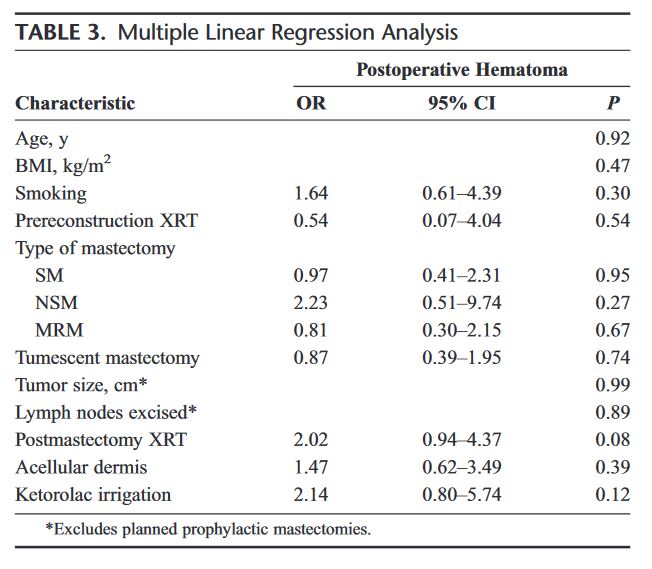
Analysis of hematoma after mastectomy with immediate reconstruction

“Although the risk of postoperative bleeding is inherent to all surgical subspecialties, the development of a hematoma after mastectomy with implant reconstruction involves unique risk factors, including the routine involvement of 2 distinct surgical teams. However, despite numerous studies reporting their outcomes following these operations, a rigorous analysis of individual andcoperative factors that contribute to postoperative hematoma formation
has never been documented.”

Continue reading

Article of interest: Evolving trends in surgical management of breast cancer: an analysis of 30 years of practice changing papers

Keelan S, Flanagan M, Hill ADK. Evolving Trends in Surgical Management of Breast Cancer: An Analysis of 30 Years of Practice Changing Papers. Front Oncol. 2021 Aug 4;11:622621. Free full-text.

Figure 1. A timeline of evolving trends in surgical management of breast cancer. OS, overall survival; DFS, disease free survival; BCS, beast conserving surgery; RT, radiotherapy; QOL, quality of life; SLNB, sentinel lymph node biopsy; ALND, axillary lymph node dissection. (p. 3)
Continue reading

Article of interest: Spotlight on the utility of the Oncotype DX ® breast cancer assay.

Siow ZR, De Boer RH, Lindeman GJ, Mann GB. Spotlight on the utility of the Oncotype DX® breast cancer assay. Int J Womens Health. 2018 Feb 21;10:89-100.

Summary: Genomic assays such as Oncotype DX have changed the landscape for the treatment of ER-positive early breast cancer. In a USA-based study, there has been a 13% decline in the use of adjuvant chemotherapy in 2006–2008, which has been largely attributed to the introduction of the Oncotype DX in 2004.78 While the Oncotype DX is expensive, the potential cost savings from chemotherapy avoidance and reduced exposure to the side effects of cytotoxic therapy appear to be cost-effective in most jurisdictions. The development and eventual validation of other genomic assays could potentially reduce test costs. While Oncotype DX is currently well validated in the node-negative population, its optimal use remains to be defined for cohorts of patients with intermediate-risk RS, as well as for patients with lymph node-positive disease. Results from the prospective TAILORx and RxPONDER trials will help shed light on these questions.

Sentinel lymph node surgery after neoadjuvant chemotherapy in node-positive breast cancer

Cavalcante FP, Millen EC, Zerwes FP, Novita GG. Role of Axillary Surgery After Neoadjuvant Chemotherapy. JCO Glob Oncol. 2020 Feb;6:238-241.

“In a US study, associating selective localization and removal of clipped nodes with SLN dissection, known as targeted axillary dissection, reduced false-negative rates to approximately 2% compared with 4% with removal of the clipped lymph node alone. [20] However, patients are required to undergo two procedures: placement of the clip before systemic treatment and marking it to identify the lymph node during surgery. A retrospective analysis showed that in patients with clipped lymph nodes who were referred for preoperative marking, the clip failed to be identified in 20% of those patients, even when computed tomography was used, with the additional risk of the clip not being removed during surgery. [21] Therefore, the use of clips is controversial, because it is sometimes impossible to remove the clip alone. Despite the association between the number of lymph nodes and false-negative rates, there are still no convincing data regarding clinical outcome.”


Caudle AS, Yang WT, Krishnamurthy S, et al. Improved Axillary Evaluation Following Neoadjuvant Therapy for Patients With Node-Positive Breast Cancer Using Selective Evaluation of Clipped Nodes: Implementation of Targeted Axillary Dissection. J Clin Oncol. 2016 Apr 1;34(10):1072-8.

Results: Of 208 patients enrolled in this study, 191 underwent ALND, with residual disease identified in 120 (63%). The clipped node revealed metastases in 115 patients, resulting in an FNR of 4.2% (95% CI, 1.4 to 9.5) for the clipped node. In patients undergoing SLND and ALND (n = 118), the FNR was 10.1% (95% CI, 4.2 to 19.8), which included seven false-negative events in 69 patients with residual disease. Adding evaluation of the clipped node reduced the FNR to 1.4% (95% CI, 0.03 to 7.3; P = .03). The clipped node was not retrieved as an SLN in 23% (31 of 134) of patients, including six with negative SLNs but metastasis in the clipped node. TAD followed by ALND was performed in 85 patients, with an FNR of 2.0% (1 of 50; 95% CI, 0.05 to 10.7).

Conclusion: Marking nodes with biopsy-confirmed metastatic disease allows for selective removal and improves pathologic evaluation for residual nodal disease after chemotherapy.

Continue reading

The timing and accuracy of SLNB for nodal management after NAC

One discussion this week included nodal management after neoadjuvant chemotherapy (NAC).


Reference: Pilewskie M and Morrow M. Axillary nodal management following neoadjuvant chemotherapy. JAMA Oncology. 2017 Apr 1;3(4):549-555.

Summary: The increasing use of NAC has raised questions about the optimal approach to the axilla, including accuracy and timing of sentinel lymph node biopsy (SLNB) in patients who are clinically node negative (cN0) at presentation, use of NAC to avoid axillary lymph node dissection (ALND) in patients presenting with node-positive disease, and the relative importance of pre-and post-NAC stage in predicting the risk of locoregional recurrence (LRR).

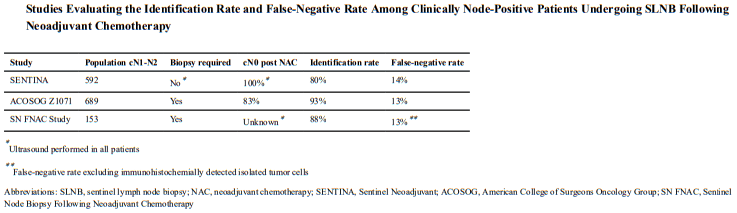
The decrease in nodal metastases in cN0 patients undergoing post-NAC axillary staging and the increasing rates of pCR in the breast in patients treated with current chemotherapy regimens led to the study of SLNB among patients presenting with cN+ disease. Table 3 (below) summarizes data from three prospective, multi-institutional trials assessing the accuracy of SLNB after NAC among node-positive patients.

SLNB

The authors conclude: NAC reduces the need for ALND, and SLNB is an accurate
method of determining nodal status post NAC. The demonstration that SLNB accurately stages the axilla after NAC regardless of the presenting nodal stage (cN0, cN1) provides an important rationale for the use of NAC for axillary downstaging in patients who are candidates for breast-conserving surgery at presentation or who desire mastectomy. SLN identification rates and FNRs in those who are cN0 are similar to those seen with initial SLN surgery, and nodal recurrence after a negative SLNB is uncommon.


Additional Reading: Boughey JC, et al. Sentinel lymph node surgery after neoadjuvant chemotherapy in patients with node-positive breast cancer: the ACOSOG Z1071 (Alliance) clinical trial. JAMA. 2013 Oct 9;310(14):1455-1461. doi:10.1001/jama.2013.278932.

ONCOTYPE IQ for DCIS: A 12-year update on the ECOG-ACRIN E5194 study

One discussion last week included Dr. Wood’s ONCOTYPE IQ for DICS, Trial E5194.

Reference: Solin LJ, et al. Surgical excision without radiation for ductal carcinoma in situ of the breast: 12-year results from the ECOG-ACRIN E5194 study. Journal of Clinical Oncology. 2015 Nov 20;33(33):3938-3944. doi: 10.1200/JCO.2015.60.8588

ClinicalTrials.gov NCT00002934.

Summary: The Eastern Cooperative Oncology Group–American College of Radiology Imaging Network (ECOG-ACRIN; formerly the Eastern Cooperative Oncology Group) Cancer Research Group E5194 study (a nonrandomized clinical trial) prospectively enrolled patients for whom surgical excision alone (without radiation) was thought to be a reasonable treatment option on the basis of low-risk clinical and pathologic characteristics. This report provides updated results from the ECOG-ACRIN E5194 study, including 10- and 12-year outcomes.

Continue reading