Guideline for Perioperative Cardiovascular Management for Noncardiac Surgery: A Report of the American College of Cardiology/American Heart Association Joint Committee on Clinical Practice Guidelines

“Top Take-Home Messages

1.A stepwise approach to perioperative cardiac assessment assists clinicians in determining when surgery should proceed or when a pause for further evaluation is warranted.
2.Cardiovascular screening and treatment of patients undergoing noncardiac surgery should adhere to the same indications as nonsurgical patients, carefully timed to avoid delays in surgery and chosen in ways to avoid overscreening and overtreatment.
3.Stress testing should be performed judiciously in patients undergoing noncardiac surgery, especially those at lower risk, and only in patients in whom testing would be appropriate independent of planned surgery.
4.Team-based care should be emphasized when managing patients with complex anatomy or unstable cardiovascular disease.
5.New therapies for management of diabetes, heart failure, and obesity have significant perioperative implications. Sodium-glucose cotransporter 2 inhibitors should be discontinued 3 to 4 days before surgery to minimize the risk of perioperative ketoacidosis associated with their use.
6.Myocardial injury after noncardiac surgery is a newly identified disease process that should not be ignored because it portends real consequences for affected patients.
7.Patients with newly diagnosed atrial fibrillation identified during or after noncardiac surgery have an increased risk of stroke. These patients should be followed closely after surgery to treat reversible causes of arrhythmia and to assess the need for rhythm control and long-term anticoagulation.
8.Perioperative bridging of oral anticoagulant therapy should be used selectively only in those patients at highest risk for thrombotic complications and is not recommended in the majority of cases.
9.In patients with unexplained hemodynamic instability and when clinical expertise is available, emergency focused cardiac ultrasound can be used for perioperative evaluation; however, focused cardiac ultrasound should not replace comprehensive transthoracic echocardiography.”
Stepwise Approach to Perioperative Cardiac Assessment
∗Cardiovascular risk factors: hypertension, smoking, high cholesterol, diabetes, women age >65 y, men age >55 y, obesity, family history of premature CAD. †Determining elevated calculated risk depends on the calculator used. Traditionally, RCRI >1 or a calculated risk of MACE with any perioperative risk calculator >1% is used as a threshold to identify patients at elevated risk. §Abnormal biomarker thresholds: troponin >99th percentile URL for the assay; BNP >92 ng/L, NT-proBNP ≥300 ng/L. ‡Conditions that pose additional risk for MACE. ‖Noninvasive stress testing or CCTA suggestive of LM or multivessel CAD. Colors correspond to Class of Recommendation in Table 3. BNP indicates B-type natriuretic peptide; CABG, coronary artery bypass grafting; CAD, coronary artery disease; CCTA, coronary computed tomography angiography; CIED, cardiovascular implantable electronic device; CVD, cardiovascular disease; DASI, Duke Activity Status Index; ECG, electrocardiogram; GDMT, guideline-directed management and therapy; ICD, implantable cardioverter-defibrillator; LM, left main; MACE, major adverse cardiovascular event; METs, metabolic equivalents; NCS, noncardiac surgery; NT-proBNP, N-terminal pro b-type natriuretic peptide; RCRI, Revised Cardiac Risk Index; and URL, upper reference limit.
Continue reading

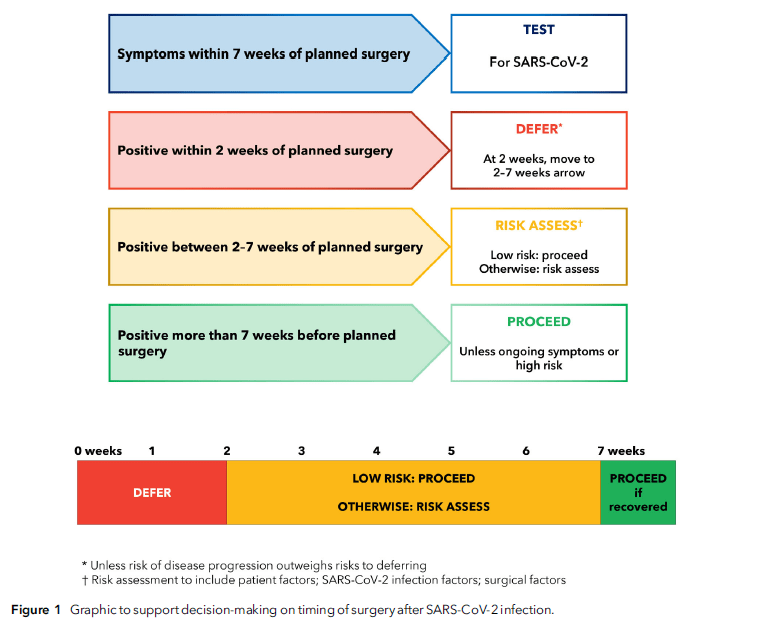
Timing of elective surgery and risk assessment after SARS-CoV-2 infection

“Patients who develop symptoms of SARS-CoV-2 infection within 7 weeks of planned surgery, including on the day of surgery, should be screened for SARS-CoV-2. Elective surgery should not usually be undertaken within 2 weeks of diagnosis of SARS-CoV-2 infection. For patients who have recovered from SARS-CoV-2 infection and who are low risk or having low-risk surgery, most elective surgery can proceed 2 weeks following a SARS-CoV-2 positive test. For patients who are not low risk or having anything other than low-risk surgery between 2 and 7 weeks following infection, an individual risk assessment must be performed. This should consider: patient factors (age; comorbid and functional status); infection factors (severity; ongoing symptoms; vaccination); and surgical factors (clinical priority; risk of disease progression; grade of surgery).”

Continue reading

Periprocedural bridging anticoagulation

Rechenmacher SJ, Fang JC. Bridging Anticoagulation: Primum Non Nocere. J Am Coll Cardiol. 2015 Sep 22;66(12):1392-403.

Full-text for Emory users.

Conclusions: Periprocedural anticoagulation management is a common clinical dilemma with limited evidence (but 1 notable randomized trial) to guide our practices. Although bridging anticoagulation may be necessary for those patients at highest risk for TE, for most patients it produces excessive bleeding, longer length of hospital stay, and other significant morbidities, while providing no clear prevention of TE. Unfortunately, contemporary clinical practice, as noted in physician surveys, continues to favor interruption of OAC and the use of bridging anticoagulation. While awaiting the results of additional randomized trials, physicians should carefully reconsider the practice of routine bridging and whether periprocedural anticoagulation interruption is even necessary.

Central Illustration. Bridging Anticoagulation: Algorithms for Periprocedural Interrupting and Bridging Anticoagulation. Decision trees for periprocedural interruption of chronic oral anticoagulation (top) and for periprocedural bridging anticoagulation (bottom). OAC = oral anticoagulation.

Continue reading

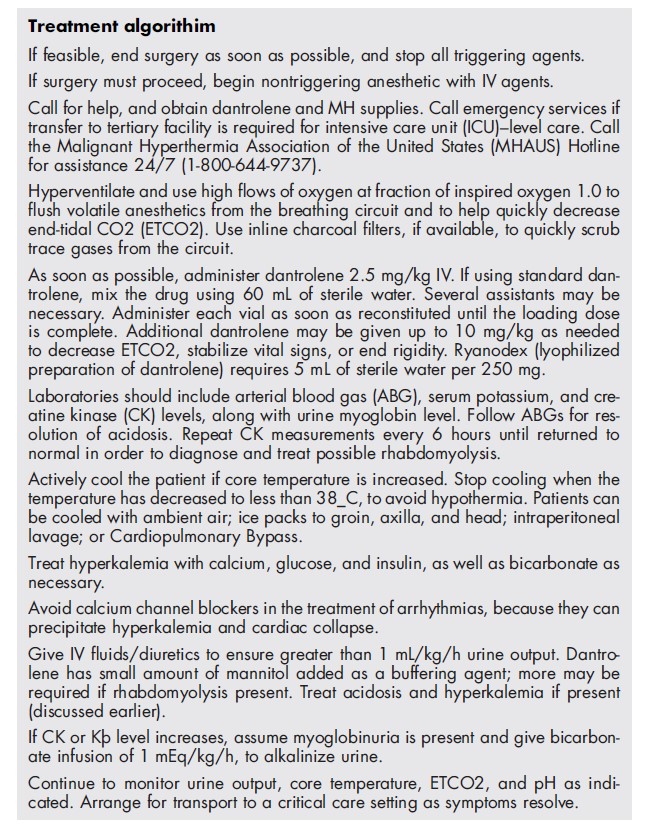
Management of malignant hyperthermia

Hopkins PM, Girard T, Dalay S, Jenkins B, Thacker A, Patteril M, McGrady E. Malignant hyperthermia 2020: Guideline from the Association of Anaesthetists. Anaesthesia. 2021 May;76(5):655-664. Free full-text.


Kim KSM, Kriss RS, Tautz TJ. Malignant Hyperthermia: A Clinical Review. Adv Anesth. 2019 Dec;37:35-51. Full-text for Emory users.

Continue reading

Guidelines for the perioperative management of anticoagulants

One discussion this week focused on the perioperative management of NOACs.


Reference:  DynaMed Plus [Internet]. Ipswich (MA): EBSCO Information Services. 1995 -. Record No. 227537, Periprocedural management of patients on long-term anticoagulation; [updated 2018 Oct 10, cited 2018 Oct 12; [about 26 screens]. Emory login required.

Summary: The information below is from DynaMed Plus (2018). To view full information on the topic, click on the citation above.

Vitamin K antagonists in patients undergoing major surgery or procedures

  • Consider continuing vitamin K antagonist (VKA) therapy in patients who require minor dental procedures, minor dermatological procedures, or cataract surgery.
  • In those having a minor dental procedure, consider coadministering an oral hemostatic agent or stopping the VKA 2 to 3 days before the procedure.
  • In those undergoing implantation of a pacemaker or an implantable cardioverter device, consider continuing VKA therapy.
  • In those having a major surgery or procedure, stop VKA therapy 5 days before surgery.
  • Resume VKA therapy 12-24 hours after surgery when there is adequate hemostasis.

Bridging therapy in patients undergoing major surgery or procedures

  • If at low risk for thrombosis, consider omitting bridging therapy.
  • If at moderate risk for thrombosis, assess individual patient- and surgery-related factors when considering bridging therapy.
  • If at high risk for thrombosis consider bridging therapy with unfractionated heparin (UFH) or low-molecular-weight heparin (LMWH).
  • For those receiving bridging therapy with UFH, stop UFH 4-6 hours before surgery.
  • For those receiving bridging therapy with therapeutic-dose LMWH, stop LMWH 24 hours before surgery.
  • For those receiving bridging therapy with UFH or therapeutic-dose LMWH and undergoing non-high-bleeding-risk surgery, consider resuming heparin 24 hours after surgery.
  • For those receiving bridging therapy with UFH or therapeutic-dose LMWH and undergoing high-bleeding-risk surgery, consider resuming heparin 48-72 hours after surgery.

Continue reading

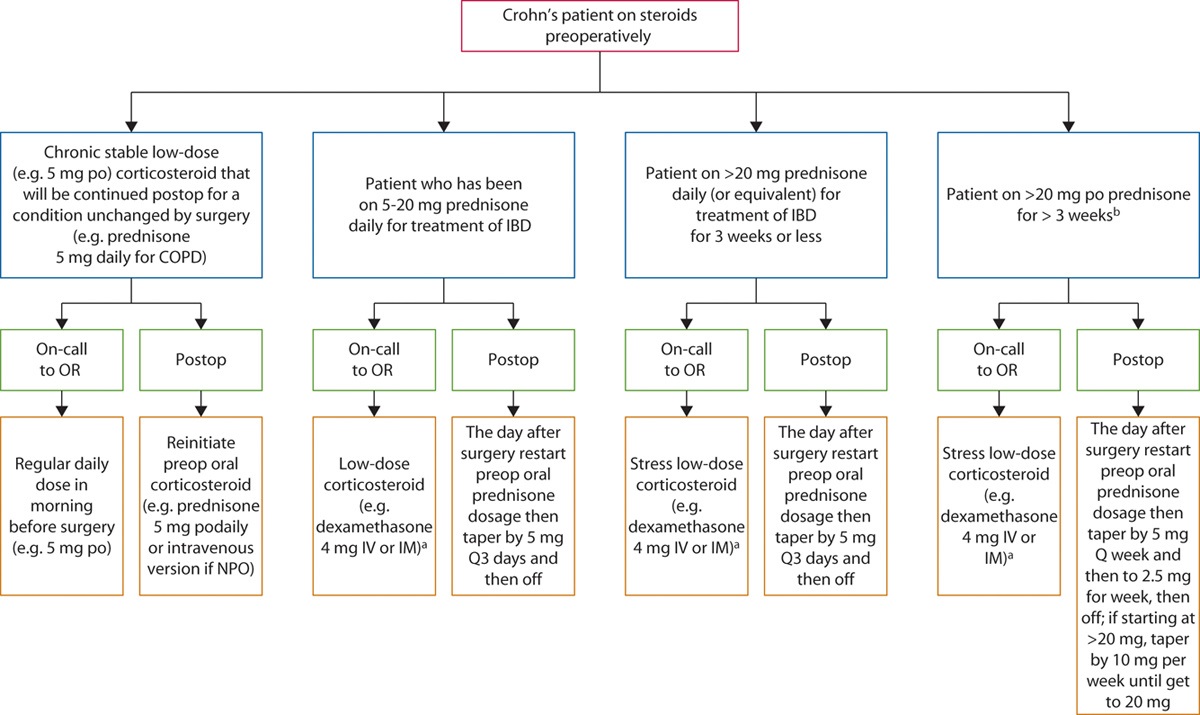
Perioperative Management of Biologic and Immunosuppressive Medications in Patients With Crohn’s Disease

Lightner AL. Perioperative Management of Biologic and Immunosuppressive
Medications in Patients With Crohn’s Disease. Dis Colon Rectum. 2018 Apr;61(4): 428-431.

EVALUATION AND TREATMENT ALGORITHMS

Algorithm 1

Continue reading