Preoperative cachexia

Mason MC, et al. Preoperative cancer cachexia and short-term outcomes following surgery. J Surg Res. 2016 Oct; 205(2):398-406.

Full-text for Emory users.

Results: Of 253 patients, 16.6% had preoperative cachexia, and 51.8% developed ≥ 1 postoperative complications. Complications were more common in cachectic patients (64.3% versus 49.3%, P = 0.07). This association varied by BMI category, and interaction analysis was significant for those with normal or underweight BMI (BMI < 25, P = 0.03). After multivariate modeling, in patients with normal or underweight BMI, preoperative cachexia was associated with higher odds of postoperative complications (odds ratios, 5.08 [95% confidence intervals, 1.18-21.88]; P = 0.029). Additional predictors of complications included major surgery (3.19 [1.24-8.21], P = 0.01), ostomy (4.43 [1.68-11.72], P = 0.003), and poor baseline performance status (2.31 [1.05-5.08], P = 0.03).

Continue reading

Extended-duration thromboprophylaxis after CRS/HIPEC

Khan S, et al. Incidence, Risk Factors, and Prevention Strategies for Venous Thromboembolism after Cytoreductive Surgery and Hyperthermic Intraperitoneal Chemotherapy. Ann Surg Oncol. 2019 Jul;26(7):2276-2284.

Full-text for Emory users.

“A policy change was made in February 2010 to discharge all patients post-CRS/HIPEC with 14 days of additional pharmacothromboprophylaxis, which consisted of low-molecular-weight heparin in 327 of 447 (73%) cases (Supplemental Figure). The 60-day VTE rate decreased from 10.2 to 4.9% after this policy was instituted (p = 0.10, Fig. 2).”

“This policy is in accordance with established guidelines indicating the need for a total of 4 weeks of pharmacothromboprophylaxis in high-risk patients after abdominal or pelvic surgery for cancer. [2,21] Given that patients have an average length of stay of nearly 2 weeks, discharging them on 14 days of pharmacothromboprophylaxis fulfills this duration.”

Continue reading

Stoma versus stent as a bridge to surgery for obstructive colon cancer

Veld JV, et al. Changes in Management of Left-Sided Obstructive Colon Cancer: National Practice and Guideline Implementation. J Natl Compr Canc Netw. 2019 Dec;17(12):1512-1520.

Free full-text. 

Results: A total of 2,587 patients were included (2,013 ER, 345 DS, and 229 SEMS). A trend was observed in reversal of ER (decrease from 86.2% to 69.6%) and SEMS (increase from 1.3% to 7.8%) after 2014, with an ongoing increase in DS (from 5.2% in 2009 to 22.7% in 2016). DS after 2014 was associated with more laparoscopic resections (66.0% vs 35.5%; P<.001) and more 2-stage procedures (41.5% vs 28.6%; P=.01) with fewer permanent stomas (14.7% vs 29.5%; P=.005). Overall, more laparoscopic resections (25.4% vs 13.2%; P<.001) and shorter total hospital stays (14 vs 15 days; P<.001) were observed after 2014. However, similar rates of primary anastomosis (48.7% vs 48.6%; P=.961), 90-day complications (40.4% vs 37.9%; P=.254), and 90-day mortality (6.5% vs 7.0%; P=.635) were observed.

CONCLUSIONS: Guideline revision resulted in a notable change from ER to BTS for LSOCC. This was accompanied by an increased rate of laparoscopic resections, more 2-stage procedures with a decreased permanent stoma rate in patients receiving DS as BTS, and a shorter total hospital stay. However, overall 90-day complication and mortality rates remained relatively high.

Continue reading

Consensus guidelines for the management of intraductal papillary mucinous neoplasms of the pancreas

This week’s discussion included information about the utility of the Fukuoka criteria.


Srinivasan N, et al. Systematic review of the clinical utility and validity of the Sendai and Fukuoka Consensus Guidelines for the management of intraductal papillary mucinous neoplasms of the pancreas.HPB (Oxford). 2018 Jun;20(6):497-504.

Free full-text. 

RESULTS: Ten studies evaluating the FCG, 8 evaluating the SCG and 4 evaluating both guidelines were included. In 14 studies evaluating the FCG, out of a total of 2498 neoplasms, 849 were malignant and 1649 were benign neoplasms. Pooled analysis showed that 751 of 1801 (42%) FCG+ve neoplasms were malignant and 599 neoplasms of 697 (86%) FCG-ve neoplasms were benign. PPV of the high risk and worrisome risk groups were 465/986 (47%) and 239/520 (46%) respectively. In 12 studies evaluating the SCG, 1234 neoplasms were analyzed of which 388 (31%) were malignant and 846 (69%) were benign. Pooled analysis demonstrated that 265 of 802 (33%) SCG+ve neoplasms were malignant and 238 of 266 SCG-ve (90%) neoplasms were benign.

CONCLUSION: The FCG had a higher positive predictive value (PPV) compared to the SCG. However, the negative predictive value (NPV) of the FCG was slightly lower than that of the SCG. Malignant and even invasive IPMN may be missed according to both guidelines.

Continue reading

Signet-ring cell carcinoma: a look at the rare colorectal cancer

A discussion this week included signet ring cell carcinoma.


Reference: Nitsche U, et al. Mucinous and signet-ring cell colorectal cancers differ from classical adenocarcinomas in tumor biology and prognosis. Annals of Surgery. 2013 Nov;258(5):775-782; discussion 782-783. doi:10.1097/SLA.0b013e3182a69f7e

Additional Reading: Korphaisarn K, et al. Signet ring cell colorectal cancer: genomic insights into a rare subpopulation of colorectal adenocarcinoma. British Journal of Cancer. 2019 Sep;121(6):505-510. doi:10.1038/s41416-019-0548-9

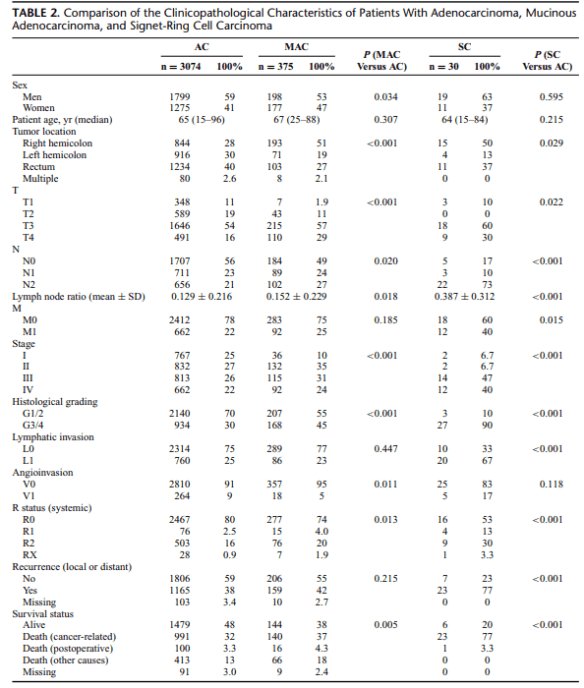
Summary: In a study analyzing clinical, histopathological, and survival data of 3479 patients undergoing surgery for primary colorectal cancer between 1982 and 2012, Nitsche et al (2013) compared the characteristics of classical adenocarcinomas (AC) to the less common mucinous adenocarcinomas (MAC) and to the rare signet-ring cell carcinomas (SC).
SC

Approximately 10% of all colorectal cancers are MAC, and about 1% are SC. Because of their relatively rare occurrence, in particular, the evaluation of the clinical impact of SC is difficult. However, compared with AC, both MAC and SC have been shown to be associated with young age, advanced tumor stage, accumulation in female patients, and distinct molecular patterns, such as microsatellite instability and activating mutations of the BRAF gene. Although ambiguous, recent data and meta-analyses suggest that the
histological subtype MAC may be associated with worse outcome compared with AC. Poor prognosis of SC is more evident, mainly due to high rates of synchronous and metachronous distant organ metastasis associated with this histological subtype.

In describing SC, the authors state: “SC have been described as being positive for intestinal trefoil factor and MUC2, 2 peptides that are usually produced only by goblet cells. Thus, SC could arise from different cells of origin than AC. Although they can be localized in the colorectum, SC may be genetically more related to signet-ring cell cancers of other organs (eg, gastric cancer) than to AC or MAC of the colorectum. The
absence of E-cadherin/β-catenin and amplification of Bcl-2 are features typically shared with signet-ring cell cancer of the stomach but not with classical colorectal adenocarcinomas” (p.781).

The authors conclude that patients with MAC and SC could profit from closer follow-up or even intensified adjuvant therapy because of their high rates of local and distant recurrence. The biological behavior of SC differs in specific, and these patients require special awareness, despite the relatively rare prevalence.

D1 vs D2 resection for gastric cancer

One discussion this week included a trial out of Denmark comparing D1 and D2 lymph-node dissection for gastric cancer.

Reference: Bonenkamp JJ, et al. Extended lymph-node dissection for gastric cancer. NEJM. 1999 Mar 25;340(12):908-914.

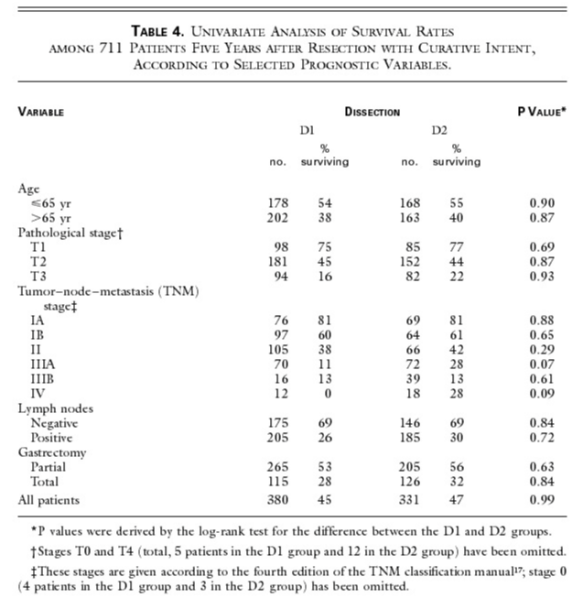
Summary: Curative resection is the treatment of choice for gastric cancer, but it is unclear whether this operation should include an extended (D2) lymph-node dissection or a limited (D1) dissection. The authors conducted a randomized trial in 80 Dutch hospitals in which they compared D1 with D2 lymph-node dissection for gastric cancer in terms of morbidity, postoperative mortality, long-term survival, and cumulative risk of relapse after surgery.

Between August 1989 and July 1993, 996 patients were enrolled. Of these, 711 underwent randomly assigned treatment (D1 = 380, D2 = 331) and 285 received palliative treatment.

General findings:

  • Complications: 43% in D2, 25% in D1
  • Postoperative deaths: 10% in D2, 4% in D1
  • Length of stay: 16 median days in D2, 14 days in D1
  • 5-year survival rates: 47% in D2, 45% in D1


d1 v d2

One of the arguments for D2 dissection is its ability to reduce rates of local recurrence, thereby increasing the quality of life. The distressing finding of local recurrence, usually in a terminal phase of the disease, often leads to second operations to restore gastrointestinal continuity. In this trial, there was a tendency toward a reduced cumulative risk of relapse after D2 dissection, but the rate of relapse remained high and the difference from D1 dissection was not significant. A subgroup analysis indicated a significant or marginally significant difference for patients with disease in UICC stages II and IIIA, but this difference was attributable largely to stage migration.

The MAGIC Trial: Does perioperative ECF improve outcomes for gastric cancer patients?

One discussion this week included the Medical Research Council Adjuvant Gastric Infusional Chemotherapy (MAGIC) Trial. [Current Controlled Trials number: ISRCTN93793971.]

Reference: Cunningham D, et al. Perioperative chemotherapy versus surgery alone for resectable gastroesophageal cancer. NEJM. 2006 Jul 6;355(1):11-20.

Summary: A regimen of epirubicin, cisplatin, and infused fluorouracil (ECF) improves survival among patients with incurable locally advanced or metastatic gastric adenocarcinoma. The MAGIC Trial assessed whether the addition of a perioperative regimen of ECF to surgery improves outcomes among patients with potentially curable gastric cancer.

METHODS: We randomly assigned patients with resectable adenocarcinoma of the stomach, esophagogastric junction, or lower esophagus to either perioperative  chemotherapy and surgery (250 patients) or surgery alone (253 patients). Chemotherapy consisted of three preoperative and three postoperative cycles of intravenous epirubicin (50 mg per square meter of body-surface area) and cisplatin (60 mg per square meter) on day 1, and a continuous intravenous infusion of fluorouracil (200 mg per square meter per day) for 21 days. The primary end point was overall survival.

CONCLUSIONS: In patients with operable gastric or lower esophageal adenocarcinomas, a perioperative regimen of ECF decreased tumor size and stage and significantly improved progression-free and overall survival.

MAGIC

(p.16)

Additional Reading: Cunningham D, et al. Perio-operative chemoterhapy with or without bevacizumab in operable oesophagogastric adenocarcinoma (UK Medical Research Council ST03): primary analysis results of a multicentre, open-label, randomised phase 2-3 trial. Lancet Oncology. 2017 Mar;18(3):357-370.  doi: 10.1016/S1470-2045(17)30043-8.

[ClinicalTrials.gov, number NCT00450203.]