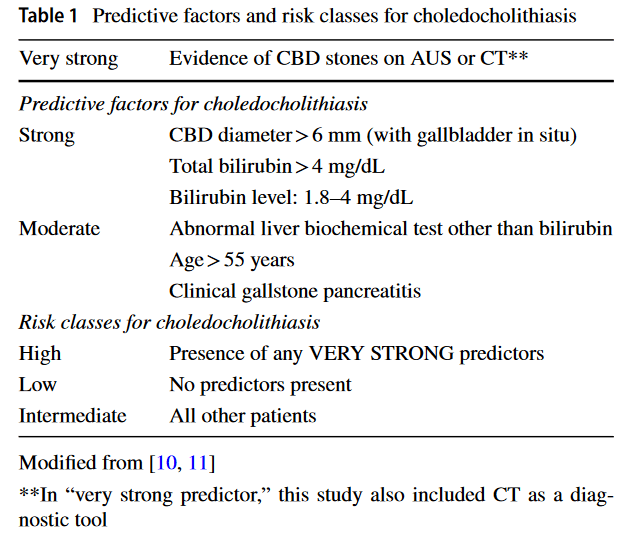
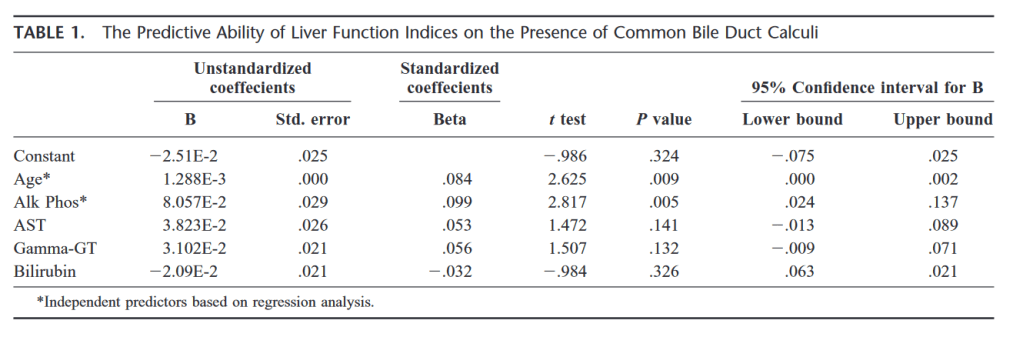
“Choledocholithiasis occurs in 3.4% of patients undergoing laparoscopic cholecystectomy but more than one third of these pass the calculi spontaneously within 6 weeks of operation and may be spared endoscopic retrograde cholangiopancreatography.” (Collins)
“The aim of this document is to provide evidence-based recommendations for the endoscopic evaluation and treatment of choledocholithiasis based on rigorous review and synthesis of the contemporary literature, using the Grading of Recommendations Assessment, Development and Evaluation (GRADE) framework. The GRADE framework is a system for rating the quality of evidence and strength of recommendations that is comprehensive and transparent and has been recently adopted by the American Society for Gastrointestinal Endoscopy (ASGE). This document addresses the following 4 clinical questions:”
1. “What is the diagnostic utility of EUS versus MRCP to confirm choledocholithiasis in patients at intermediate risk of choledocholithiasis? 2. In patients with gallstone pancreatitis, what is the role of early ERCP? 3. In patients with large choledocholithiasis, is endoscopic papillary dilation after sphincterotomy favored over sphincterotomy alone? 4. What is the role of ERCP-guided intraductal therapy (EHL and laser lithotripsy) in patients with large and difficult choledocholithiasis?”
Early oral feeding is the preferred mode of nutrition for surgical patients. Avoidance of any nutritional therapy bears the risk of underfeeding during the postoperative course after major surgery. Considering that malnutrition and underfeeding are risk factors for postoperative complications, early enteral feeding is especially relevant for any surgical patient at nutritional risk, especially for those undergoing upper gastrointestinal surgery.
“Bevacizumab has been associated with multiple complications in regard to wound healing, such as dehiscence, ecchymosis, surgical site bleeding, and wound infection. Current literature suggests patients should wait at least 6 to 8 weeks (40 days) after cessation to have surgery (half-life 20 days). In addition, postoperative reinitiation of bevacizumab must wait 28 days to prevent an increased risk of wound healing complications, and the surgical incision should be fully healed”
“This meta-analysis included seven studies with 400,822 patients. Our results demonstrated that ketorolac administration after surgery increases the risk of anastomotic leak [OR = 1.41, 95% CI: 0.81–2.49, Z = 1.21, P = 0.23].”
(Chen)
“Anastomotic leak is a serious complication that occurs after colorectal surgery, which can lead to increased morbidity and mortality. Non-selective NSAIDs (such as ketorolac) may affect the healing of the intestine by inhibiting the action of cyclooxygenase. NSAIDs have been shown to weaken granulocyte function, which is an essential part of the acute phase of wound healing. NSAIDs may also inhibit epithelial cell migration and mucosal recovery, which are important in the pathophysiology of intestinal ulcer healing. These findings suggest a potential biological mechanism that may explain the association identified in this study.”
A generally accepted explanation for the etiology of anorectal abscess and fistula-in-ano is that the abscess results from obstruction of an anal gland and the fistula is due to chronic infection and epithelialization of the abscess drainage tract. Anorectal abscesses are defined by the anatomic space in which they develop and are more common in the perianal and ischiorectal spaces and less common in the intersphincteric, supralevator,and submucosal locations.
“The role of fecal diversion using a loop ileostomy in patients undergoing rectal resection and anastomosis is controversial. There has been conflicting evidence on the perceived benefit vs. the morbidity of a defunctioning stoma. This is a review of the relevant surgical literature evaluating the risks, benefits, and costs of constructing a diverting ileostomy in current colorectal surgical practice”