
The Society for Vascular Surgery clinical practice guidelines on the management of visceral aneurysms

“Although not directed by randomized prospective trials, general principles of management of visceral artery aneurysms do exist. Because of their potential for rupture, most visceral artery pseudoaneurysms, mycotic aneurysms, and many larger true aneurysms warrant intervention. Treatment can generally be accomplished by either open surgical or endovascular approaches. The treatment goal is to prevent aneurysm expansion and potential rupture by exclusion from the arterial circulation while maintaining necessary distal or collateral bed perfusion. Depending on the location of the aneurysm, this can be accomplished in a variety of ways. In areas of the visceral circulation with an abundance of collateral flow, for example, in the splenic artery, proximal and distal ligation of the aneurysm segment is a viable surgical option. This can also be accomplished with endovascular isolation of the aneurysmal segment, either by placement of a stent graft or by coil embolization of the proximal and distal arterial segment. The preferred treatment of an individual patient and aneurysm must be carefully based on the particular anatomy and any associated clinical conditions as well as the underlying condition of the patient. The purpose of these guidelines is to inform the diagnosis, treatment options, screening, and follow-up of visceral aneurysms based on the available published literature and the Grading of Recommendations Assessment, Development, and Evaluation (GRADE) approach”
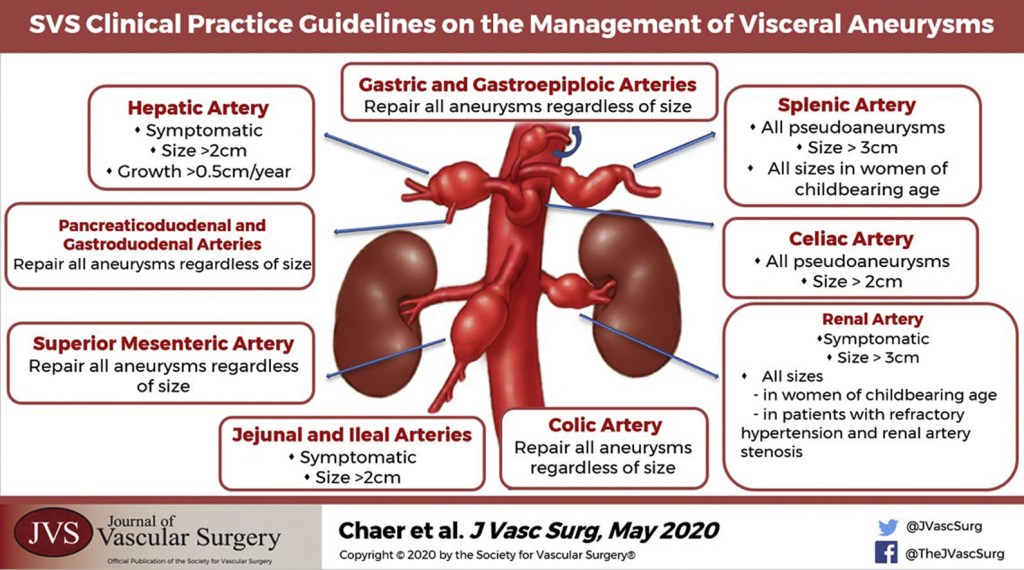
Graphical Abstract
Continue reading

Society for Vascular Surgery (SVS) Clinical Practice Guidelines on Popliteal Artery Aneurysms

“Popliteal artery aneurysms (PAAs) are the most common peripheral arterial aneurysms, defined as aneurysms outside the aortoiliac system or the brain, accounting for 70% of all peripheral arterial aneurysms. They are more common in men (95%) and tend to occur in the sixth and seventh decades of life. Few modern studies have been performed on the natural history of PAAs, and many of these were retrospective reviews of surgical patients. As such, the timing and details of PAA management remain nuanced.”

“These guidelines focus on PAA screening, indications for intervention, choice of repair strategy, management of asymptomatic and symptomatic PAAs (including those presenting with acute limb ischemia), and follow-up of both untreated and treated PAAs. They offer long-awaited evidence-based recommendations for physicians taking care of these patients.”

Continue reading

Splenic artery aneurysms: Comparing open and endovascular surgical modalities

Barrionuevo P, Malas MB, Nejim B, et al. A systematic review and meta-analysis of the management of visceral artery aneurysms. J Vasc Surg. 2019;70(5):1694–1699.

Full-text for Emory users.

“We included 33 case series of 523 splenic artery aneurysms treated with an endovascular approach and 22 series of 252 splenic artery aneurysms treated with open surgery. Short-term and long-term mortality rates were very low and not significantly different between the two interventions. Mortality was high for ruptured aneurysms treated with an open approach, with an event rate of 0.29 (95% CI, 0.04-0.71). End-organ infarction and gastrointestinal complications rates were not significantly different between the two approaches. The need for reintervention was lower for open surgery 0.00 (95% CI, 0.00-0.11) than for the endovascular approach 0.07 (95% CI, 0.01-0.17). The risk of access site complications for the endovascular approach was low at 0.02 (95% CI, 0.00-0.09). Rates of PES and coil migration were 0.38 (95% CI, 0.04-0.79) and 0.08 (95% CI, 0.00-0.24), respectively. Data were insufficient to identify a difference in mortality based on aneurysm size.”

Continue reading