
Advantages of routine intraoperative cholangiography in a teaching hospital

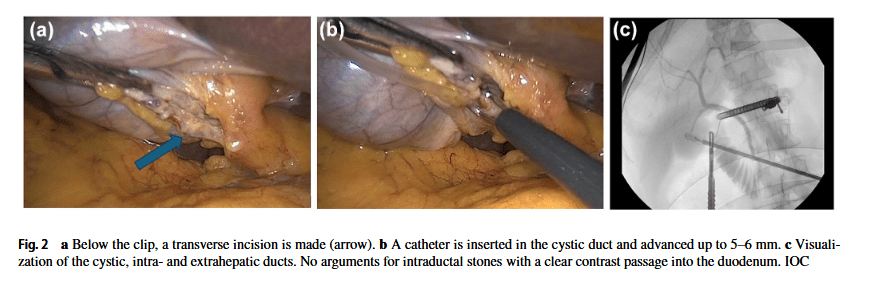
“The role of routine IOC during cholecystectomy has been controversial. Opponents to routine IOC assert that this procedure increases operating times and exposes caregivers and patients to radiation. In addition, there is the possibility of detection of indolent CBD stones with consequently unnecessary removal. On the other hand, advocates in favor
of routine IOC state that intraoperative visualization of the bile duct anatomy may decrease either the rate of complications such as CBD injury, or hospital readmissions for subsequent removal of retained CBD stones. Despite lacking strong evidence for not performing IOC vs. routine IOC vs. selective IOC, fitting in one of these three groups can depend on training, technical experience, and surgical habit. If a surgeon never performs IOC in their daily practice, they are not eager to change their habits, even though literature may suggest otherwise.”
Continue reading

T-Tubes

Dageforde LA, Lillemoe KD. (2020). Management of Acute Cholangitis. In: Cameron JL, Cameron AM (Eds), Current Surgical Therapy, 13th ed. Elsevier: Philadelphia.

“Recent literature advocates for primary closure of the common bile duct after elective CBDE because of complications from T-tube placement. But in patients with cholangitis, placement of a T-tube is necessary for biliary decompression and allows easy access for future cholangiogram if the obstruction does not resolve. T-tube drainage has been associated with bile leak and requires externalization of the tube for several days until postoperative cholangiography demonstrates resolution of obstruction. Primary closure can lead to stricture and bile leak and result in no direct access to the biliary tree for future investigations.”

Fig. 2. Insertion of a T-tube in the common bile duct with subsequent closure using absorbable monofilament suture (4-0 or 5-0). The T-tube is prepared in one of the ways shown. From: Zollinger RM, Jr, Zollinger RM. Atlas of Surgical Operations. 7th ed. New York: McGraw-Hill; 1993.

Continue reading