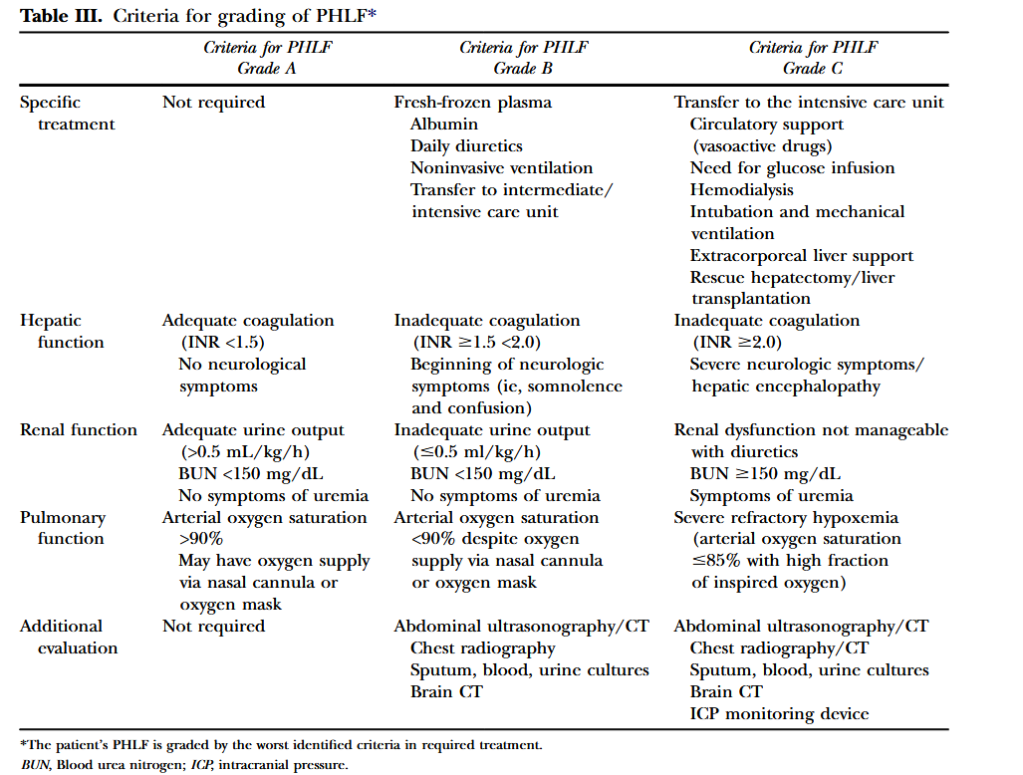
Posthepatectomy liver failure: A definition and grading by the International Study Group of Liver Surgery (ISGLS)

“Liver resection is used increasingly for the management of a variety of benign and malignant conditions. These data have paralleled substantial advances in perioperative management and operative techniques that have improved the safety of, and extended the indications for, liver resection over the past 2 decades. Extended liver resections, liver resections in diseased liver or liver parenchyma affected by chemotherapy, and repeat
or staged liver resections are being used to achieve curative resection and extend long-term survival. The resulting small functional remnant liver volumes and compromised liver function in these patients increase the risk for the development of posthepatectomy liver failure (PHLF). Despite the introduction of functional and imaging measures to assess preoperatively the size and function of the future liver remnant, as well as the use of
portal vein embolization as a preventive intervention, PHLF remains a major concern and has been shown to be a predominant cause of hepatectomy-related mortality.”
Continue reading

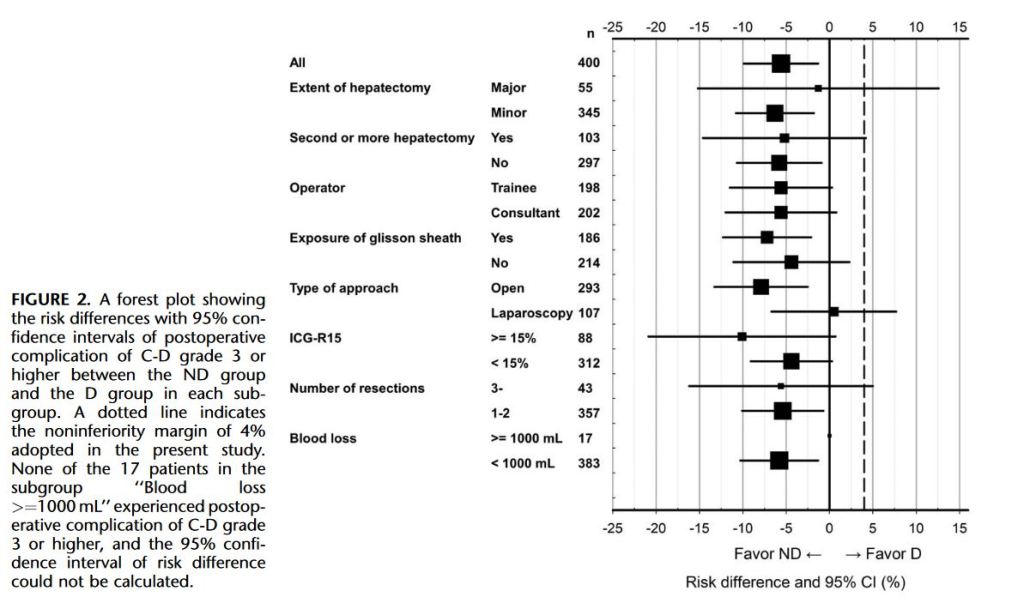
Drain Placement After Uncomplicated Hepatic Resection Increases Severe Postoperative Complication Rate

“Advances in surgical techniques and perioperative management over the last 2–3 decades have enabled the safe performance of hepatic resections. In the 1980s, when the perioperative mortality was reported to be as high as around 10%, drain placement was
considered to be necessary so as to provide information about intraabdominal adverse events promptly and for prophylactic drainage. However, as the necessity of drain placement in other surgical fields has been ruled out and as the incidence of life-threatening adverse
events after hepatic resection decreased, several randomized controlled trials (RCTs) were performed; the conclusions of these trials were that drain placement was not necessary. However, some of them lacked a primary endpoint and calculation of sample size; in
the other studies, the primary endpoint was the incidence of wound-related complication, most of which could be resolved using antibiotics or bed-side opening of the wound, corresponding to Clavien-Dindo (C-D) grade 11 2 or even 1.”

Continue reading

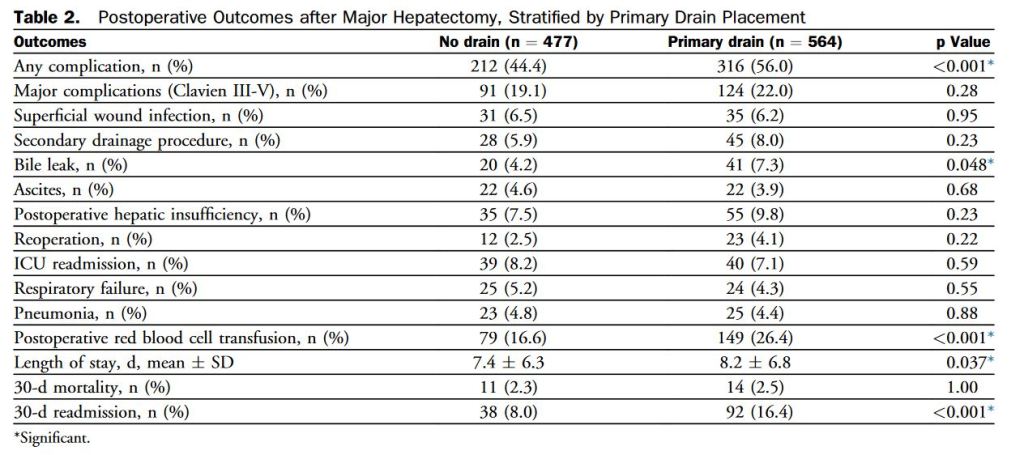
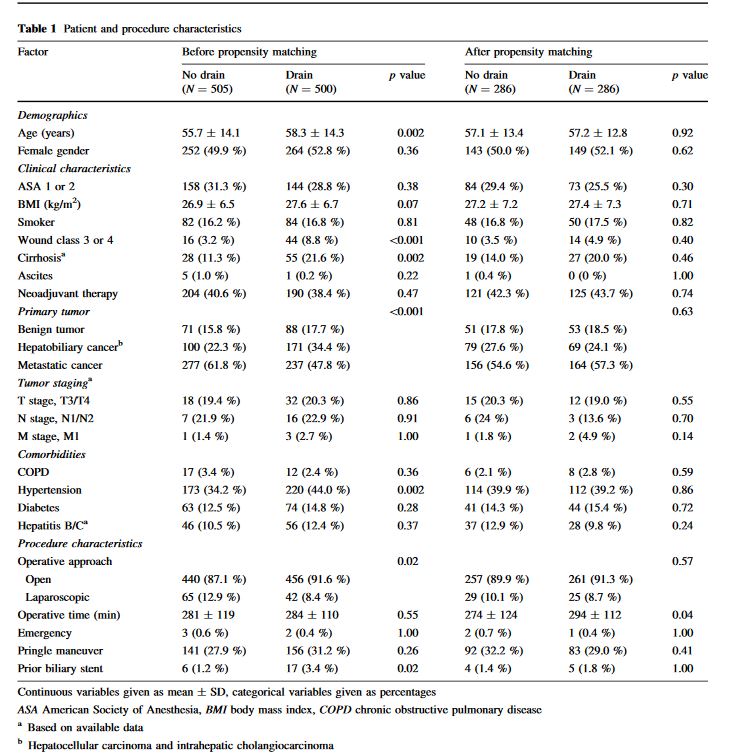
Value of primary operative drain placement after major hepatectomy

“Historically, prophylactic intraoperative peritoneal drain placement has been advocated after hepatectomy in order to identify and drain bile leaks and decrease the risk of potential perihepatic fluid collections and abscess formation postoperatively. Several small randomized trials have suggested, however, that routine abdominal drainage after elective liver resection may not be necessary.”

Continue reading

Role of Drain Placement in Major Hepatectomy

“The use of drains in surgery has been practiced for many years. Prophylactic drainage of the abdominal cavity is employed to prevent the formation of collections and abscesses and for early detection of complications. For years, there has been debate as to whether the use of prophylactic drains has more advantages than disadvantages. For many procedures such as routine colon resection, cholecystectomy, and appendectomy, the use of prophylactic drains has been abandoned as studies have shown that drains do not lower the rate of postoperative complications. However, there is still debate of whether to leave a drain routinely after major liver resection.”

Continue reading

Liver hanging maneuver: an anatomic and clinical review.

Gaujoux S, et al. Liver hanging maneuver: an anatomic and clinical review. Am J Surg. 2007 Apr;193(4):488-92.

Full-text for Emory users.

“LHM is as an effective and safe method of guiding hepatic transection to the IVC during right hepatectomies with a feasibility rate up to 95% and minor bleeding in 0% to 6% of cases. According to small series and experts’ opinions, LHM would improve parenchymal transection by reducing operative time and blood loss. The tape would ensure a linearly cut surface with IVC safer protection, better exposure, and hemostasis of the deeper plane. Limited remnant liver mobilization could reduce the risk for malignant dissemination and improve liver function. Hepatectomies for huge tumor with diaphragm adhesions could be facilitated.”

Glissonian approach during hepathectomy

Chapuis-Roux E, et al. Glissonian approach during hepathectomy (with video). J Visc Surg. 2015 Jun;152(3):199-200.

Full-text for Emory users.

“To facilitate liver resection, a technique of glissonian approach was developed [2]. The glissonian approach during hepatectomy is a selective vascular clamping procedure reproducible requiring preoperative imaging data study and intraoperative ultrasound Doppler [3] and permeability with US air test [4]. In practice, this approach is feasible in about 80% of patients due to portal anatomical abnormalities.”

Preoperative portal vein embolization for major liver resection

Rassam F, et al. Functional and volumetric assessment of liver segments after portal
vein embolization: Differences in hypertrophy response. Surgery. 2019 Apr;165(4):686-695.

Full-text for Emory users.

RESULTS: A total of 90 patients underwent portal vein embolization of the right liver. After 3 weeks, there was a significant increase in both volumetric and functional share of the future remnant liver (both P < .01). The increase in functional share exceeded the increase in volumetric share (P < .01). The median functional contribution of segment 4 after portal vein embolization was 41.5% (31.7%-48.7%) of the nonembolized lobe. Preoperative chemotherapy was not a significant predictor of the increase in function or volume. Compared with benign lesions, malignant diseases were significant negative predictors of the functional response.

Continue reading