High ileostomy output: A practical review of pathophysiology, causes,and management

“An estimated 100,000 surgical cases result in the creation of a stoma annually, of which approximately 40,000 are ileostomies. Given the truncation of the gastrointestinal (GI) tract and loss of the colon, ileocecal valve, and “ileal brake”, ileostomy patients are high risk for impaired sodium and water gastrointestinal absorption. Unsurprisingly, such alterations can lead to serious complications such as electrolyte derangements, dehydration, and acute kidney injury.”
“Though the definition of high-ileostomy output is debatable, it is typically recognized that a total ileostomy output exceeding 1.4 L per day has a potential of leading to such complications. An estimated 2030% of ileostomy patients experience high output in the early
postoperative period which imparts increases in morbidity, healthcare resource utilization, and length of inpatient stay.”

Continue reading

Decreasing Hospital Readmission in Ileostomy Patients

“Nearly 30% of patients with newly formed ileostomies require hospital readmission from severe dehydration or associated complications. This contributes to significant morbidity and rising healthcare costs associated with this procedure. The aim of this study was to design and pilot a novel program to decrease readmissions in this patient population.”

“Implementation of a novel program reduced the 30-day readmission rate by 58% and cost of readmissions per patient by >80% in a high risk for readmission patient population with newly created ileostomies. Future efforts will expand this program to a greater number of patients, both institutionally and systemically, to reduce the readmission-rate and healthcare
costs for this high-risk patient population.”

Continue reading

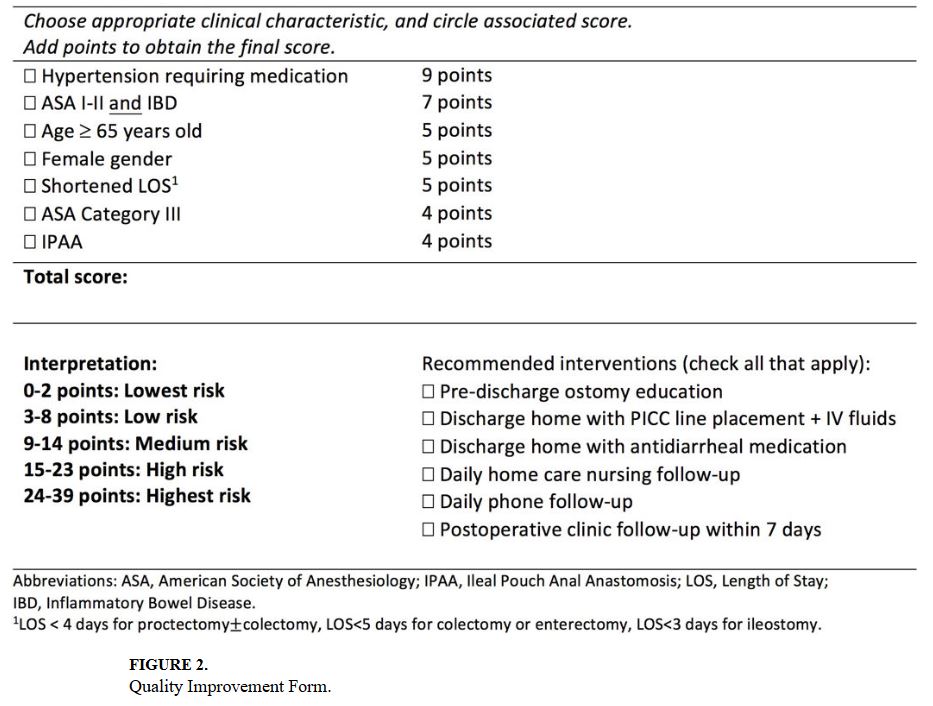
Predicting the Risk of Readmission From Dehydration After Ileostomy Formation

“Readmission within 30-days of hospital discharge has received widespread attention as a
potential healthcare quality indicator. In 2013, the Center for Medicare and Medicaid
Services established the Hospital Readmission Reduction Program (HRRP), a cost-
containment strategy that financially penalizes hospitals with higher than expected 30-day
readmission. Though conditions targeted by the HRRP have been predominately medical, it
is anticipated that readmission after surgical procedures will be used to structure financial
incentives and hospital compensation in the near future.”

Continue reading

Comparison of stapled versus handsewn loop ileostomy closure

“The purpose of this study was to compare the rates of small bowel obstruction, anastomotic complications, and wound infections between stapled and handsewn closures of loop ileostomies. The diverting loop ileostomy is a commonly used stoma, often employed to diminish the consequences of an anastomotic leak in low colorectal anastomoses, ileal pouch-anal anastomoses, and in situations where reversible patient factors increase the risk of an anastomotic dehiscence. They are also used to divert the fecal stream in the event of an anastomotic leak and, occasionally, in severe fistulizing perianal disease.”

Continue reading

The surgical management of purulent peritonitis from perforated diverticulitis

Oberkofler CE, et al. A multicenter randomized clinical trial of primary anastomosis or Hartmann’s procedure for perforated left colonic diverticulitis with purulent or fecal peritonitis. Ann Surg. 2012 Nov; 256(5):819-26; discussion 826-7.

Full-text for Emory users.

Results: Patient demographics were equally distributed in both groups (Hinchey III: 76% vs 75% and Hinchey IV: 24% vs 25%, for HP vs PA, respectively). The overall complication rate for both resection and stoma reversal operations was comparable (80% vs 84%, P = 0.813). Although the outcome after the initial colon resection did not show any significant differences (mortality 13% vs 9% and morbidity 67% vs 75% in HP vs PA), the stoma reversal rate after PA with diverting ileostomy was higher (90% vs 57%, P = 0.005) and serious complications (Grades IIIb-IV: 0% vs 20%, P = 0.046), operating time (73 minutes vs 183 minutes, P < 0.001), hospital stay (6 days vs 9 days, P = 0.016), and lower in-hospital costs (US $16,717 vs US $24,014) were significantly reduced in the PA group.

Conclusions: This is the first randomized clinical trial favoring PA with diverting ileostomy over HP in patients with perforated diverticulitis.


Thornell A, et al. Laparoscopic Lavage for Perforated Diverticulitis With Purulent Peritonitis: A Randomized Trial. Ann Intern Med. 2016 Feb 2;164(3):137-45.

Full-text for Emory users.

LL vs Hartmann

Continue reading

Considerations in stoma reversal

Sherman KL, Wexner SD. Considerations in Stoma Reversal. Clin Colon Rectal Surg. 2017 Jul;30(3):172-177.

Free full-text.

Temporary stomas are frequently used in the management of diverticulitis, colorectal cancer, and inflammatory bowel disease. These temporary stomas are used to try to mitigate septic complications from anastomotic leaks and to avoid the need for reoperation. Once acute medical conditions have improved and after the anastomosis has been proven to be healed, stomas can be reversed. Contrast enemas, digital rectal examination, and endoscopic evaluation are used to evaluate the anastomosis prior to reversal. Stoma reversal is associated with complications including anastomotic leak, postoperative ileus, bowel obstruction, enterocutaneous fistula, and, most commonly, surgical site infection. Furthermore, many stomas, which were intended to be temporary, may not be reversed due to postoperative complications, adjuvant therapy, or prohibitive comorbidities.

Decreasing hospital readmission in ileostomy patients: Results of novel pilot program

Shaffer VO, Owi T, Kumarusamy MA, Sullivan PS, Srinivasan JK, Maithel SK, Staley CA, Sweeney JF, Esper G. Decreasing Hospital Readmission in Ileostomy Patients: Results of Novel Pilot Program. J Am Coll Surg. 2017 Apr;224(4):425-430.

Full-text for Emory users.

BACKGROUND: Nearly 30% of patients with newly formed ileostomies require hospital readmission from severe dehydration or associated complications. This contributes to significant morbidity and rising healthcare costs associated with this procedure. Our aim was to design and pilot a novel program to decrease readmissions in this patient population.

STUDY DESIGN: An agreement was established with Visiting Nurse Health System (VNHS) in March 2015 that incorporated regular home visits with clinical triggers to institute surgeon-supervised corrective measures aimed at preventing patient decompensation associated with hospital readmissions. Thirty-day readmission data for patients managed with and without VNHS support for 10.5 months before and after implementation of this new program were collected.

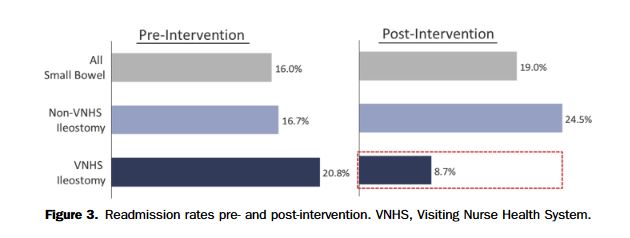
RESULTS: Of 833 patients with small bowel procedures, 162 were ileostomies with 47 in the VNHS and 115 in the non-VNHS group. Before program implementation, VNHS (n = 24) and non-VNHS patients (n = 54) had similar readmission rates (20.8% vs 16.7%). After implementation, VNHS patients (n = 23) had a 58% reduction in hospital readmission (8.7%) and non-VNHS patient hospital readmissions (n = 61) increased slightly (24.5%). Total cost of readmissions per patient in the cohort decreased by >80% in the pilot VNHS group.

CONCLUSIONS: Implementation of a novel program reduced the 30-day readmission rate by 58% and cost of readmissions per patient by >80% in a high risk for readmission patient population with newly created ileostomies. Future efforts will expand this program to a greater number of patients, both institutionally and systemically, to reduce the readmission-rate and healthcare costs for this high-risk patient population.