
Inter-Rater Agreement of the Classification of Intraoperative Adverse Events (ClassIntra) in Abdominal Surgery

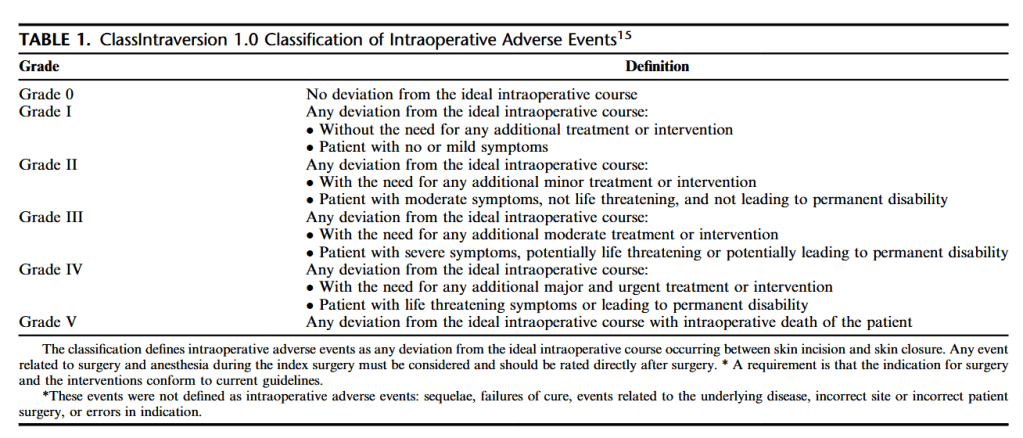
“In surgery, adverse events and medical errors occur pre-operatively, intraoperatively, and postoperatively. Standardized classification of postoperative complications, for example, using the Clavien-Dindo classification, is widely adopted, and has proven relevant to research and quality improvement programs. Prospectively validated classification systems for intraoperative adverse events (iAEs) are not yet broadly adopted. IAEs have a major impact at many levels. First, there is an association between iAEs and postoperative outcome. Second, hospital stays for patients experiencing iAEs are 40% more expensive compared with patients without iAEs. Third, readmission rates in patients whose surgery is
complicated by an iAE are twofold higher. Recently a promising new and practical classification system for iAEs was proposed, the classification of intraoperative complications (CLASSIC). CLASSIC defines iAEs as any deviation from the ideal intraoperative course occurring between skin incision and skin closure, irrespective of the origin (ie, surgical and anesthesiological difficulties, or technical failures). Compared with previous scores such as the severity score by Kaafarani et al. ClassIntra is more inclusive,
accounting for any type iAE, for example, surgical, anesthesiologic, and organizational, and can be graded directly after skin closure.”
Continue reading

Laparoscopic Entry Techniques and Injuries

“Recent reports by the Australian Safety and Efficacy Register for New interventions and Procedures (ASERNIP-S) and the Royal Australian and New Zealand College of Obstetricians and Gynaecologists (RANZCOG) concluded that insufficient evidence is available to assess the safety of the open versus closed laparoscopy in regard to major vascular and visceral injuries.” (Larobina & Nottle)

Major Vascular Injuries in Closed vs. Open Laparoscopy (Larobina & Nottle)

“Our case series shows that open laparoscopy can vastly reduce the incidence of access-related morbidity and mortality. Only a single visceral injury occurred in 5900 cases, and no major vascular injuries were reported.These figures are consistent with those of other reported series of open laparoscopy, which also show a zero rate of vascular injury and low rates of visceral injury.The literature review showed a rate of 1 injury to major retroperitoneal vessels per 2272 cases of closed laparoscopy procedures. This compares with a major vascular injury rate of 0 for the open technique. This difference is both statistically significant ( P = 0.003) and highly clinically significant.” (Larobina & Nottle)

Continue reading

Handsewn vs. stapled anastomoses in colon and rectal surgery

“Trials comparing handsewn with stapled anastomoses in colon and rectal surgery have not found statistical differences. Despite this, authors have differed in their conclusions as to which technique is superior. To help determine whether differences in patient outcomes are present, a meta-analysis of all trials was performed.”

Continue reading

The risk of injury to inferior epigastric artery (IEA) subjects during abdominal procedure

“The anatomical position of the inferior epigastric artery (IEA) subjects it to risk of injury during abdominal procedures that are close to the artery, such as laparoscopic trocar insertion, insertion of intra-abdominal drains, Tenckhoffâ catheter (peritoneal dialysis catheter) and paracentesis. This article aims to raise the awareness of the anatomical variations of the course of the IEA in relation to abdominal landmarks in order to define a safer zone for laparoscopic ancillary trocar placement. Methods of managing the IEA injury as well as techniques to minimise the risk of injury to the IEA are reviewed and discussed.”

Continue reading

Trocar injuries in laparoscopy

Nishimura M, et al. Complications Related to the Initial Trocar Insertion of 3 Different Techniques: A Systematic Review and Meta-analysis. J Minim Invasive Gynecol. 2019 Jan;26(1):63-70.

Emory users, request article via ILLiad.

This systematic review aimed to investigate complications related to initial trocar insertion among 3 different laparoscopic techniques: Veress needle (VN) entry, direct trocar entry (DTE), and open entry (OE). A literature search was completed, and complications were assessed. Major vessel injury, gastrointestinal injury, and solid organ injury were defined as major complications. Minor complications were defined as subcutaneous emphysema, extraperitoneal insufflation, omental emphysema, trocar site bleeding, and trocar site infection. Arm-based network meta-analyses were performed to identify the differences in complications among the 3 techniques. Seventeen studies were included in the quantitative analysis. DTE resulted in fewer major complications when compared with VN entry although the difference was not significant (p = .23) as well as significantly fewer minor complications (p < .001). There were no significant differences in minor complications when comparing OE and DTE (p = .74). Fewer major complications were observed with OE compared with VN entry although the difference was not significant (p = .31). There were significantly fewer minor complications for patients who underwent OE (p = .01). DTE patients experienced the least number of minor complications followed by VN entry and OE. In conclusion, major complications are extremely rare, and all 3 insertion methods can be performed without mortality.

Continue reading

Iatrogenic ureteral injury in colorectal cancer surgery

Andersen P, et al. Iatrogenic ureteral injury in colorectal cancer surgery: a nationwide study comparing laparoscopic and open approaches. Surg Endosc. 2015 Jun;29(6): 1406-12.

Full-text for Emory users.

Results: A total of 18,474 patients had a resection for colorectal cancer. Eighty-two ureteral injuries were related to colorectal surgery. The rate of ureteral injuries in the entire cohort was 0.44 %, with 37 (0.59 %) injuries in the laparoscopic group (n = 6,291) and 45 (0.37 %) injuries in the open group (n = 12,183), (P = 0.03). No difference in ureteral injury was found in relation to surgical approach in colon cancer patients. In rectum cancer patients (n = 5,959), the laparoscopic approach was used in 1,899 patients, and 19 (1.00 %) had ureteral injuries, whereas 17 (0.42 %) of 4,060 patients who underwent an open resection had a ureteral injury. In multivariate analysis adjusted for age, gender, ASA score, BMI, tumor stage, preoperative chemo-radiation, calendar year, and specialty of the surgeon, the laparoscopic approach was associated with an increased risk of ureteral injury, OR = 2.67; 95 % CI 1.26-5.65.

Conclusion: In this nationwide study laparoscopic surgery for rectal cancer with curative intent was associated with a significantly increased risk of iatrogenic ureteral injury compared to open surgery.

Continue reading

Rate of postoperative biliary complications during major liver resection reduced by intraoperative air leak test

Zimmitti G, Vauthey JN, et al. Systematic use of an intraoperative air leak test
at the time of major liver resection reduces the rate of postoperative biliary
complications. J Am Coll Surg. 2013 Dec;217(6):1028-37.

Free full-text.

STUDY DESIGN: Rates of postoperative biliary complications were compared among 103 patients who underwent ALT and 120 matched patients operated on before ALT was used. All study patients underwent major hepatectomy without bile duct resection at 3 high-volume hepatobiliary centers between 2008 and 2012. The ALT was performed by placement of a transcystic cholangiogram catheter to inject air into the biliary tree, the upper abdomen was filled with saline, and the distal common bile duct was manually occluded. Uncontrolled bile ducts were identified by localization of air bubbles at the transection surface and were directly repaired.

RESULTS: The 2 groups were similar in diagnosis, chemotherapy use, tumor number and size, resection extent, surgery duration, and blood loss (all, p > 0.05). Single or multiple uncontrolled bile ducts were intraoperatively detected and repaired in 62.1% of ALT vs 8.3% of non-ALT patients (p < 0.001). This resulted in a lower rate of postoperative bile leaks in ALT (1.9%) vs non-ALT patients (10.8%; p = 0.008). Independent risk factors for postoperative bile leaks included extended hepatectomy (p = 0.031), caudate resection (p = 0.02), and not performing ALT (p = 0.002) (odds ratio = 3.8; 95% CI, 1.3-11.8; odds ratio = 4.0; 95% CI, 1.1-14.3; and odds ratio = 11.8; 95% CI, 2.4-58.8, respectively).


More forthcoming…