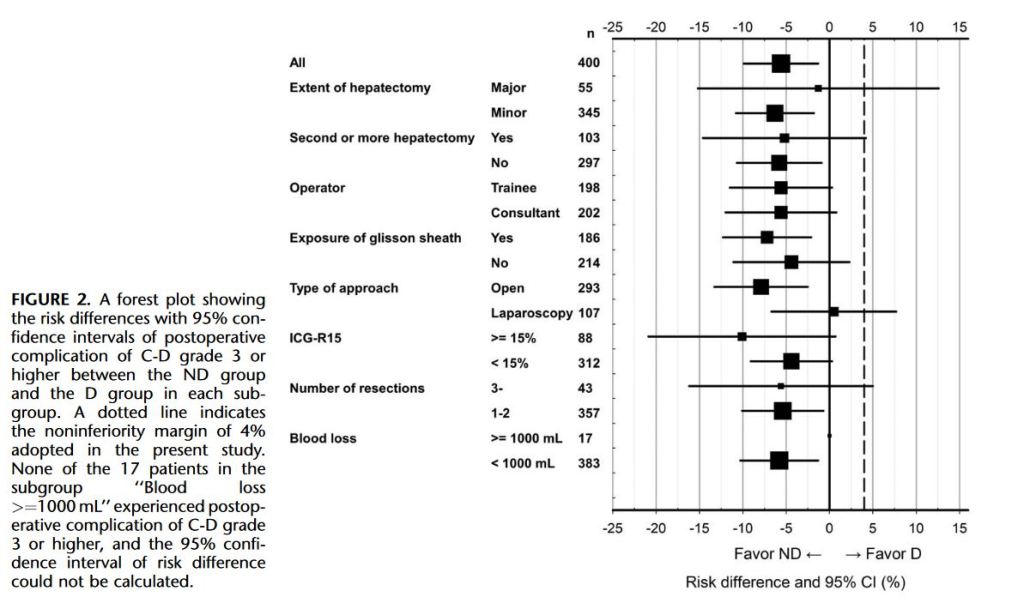
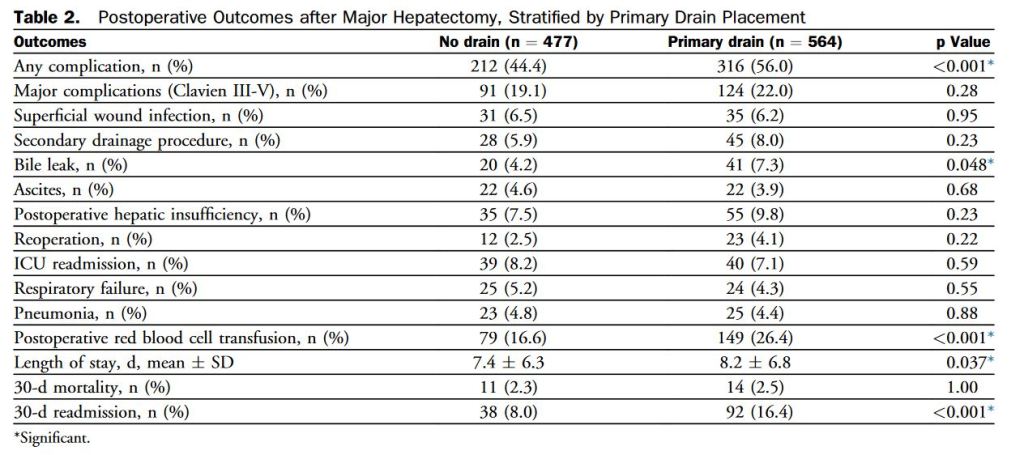
Drain Placement After Uncomplicated Hepatic Resection Increases Severe Postoperative Complication Rate

“Advances in surgical techniques and perioperative management over the last 2–3 decades have enabled the safe performance of hepatic resections. In the 1980s, when the perioperative mortality was reported to be as high as around 10%, drain placement was
considered to be necessary so as to provide information about intraabdominal adverse events promptly and for prophylactic drainage. However, as the necessity of drain placement in other surgical fields has been ruled out and as the incidence of life-threatening adverse
events after hepatic resection decreased, several randomized controlled trials (RCTs) were performed; the conclusions of these trials were that drain placement was not necessary. However, some of them lacked a primary endpoint and calculation of sample size; in
the other studies, the primary endpoint was the incidence of wound-related complication, most of which could be resolved using antibiotics or bed-side opening of the wound, corresponding to Clavien-Dindo (C-D) grade 11 2 or even 1.”

Continue reading

Value of primary operative drain placement after major hepatectomy

“Historically, prophylactic intraoperative peritoneal drain placement has been advocated after hepatectomy in order to identify and drain bile leaks and decrease the risk of potential perihepatic fluid collections and abscess formation postoperatively. Several small randomized trials have suggested, however, that routine abdominal drainage after elective liver resection may not be necessary.”

Continue reading

Postoperative atrial fibrillation: Predictors and risk of mortality

“Atrial fibrillation, the most common sustained dysrhythmia, is a common postoperative complication. Previous studies have shown that the incidence, prevalence, and associated morbidity and mortality increase progressively with age.
Development of POAF and mortality is dependent upon a wide range of factors not limited to age and medical comorbidities. Although a patient may be at an increased risk for POAF this does not mean they are at an increased risk for mortality.”

Continue reading

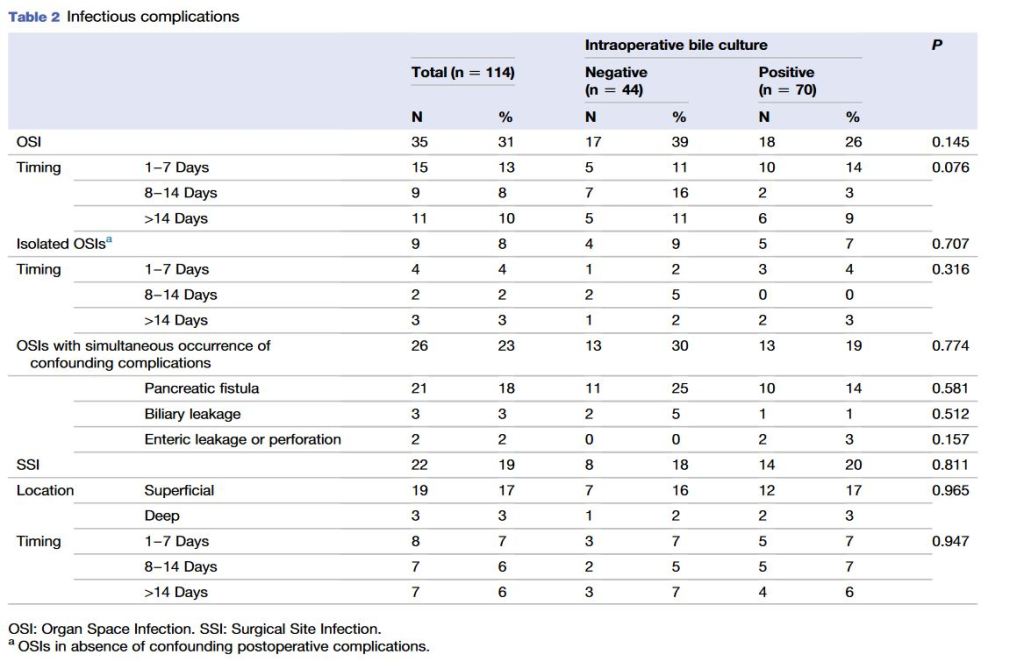
Association between positive intra-operative bile cultures during Whipple procedures and subsequent organ space infections

“The association between intraoperative bile cultures and infectious complications after
pancreatoduodenectomy remains unclear. Pancreatoduodenectomy remains a complex and technically demanding procedure with high rates of morbidity (25–52%) and mortality (1–3%). Infectious complications, such as surgical site infections (SSIs) and organ space infections (OSIs), are reported as the most common complications following pancreatoduodenectomy besides pancreatic fistula and delayed gastric emptying.”

Continue reading

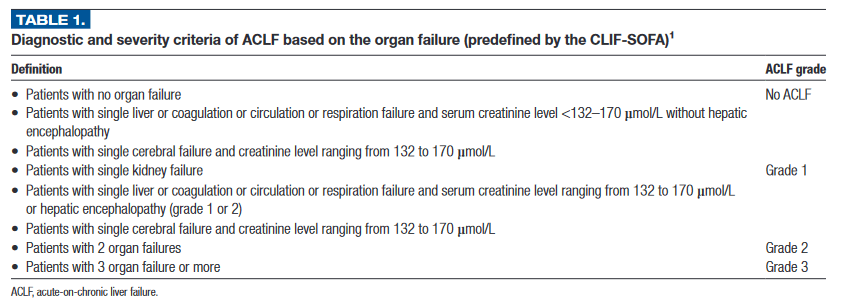
Liver Transplantation in Acute-on-chronic Liver Failure

“Liver transplantation (LT) has revolutionized the treatment of cirrhotic patients. However, access to transplant is limited as demand for organs exceeds availability. Current allocation gives the highest priority to patients with the highest mortality risk. Hence, several
patients awaiting LT may deteriorate while waiting for LT.”

Continue reading

Life-threatening pelvis sepsis

“Although extremely uncommon, severe sepsis does occur post-treatment for haemorrhoids and all surgeons who treat such patients should be aware of the potential complications and alert to their presenting features. Early presentation without evidence of tissue necrosis may be managed conservatively, although most cases are managed by means of surgery.”

“Treatments for haemorrhoids can be divided in to conservative measures such as anal hygiene and topical ointments or suppositories, and interventions.

These are either office-based such as:
-injection sclerotherapy
-rubber band ligation (RBL)
-surgical procedures.

Haemorrhoidectomy has long been the mainstay of surgical therapy, but recently new techniques have been described, principally the stapled haemorrhoidopexy or procedure for prolapsing haemorrhoids (PPH).”

Continue reading

Incidence of problematic common bile duct calculi in patients undergoing laparoscopic cholecystectomy.

“Choledocholithiasis occurs in 3.4% of patients undergoing laparoscopic cholecystectomy but more than one third of these pass the calculi spontaneously within 6 weeks of operation and may be spared endoscopic retrograde cholangiopancreatography.” (Collins)

(Collins)
Continue reading