
Surgical management of Crohn’s Disease

One discussion this week involved the surgical management of Crohn’s Disease.

Reference: Strong S, et al. Clinical practice guideline for the surgical management of Crohn’s Disease. Diseases of the Colon and Rectum. 2015 Nov;58(11):1021-1036. doi:10.1097/DCR.0000000000000450

Summary: The authors state “these guidelines should not be deemed inclusive of all proper methods of care or exclusive of methods of care reasonably directed to obtaining the same results. The ultimate judgment regarding the propriety of any specific procedure must be made by the physician in light of all the circumstances presented by the individual patient” (p.1021).

OPERATIVE INDICATIONS

Failed Medical Therapy

  1. Patients who demonstrate an inadequate response to, develop complications from, or are noncompliant with medical therapy should be considered for surgery. Grade of Recommendation: Strong  based on low-or very low-quality evidence, 1C.
  2. Patients receiving therapy with anti-TNFs, high-dose glucocorticoids and/or cyclosporine may warrant staged procedures because of concerns about postoperative complications; however, decisions should be individualized based on the patient’s risk stratification, overall clinical status, and surgeon judgment. Grady of Recommendation: Weak based on low- or very low-quality evidence, 2C.

Inflammation

  1. Patient with acute colitis who have symptoms or signs of impending or actual perforation should typically undergo surgery. Grade of Recommendation: Strong based on low- or very low-quality evidence, 1C.

Stricture

  1. Endoscopic dilation may be considered for patients with symptomatic small-bowel or anastomotic strictures that are not amenable to medical therapy. Grade of Recommendation: Strong based on low- or very low-quality evidence, 1C.
  2. Surgery is indicated for patients with symptomatic small-bowel or anastomotic strictures that are not amenable to medical therapy and/or dilation. Grade of Recommendation: Strong based on low- or very low-quality evidence, 1C.
  3. Patients with strictures of the colon that cannot be adequately surveyed endoscopically should be considered for resection. Grade of Recommendation: Strong based on low- or very-low quality evidence, 1C.

Penetrating Disease

  1. Patients with a free perforation should undergo surgery. Grade of Recommendation: Strong based on moderate-quality evidence, 1B.
  2. Patients with enteroparietal, interloop, intramesenteric, or retroperitoneal abscesses may be managed by antibiotics with or without percutaneous drainage. Surgical drainage with or without resection should be considered when this is not successful. Grade of Recommendation: Weak based on moderate-quality evidence, 2B.
  3. Patients with enteric fistulas and symptoms or signs of localized or systemic sepsis that persist despite appropriate medical therapy should be considered for surgery. Grade of Recommendation: Strong based on low- or very low-quality evidence, 1C.

Hemorrhage

  1. Stable patients with significant GI heomrrhage may be evaluated and treated by endoscopic and/or interventional radiological techniques. Unstable patients should typically undergo operative exploration. Grade of Recommendation: STrong based on low- or very low-quality evidence, 1C.

Growth Retardation

  1. Prepubertal patients with significant growth retardation despite appropriate medical therapy should be considered for surgery. Grade of Recommendation: STrong based on moderate-quality evidence, 1B.

Neoplasia

  1. Patients with long-standing Crohn’s disease of the ileocolic region or colon should have endoscopic surveillance of the large bowel. Grade of Recommendation: Strong based on moderate-quality evidence, 1B.
  2. Total proctocolectomy should be considered for patients with carcinoma, a nonadenoma-like dysplasi-associated lesion or mass (DALM), high-grade dysplasia, or multifocal low-grade dysplasia of the colon or rectum. Grade of Recommendation: Strong based on moderate-quality evidence, 1B.
  3. Suspicious lesions (mass, ulcer) identified in patients with Crohn’s should typically be biopsied, especially when considering a small-bowel strictureplasty. Grade of Recommendation: Strong based on low- or very low-quality evidence.

For complete guidelines (site-specific operations, technical considerations), methodologies, and definition of GRADE system-grading recommendations, see full text article.
Endovascular repair vs open repair for ruptured abdominal aortic aneurysm

One discussion this week included open vs endovascular repair for ruptured AAA.

Reference: IMPROVE trial investigators. Comparative clinical effectiveness and cost effectiveness of endovascular strategy v open repair for ruptured abdominal aortic aneurysm: three year results of the IMPROVE randomised trial. BMJ. 2017 Nov 14;359:j4859. doi: 10.1136/bmj.j4859

Trial registration: Current controlled trials ISRCTN48334791; ClinicalTrials NCT00746122.

Summary: Involving 30 vascular centers – 29 in UK, one in Canada – and 613 patients between 2009 and 2016, the IMPROVE trial is the first RCT comparing keyhole endovascular aneurysm repair to the traditional open surgery with comprehensive mid-term outcomes. The primary outcome was mortality; secondary outcomes included reinterentions, quality of life, resource use, consts, quality adjusted life year (QALYs), and cost effectiveness.

The data analyses showed endovascular repair “offers no significant reduction in operative mortality at 30 or 90 days, but there is an interim midterm survival advantage (3 months to 3 years), that when taken together with the early gains in QoL, leads to a mid-term gain in QALYs after 3 years.

  • Mortality: 179 deaths in endovascular group, 183 in open repair, with similar results for mortality related to aneurysm
    • Of the 502 patients treated for confirmed rupture, mortality at 3 years: 109/259 (42%) in endovascular, 131/243 (54%) in open repair
  • Reinterventions related to aneurysm: occured at similar rate in both groups, especially those for life threatening conditions.
  • Cost differences at 30 days: “not erorded by an increased burden of reinterventions in later follow-up and therefore the endovascular strategy is cost effective” (p.7).

The authors conclude that at three years, the endovascular repair “offers an increase in QALYs, without an excess of reinterventions, and is cost effective” (p.9). The IMPROVE trial mid-term follow-up supports the benefits of endvascular vs open repair to treat ruptured AAA.

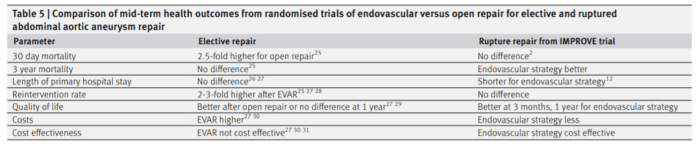
Table 5 (p.8) compares the mid-term outcomes from multiple RCTs of endovascular vs open repair for AAA, including the IMPROVE trial.

improve table 5

Additional reading: Bjorck M. Endovascular or open repair for ruptured abdominal aortic aneurysm? BMJ. 2017;359:j5170. doi:10.1136/bmj.j5170.

Laparoscopic sleeve gastrectomy vs laparoscopic Roux-en-Y gastric bypass on weight loss: Two RCTs

A discussion in December included gastric bypass versus sleeve gastrectomy.

References: Peterli R, et al. Effect of laparoscopic sleeve gastrectomy vs laparoscopic Roux-en-Y gastric bypass on weight loss patients with morbid obesity: the SM-BOSS randomized clinical trial. JAMA. 2018 Jan 16;319(3):255-265. doi:10.1001/jama.2017.20897

Salminen P, et al. Effect of laparoscopic sleeve gastrectomy vs laparoscopic Roux-en-Y gastric bypass on weight loss at 5 years among patients with morbid obesity: the SLEEVEPASS randomized clinical trial. JAMA. 2018 Jan 16;319(3):241-254. doi:10.1001/jama.2017.20313

Summary: Published in the same issue of JAMA, these two trials – one in Switzerland, one in Finland – provide thorough insight into comparing the sleeve and gastric bypass for weight loss in morbidly obese patients. To be consice, the study designs, results, and conclusions are quoted below.

SM-BOSS trial – clinicaltrials.gov Identifier: NCT00356213

DESIGN, SETTING, AND PARTICIPANTS: The Swiss Multicenter Bypass or Sleeve Study (SM-BOSS), a 2-group randomized trial, was conducted from January 2007 until November 2011 (last follow-up in March 2017). Of 3971 morbidly obese patients evaluated for bariatric surgery at 4 Swiss bariatric centers, 217 patients were enrolled and randomly assigned to sleeve gastrectomy or Roux-en-Y gastric bypass with a 5-year follow-up period.

RESULTS: Among the 217 patients (mean age, 45.5 years; 72% women; mean BMI, 43.9) 205 (94.5%) completed the trial. Excess BMI loss was not significantly different at 5 years: for sleeve gastrectomy, 61.1%, vs Roux-en-Y gastric bypass, 68.3% (absolute difference, −7.18%; 95% CI, −14.30% to −0.06%; P = .22 after adjustment for multiple comparisons). Gastric reflux remission was observed more frequently after Roux-en-Y gastric bypass (60.4%) than after sleeve gastrectomy (25.0%). Gastric reflux worsened (more symptoms or increase in therapy) more often after sleeve gastrectomy (31.8%) than after Roux-en-Y gastric bypass (6.3%). The number of patients with reoperations or interventions was 16/101 (15.8%) after sleeve gastrectomy and 23/104 (22.1%) after Roux-en-Y gastric bypass.

CONCLUSIONS AND RELEVANCE: Among patients with morbid obesity, there was no significant difference in excess BMI loss between laparoscopic sleeve gastrectomy and laparoscopic Roux-en-Y gastric bypass at 5 years of follow-up after surgery.

SLEEVEPASS trial – clinicaltrials.gov Identifier: NCT00793143

DESIGN, SETTING, AND PARTICIPANTS: The Sleeve vs Bypass (SLEEVEPASS) multicenter, multisurgeon, open-label, randomized clinical equivalence trial was conducted from March 2008 until June 2010 in Finland. The trial enrolled 240 morbidly obese patients aged 18 to 60 years, who were randomly assigned to sleeve gastrectomy or gastric bypass with a 5-year follow-up period (last follow-up, October 14, 2015).

RESULTS: Among 240 patients randomized (mean age, 48 [SD, 9] years; mean baseline body mass index, 45.9, [SD, 6.0]; 69.6% women), 80.4% completed the 5-year follow-up. At baseline, 42.1% had type 2 diabetes, 34.6% dyslipidemia, and 70.8% hypertension. The estimated mean percentage excess weight loss at 5 years was 49% (95% CI, 45%-52%) after sleeve gastrectomy and 57% (95% CI, 53%-61%) after gastric bypass (difference, 8.2 percentage units [95% CI, 3.2%-13.2%], higher in the gastric bypass group) and did not meet criteria for equivalence. Complete or partial remission of type 2 diabetes was seen in 37% (n = 15/41) after sleeve gastrectomy and in 45% (n = 18/40) after gastric bypass (P > .99). Medication for dyslipidemia was discontinued in 47% (n = 14/30) after sleeve gastrectomy and 60% (n = 24/40) after gastric bypass (P = .15) and for hypertension in 29% (n = 20/68) and 51% (n = 37/73) (P = .02), respectively. There was no statistically significant difference in QOL between groups (P = .85) and no treatment-related mortality. At 5 years the overall morbidity rate was 19% (n = 23) for sleeve gastrectomy and 26% (n = 31) for gastric bypass (P = .19).

CONCLUSIONS AND RELEVANCE: Among patients with morbid obesity, use of laparoscopic sleeve gastrectomy compared with use of laparoscopic Roux-en-Y gastric bypass did not meet criteria for equivalence in terms of percentage excess weight loss at 5 years. Although gastric bypass compared with sleeve gastrectomy was associated with greater percentage excess weight loss at 5 years, the difference was not statistically significant, based on the prespecified equivalence margins.

Early versus delayed cholecystectomy

A discussion in December compared early versus delayed cholecystectomy.


References: Ackerman J, et al. Beware of the interval cholecystectomy. The Journal of Trauma and Acute Care Surgery. 2017 Jul;83(10):55-60. Full-text for Emory users.

Gurusamy KS, Davidson C, Gludd C, Davidson BR. Early versus delayed laparoscopic cholecystectomy for people with acute cholecystitis (Review). Cochrane Database of Systematic Reviews. 2013 Jun 30;(6):CD005440. Full-text for Emory users.

Summary: Cochrane’s review on early vs delayed cholecystectomy included 6 trials and 488 individuals. Of those, 244 received laparoscopic cholecystectomy early (within 7 days of presentation), while the remaining 244 received it at least 6 weeks after index admission with acute cholecystitis. The primary conclusion is that “based on information from a varied number of participants as well as trials at high risk of bias, early laparoscopic cholecystectomy during acute cholecystitis appears safe and shortens the total hospital stay [by 4 days]” (p.2).

There was no significant difference in operating time. Only one of the trials measured time to return to work, nothing that patients in the early group returned to work an average of 11 days earlier than the delayed group. Four trials did not report any gallstone-related complications; one trial reported five, including two people with cholangitis. In five trials, one-sixth of people in the delayed group had either non-resolution or recurrence of symptoms before their planned operation and had to have emergency laparoscopic cholecystectomy (p.6).

Using the terms immediate and interval, Ackerman et al (2017) conducted a retrospective cohort analysis to quantify the morbidity and mortality associated with a delayed, or interval cholecystectomy (IC). Of all patients admitted to 7 hospitals within the same healthcare system, 337 had percutaneous cholecystostomy (PC), 177 (52.5%) of those also had an interval cholecystectomy (IC). The table below illustrates the outcomes:

ic outcomes

(Ackerman et al, 2017, p.57)

Simultaneous vs staged colorectal and hepatic resections

One discussion this week involved the comparison of simultaneous and staged resections of colorectal cancer and synchronous colorectal liver metastases (SCRLM).


Reference: Reddy SK, et al. Simultaneous resections of colorectal cancer and synchronous liver metastases: a multi-institutional analysis. Annals of Surgical Oncology. 2007 Dec;14(12):3481-3491. doi:10.1245/s10434-007-9522-5

Summary: In a retrospective study of 610 patients at three institutions between 1985 and 2006, the authors compared postoperative morbidity and mortality after simultaneous and staged resections of colorectal cancer and SCRLM.

Continue reading

Neoadjuvant chemotherapy for initially unresectable intrahepatic cholangiocarcinoma

One discussion this week included using chemotherapy to enable initially unresectable intrahepatic cholangiocarcinoma (ICC) to be resectable.


Reference: Le Roy B, et al. Neoadjuvant chemotherapy for initially unresectable intrahepatic cholangiocarcinoma. The British Journal of Surgery. 2018 Jun;105(7):839-847. doi: 10.1002/bjs.10641

Summary: Surgical resection is the standard treatment for ICC, with a 5-year survival rate of 25-35% for those presenting with potentially resectable disease. Those with initially unresectable ICC are treated with chemotherapy alone and have a poor prognosis (p.839). The strategy of conversion to secondary resectability through chemotherapy regimens has resulted in good long-term survival for other tumors (colorectal liver and neuroendocrine liver metastases).  The authors state there is no published data on the use of neoadjuvant chemotherapy to achieve secondary resectability in locally advanced ICC.

Continue reading

Small bowel obstruction: clinical and radiographic predictors for surgical intervention

One discussion this week included the clinical and radiographic signs for operation or nonoperation in the setting of adhesive small bowel obstruction (ASBO).


Reference: Kulvatunyou N, et al. A multi-institution prospective observational study of small bowel obstruction: Clinical and computerized tomography predictors of which patients may require early surgery. The Journal of Trauma and Acute Care Surgery. 2015. 79(3);393-398. doi:10.1079/TA.0000000000000759.

Summary: The absence of flatus and the CT finding of free fluid and high-grade obstruction have been identified by Kulvatunyou et al (2015) as predictors that early operative intervention would be beneficial. This prospective observational study involved 200 patients at three academic and tertiary referral medical centers; 148 in the nonoperative group, 52 in the operative group.

Clinical signs: The only clinical sign identified as a predictor for surgical intervention, “no flatus” was listed in 58% of the operative group, 34% of the nonoperative group. Too large to include here, Table 3 in the text (p.397) lists the univariate analysis of all clinical signs.

CT findings: Individual CT signs listed include transition point, free fluid, multiple fluid locations, small bowel fecalization, mesenteric edema, closed loop, and high-grad obstruction. All had low PPVs, ranging 21-41%. Using the three predictors identified, the PPV improved but remained low at 37-56% (p.397).

The table below (p.397) illustrates the utility of the three variables in a few combinations.

predictors

In the article, the authors state that they are currently (2015) pursuing a study applying the predictors to a different ASBO patient population so as to cross-validate this predictor model. A search for such a study in the published literature was not successful.

Additional Reading: Catena F, et al. Bologna guidelines for diagnosis and management of adhesive small bowel obstruction (ASBO): 2010 evidence-based guidelines of the World Society of Emergency Surgery. World Journal of Emergency Surgery. 2011 Jan 21;6:5. doi: 10.1186/1749-7922-6-5.