Janeway Gastrostomy

Gastrostomy. Ellison E, & Zollinger R.M., Jr.(Eds.), (2016). Zollinger’s Atlas of Surgical Operations, 10e. McGraw-Hill. Emory login required.

“As a temporary gastrostomy, the Witzel or the Stamm procedure is used frequently and is easily performed. A permanent type of gastrostomy, such as the Janeway and its variations, is best adapted to patients in whom it is essential to have an opening into the stomach for a prolonged period of time. Under these circumstances, the gastric mucosa must be anchored to the skin to ensure long-term patency of the opening. Furthermore, the construction of a mucosa-lined tube with valve-like control at the gastric end tends to prevent the regurgitation of the irritating gastric contents. This allows periodic intubation and frees the patient from the irritation of a constant indwelling tube.”

Continue reading →

Article of interest: Randomized placebo-controlled study of intravenous methylnaltrexone in postoperative ileus.

Viscusi ER, Rathmell JP, Fichera A, et al. Randomized placebo-controlled study of intravenous methylnaltrexone in postoperative ileus. J Drug Assess. 2013 Aug 27; 2(1):127-34.

Results: A total of 65 patients (methylnaltrexone, n = 33; placebo, n = 32) were randomized. Mean time to first bowel movement was accelerated by 20 h (p = 0.038) and time to discharge eligibility was accelerated by 33 h (p = 0.049) with methylnaltrexone vs placebo. Opioid use was similar between groups until postoperative day 4, then fluctuated in the placebo group. Methylnaltrexone was generally well tolerated.

Conclusions: In this study, intravenous methylnaltrexone significantly decreased time to postoperative bowel recovery and eligibility for hospital discharge by ∼1 d, with an adverse event profile similar to placebo. These were two of several exploratory endpoints; not all efficacy endpoints showed a significant difference between methylnaltrexone and placebo. The efficacy results in this trial were not seen in two subsequent large-scale studies.

Continue reading →

Ileal pouch-anal anastomosis (IPAA) for familial adenomatous polyposis (FAP) patients

Xie M, et al. Does ileoanal pouch surgery increase the risk of desmoid in patients with familial adenomatous polyposis? Int J Colorectal Dis. 2020 Aug;35(8):1599-1605.

Full-text for Emory users.

Results: Eight retrospective studies with a total of 1072 patients were identified: 491 underwent IPAA and 581 IRA. There was no significant difference in the incidence of DTs between IPAA and IRA (11.81% vs. 9.47%, OR 0.95, P = 0.85). Meanwhile, the overall complication (42.97% vs. 36.76%, OR 1.32, P = 0.11), incidence of cancer (4.88% vs. 8.37%, OR 0.28, P = 0.26), and overall mortality (0.33% vs. 5.20%, OR 0.49, P = 0.53) were comparable too.

Conclusion: Ileoanal pouch surgery is associated with similar risk of desmoid in patients with FAP after surgery.


Ng KS, Gonsalves SJ, Sagar PM. Ileal-anal pouches: A review of its history, indications, and complications. World J Gastroenterol. 2019 Aug 21;25(31):4320-4342.

As the IPAA celebrated its 40th anniversary in 2018, this review provides a timely outline of its history, indications, and complications. IPAA has undergone significant modification since 1978. For both UC and FAP, IPAA surgery aims to definitively cure disease and prevent malignant degeneration, while providing adequate continence and avoiding a permanent stoma. The majority of patients experience long-term success, but “early” and “late” complications are recognised. Pelvic sepsis is a common early complication with far-reaching consequences of long-term pouch dysfunction, but prompt intervention (either radiological or surgical) reduces the risk of pouch failure. Even in the absence of sepsis, pouch dysfunction is a long-term complication that may have a myriad of causes. Pouchitis is a common cause that remains incompletely understood and difficult to manage at times. 10% of patients succumb to the diagnosis of pouch failure, which is traditionally associated with the need for pouch excision. This review provides a timely outline of the history, indications, and complications associated with IPAA. Patient selection remains key, and contraindications exist for this surgery. A structured management plan is vital to the successful management of complications following pouch surgery.

Continue reading →

Adhesiolysis-related morbidity in abdominal surgery

ten Broek RP, et al. Adhesiolysis-related morbidity in abdominal surgery. Ann Surg. 2013 Jul;258(1):98-106. 

Full-text for Emory users.

Results: A total of 755 (out of 844) surgeries in 715 patients were included. Adhesiolysis was required in 475 (62.9%) of operations. Median adhesiolysis time was 20 minutes (range: 1-177). Fifty patients (10.5%) undergoing adhesiolysis inadvertently incurred bowel defect, compared with 0 (0%) without adhesiolysis (P < 0.001). In univariate and multivariate analyses, adhesiolysis was associated with an increase of sepsis incidence [odds ratio (OR): 5.12; 95% confidence interval (CI): 1.06-24.71], intra-abdominal complications (OR: 3.46; 95% CI: 1.49-8.05) and wound infection (OR: 2.45; 95% CI: 1.01-5.94), longer hospital stay (2.06 ± 1.06 days), and higher hospital costs [$18,579 (15,204-21,954) vs $14,063 (12,471-15,655)]. Mortality after adhesiolysis complicated by a bowel defect was 4 out of 50 (8%), compared with 7 out of 425 (1.6%) after uncomplicated adhesiolysis (OR: 5.19; 95% CI: 1.47-18.41).

Continue reading →

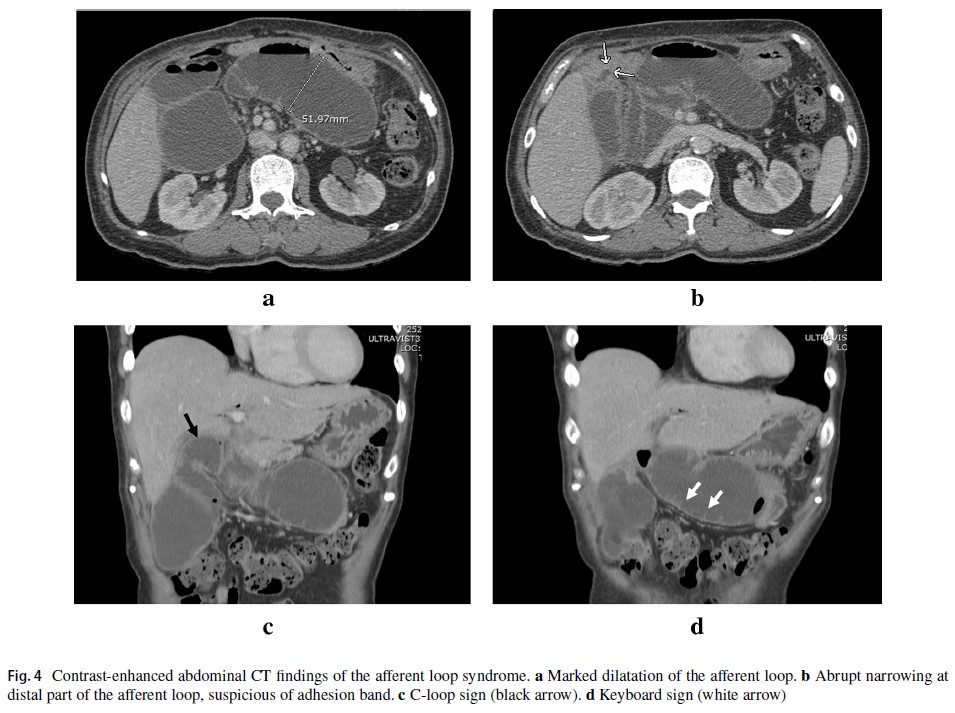
Afferent loop syndrome

Termsinsuk P, Chantarojanasiri T, Pausawasdi N. Diagnosis and treatment of the afferent loop syndrome. Clin J Gastroenterol. 2020 Oct;13(5):660-668.

“ALS is a rare condition with the incidence ranging from 0.2 to 1.0% depending on the type of operation and anastomotic limb reconstruction. ALS has been reported in 0.3–1.0% of patients after total gastrectomy with Billroth II or Roux-en-Y reconstruction, 1% after laparoscopic distal gastrectomy with Billroth II reconstruction, and 0.2% after distal gastrectomy with Roux-en-Y reconstruction [4–6]. Other operations of which ALS can occur include total gastrectomy with loop esophagojejunostomy with simple or pouch Roux-en-Y reconstruction and pancreaticoduodenectomy with conventional loop and Roux-en-Y reconstruction; nonetheless, the data on incidence were limited [7].”

Continue reading →

ASCRS Clinical Practice Guidelines for the Treatment of Left-Sided Colonic Diverticulitis

Hall J, Hardiman K, Lee S, et al. The American Society of Colon and Rectal Surgeons Clinical Practice Guidelines for the Treatment of Left-Sided Colonic Diverticulitis. Dis Colon Rectum. 2020 Jun;63(6):728-747.

Full-text for Emory users.

“This publication summarizes the changing treatment paradigm for patients with left-sided diverticulitis. Although diverticular disease can affect any segment of the large intestine, we will focus on left-sided disease. Bowel preparation, enhanced recovery pathways, and prevention of thromboembolic disease, while relevant to the management of patients with diverticulitis, are beyond the scope of these guidelines and are addressed in other ASCRS clinical practice guidelines.”

Continue reading →

Visceral Hypersensitivity

Zhou Q, Verne GN. New insights into visceral hypersensitivity–clinical implications in IBS. Nat Rev Gastroenterol Hepatol. 2011 Jun;8(6):349-55.

Key points

  • Visceral and somatic hypersensitivity are present in some patients with functional gastrointestinal disorders
  • Injury to visceral afferents is the most common underlying cause of visceral hypersensitivity that is maintained by either peripheral and/or central nervous system mechanisms
  • Animal models of hypersensitivity have been used to examine the neural mechanisms of hypersensitivity following inflammatory injury, such as alterations in the N-methyl, D-aspartate receptor, dorsal horn neurons or c-Fos
  • Increased intestinal permeability might lead to hypersensitivity and abdominal pain in patients with functional gastrointestinal disorders
  • Functional gastrointestinal disorders are similar to other chronic pain disorders in which persistent nociceptive mechanisms are activated

Continue reading →