Thrombolysis for acute deep vein thrombosis

Watson L, Broderick C, Armon MP. Thrombolysis for acute deep vein thrombosis. Cochrane Database Syst Rev. 2016 Nov 10;11(11):CD002783.

Main results: Seventeen RCTs with 1103 participants were included. These studies differed in the both thrombolytic agent used and in the technique used to deliver it. Systemic, loco-regional and catheter-directed thrombolysis (CDT) were all included. Fourteen studies were rated as low risk of bias and three studies were rated as high risk of bias. We combined the results as any (all) thrombolysis compared to standard anticoagulation. Complete clot lysis occurred significantly more often in the treatment group at early follow-up (RR 4.91; 95% CI 1.66 to 14.53, P = 0.004) and at intermediate follow-up (RR 2.44; 95% CI 1.40 to 4.27, P = 0.002; moderate quality evidence). A similar effect was seen for any degree of improvement in venous patency. Up to five years after treatment significantly less PTS occurred in those receiving thrombolysis (RR 0.66, 95% CI 0.53 to 0.81; P < 0.0001; moderate quality evidence). This reduction in PTS was still observed at late follow-up (beyond five years), in two studies (RR 0.58, 95% CI 0.45 to 0.77; P < 0.0001; moderate quality evidence). Leg ulceration was reduced although the data were limited by small numbers (RR 0.87; 95% CI 0.16 to 4.73, P = 0.87). Those receiving thrombolysis had increased bleeding complications (RR 2.23; 95% CI 1.41 to 3.52, P = 0.0006; moderate quality evidence). Three strokes occurred in the treatment group, all in trials conducted pre-1990, and none in the control group. There was no significant effect on mortality detected at either early or intermediate follow-up. Data on the occurrence of pulmonary embolism (PE) and recurrent DVT were inconclusive. Systemic thrombolysis and CDT had similar levels of effectiveness. Studies of CDT included two trials in femoral and iliofemoral DVT, and results from these are consistent with those from trials of systemic thrombolysis in DVT at other levels of occlusion.

Continue reading

Regional anesthesia for arteriovenous fistula surgery

Cole NM, et al. Regional Anesthesia for Arteriovenous Fistula Surgery May Reduce Hospital Length of Stay and Reoperation Rates. Vasc Endovascular Surg. 2018 Aug; 52(6):418-426.

Full-text for Emory users.

Results: Patients who received regional anesthesia had the shortest postoperative length of stay (0.67 [standard deviation: 2.0] days) compared to monitored anesthesia care/intravenous (IV) sedation (0.77 [1.8] days) and general anesthesia (1.44 [2.8] days). Administration of regional anesthesia was associated with a shorter length of stay compared to general anesthesia (odds ratio [OR]: 0.55, P = .001). Patients who received monitored anesthesia care/IV sedation had a lower risk of reoperation compared to general anesthesia (OR: 0.65, P = .012) but not compared to regional anesthesia (OR: 0.89, P = .759). Anesthesia type had no significant effects on other measured postoperative complications. Predictors of the type of anesthesia were age and surgical procedure as defined by Current Procedural Terminology code ( P < .001).

Continue reading

Surgical management of ruptured abdominal aortic aneurysms

Powell JT, Wanhainen A. Analysis of the Differences Between the ESVS 2019 and NICE 2020 Guidelines for Abdominal Aortic Aneurysm. Eur J Vasc Endovasc Surg. 2020 Jul;60(1):7-15.

Full-text for Emory users.

Click to enlarge.


See also: Surgical Grand Rounds: EVAR, FEVAR, and Open Repair: What to make of alphabet soup

Continue reading

Surgical management of mycotic aortic aneurysms

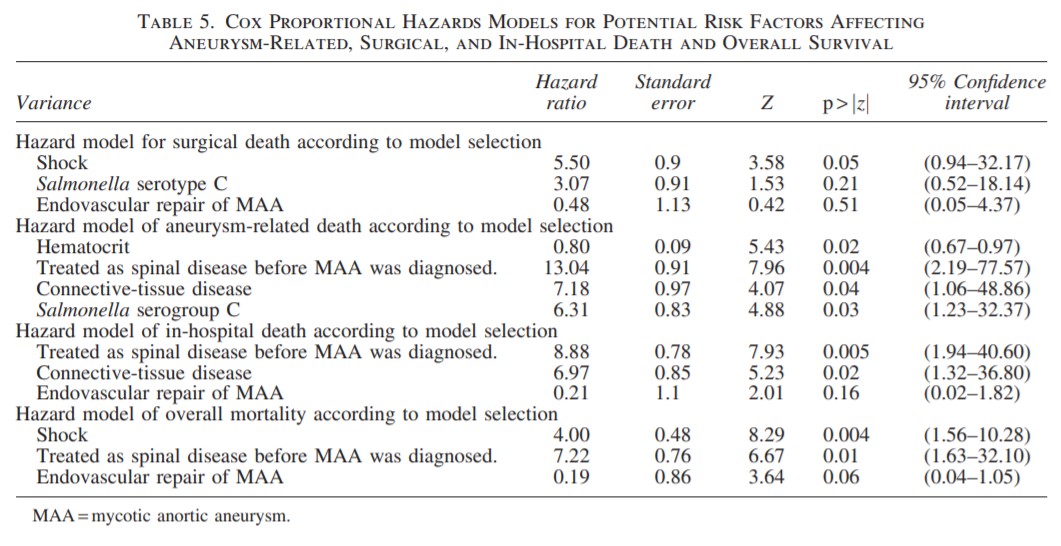
Huang YK, et al. Clinical, microbiologic, and outcome analysis of mycotic aortic aneurysm: the role of endovascular repair. Surg Infect (Larchmt). 2014 Jun;15(3): 290-8.

Free full-text.

Click to enlarge.

Results: All of the patients had positive blood cultures, radiologic findings typical of MAA, and clinical signs of infection (leukocytosis, fever, and elevated C-reactive protein). The mean age of the patients was 63.8±10.6 y and the mean period of their follow up was 35.7±39.3 mo. Twenty-nine patients with MAAs underwent traditional open surgery, 11 others received endovascular stent grafts, and four MAAs were managed conservatively. The most frequent causative pathogens were Salmonella (36/44 patients [81.8%]), in whom organisms of Salmonella serogroup C (consisting mainly of S. choleraesuis) were identified in 14 patients, organisms of Salmonella serogroup D were identified in 13 patients, and species without serogroup information were identified in nine patients. The overall mortality in the study population was 43.2% (with an aneurysm-related mortality of 18.2%, surgically related mortality of 13.6%, and in-hospital mortality of 22.7%).

Continue reading

Mortality and treatment outcome following surgical interventions for acute mesenteric ischemia.

Beaulieu RJ, et al. Comparison of open and endovascular treatment of acute mesenteric ischemia. J Vasc Surg. 2014 Jan;59(1):159-64. Erratum in: J Vasc Surg. 2014 Jul;60(1):273.

Full-text for Emory users.

Results: Of 23,744 patients presenting with AMI, 4665 underwent interventional treatment from 2005 through 2009. Of these patients, 57.1% were female, and the mean age was 70.5 years. A total of 679 patients underwent vascular intervention; 514 (75.7%) underwent open surgery and 165 (24.3%) underwent endovascular treatment overall during the study period. The proportion of patients undergoing endovascular repair increased from 11.9% of patients in 2005 to 30.0% in 2009. Severity of comorbidities, as measured by the Charlson index, did not differ significantly between the treatment groups. Mortality was significantly more commonly associated with open revascularization compared with endovascular intervention (39.3% vs 24.9%; P = .01). Length of stay was also significantly longer in the patient group undergoing open revascularization (12.9 vs 17.1 days; P = .006). During the study time period, 14.4% of patients undergoing endovascular procedures required bowel resection compared with 33.4% for open revascularization (P < .001). Endovascular repair was also less commonly associated with requirement for TPN support (13.7% vs 24.4%; P = .025).

Conclusions: Endovascular intervention for AMI had increased significantly in the modern era. Among AMI patients undergoing revascularization, endovascular treatment was associated with decreased mortality and shorter length of stay. Furthermore, endovascular intervention was associated with lower rates of bowel resection and need for TPN. Further research is warranted to determine if increased use of endovascular repair could improve overall and gastrointestinal outcomes among patients requiring vascular repair for AMI.

Continue reading

15-Year Patency and Life Expectancy After Primary Stenting Guided by Intravascular Ultrasound for Iliac Artery Lesions in Peripheral Arterial Disease

Kumakura H, et al. 15-Year Patency and Life Expectancy After Primary Stenting Guided by Intravascular Ultrasound for Iliac Artery Lesions in Peripheral Arterial Disease. JACC Cardiovasc Interv. 2015 Dec 21;8(14): 1893-901.

Full-text for Emory users.

Methods: EVT was performed for 507 lesions in 455 patients with PAD. The 15-year endpoints were primary, primary-assisted, and secondary patency; overall survival; freedom from major adverse cardiovascular events (MACE); and freedom from major adverse cardiovascular and limb events (MACLE).

Results: The 5-, 10-, and 15-year primary and secondary patencies were 89%, 83%, and 75%, respectively, and 92%, 91%, and 91%, respectively. There were no significant differences among TASC-II categories.

Continue reading

Coronary-artery revascularization before elective major vascular surgery

McFalls EO, Ward HB, Moritz TE, et al. Coronary-artery revascularization before elective major vascular surgery. N Engl J Med. 2004 Dec 30;351(27):2795-804.

Full-text for Emory users.

Results: Of 5859 patients scheduled for vascular operations at 18 Veterans Affairs Medical centers, 510 (9 percent) were eligible for the study and were randomly assigned to either coronary-artery revascularization before surgery or no revascularization before surgery. The indications for a vascular operation were an expanding abdominal aortic aneurysm (33 percent) or arterial occlusive disease of the legs (67 percent). Among the patients assigned to preoperative coronary-artery revascularization, percutaneous coronary intervention was performed in 59 percent, and bypass surgery was performed in 41 percent. The median time from randomization to vascular surgery was 54 days in the revascularization group and 18 days in the group not undergoing revascularization (P<0.001). At 2.7 years after randomization, mortality in the revascularization group was 22 percent and in the no-revascularization group 23 percent (relative risk, 0.98; 95 percent confidence interval, 0.70 to 1.37; P=0.92). Within 30 days after the vascular operation, a postoperative myocardial infarction, defined by elevated troponin levels, occurred in 12 percent of the revascularization group and 14 percent of the no-revascularization group (P=0.37). Continue reading