Perioperative morbidity in patients randomized to epidural or general anesthesia for lower extremity vascular surgery.

Christopherson R, Beattie C, Frank SM, Norris EJ, Meinert CL, Gottlieb SO, Yates H, Rock P, Parker SD, Perler BA, et al. Perioperative morbidity in patients randomized to epidural or general anesthesia for lower extremity vascular surgery. Anesthesiology. 1993 Sep;79(3): 422-34.

Full-text for Emory users.

Background: Perioperative morbidity may be modifiable in high risk patients by the anesthesiologist’s choice of either regional or general anesthesia. This clinical trial compared outcomes between epidural (EA) and general (GA) anesthesia/analgesia regimens in a group of patients at high risk for cardiac and other morbidity who were undergoing similarly stressful surgical procedures.

Continue reading

Preoperative splenic artery embolization for massive splenomegaly

Wu Z, Zhou J, Pankaj P, Peng B. Comparative treatment and literature review for laparoscopic splenectomy alone versus preoperative splenic artery embolization splenectomy. Surg Endosc. 2012 Oct;26(10):2758-66.

Full-text for Emory users.
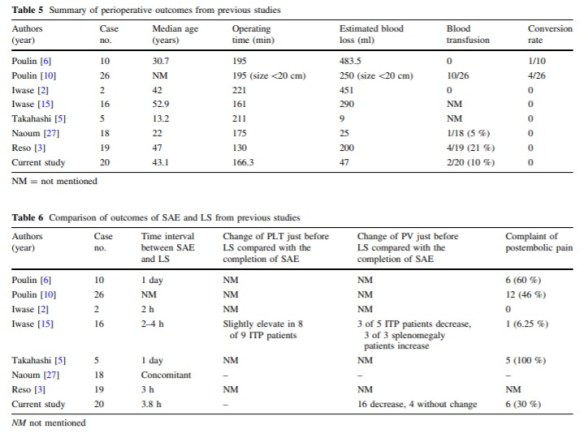
Surg Endo screenshot

Results: Preoperative splenic artery embolization plus laparoscopic splenectomy was successfully performed in all patients in group 1. One patient in group 2 required an intraoperative conversion to traditional open splenectomy because of severe blood loss. Compared with group 2, significantly shorter operating time, less intraoperative blood loss, and shorter postoperative hospital stay were noted in group 1. No marked significant differences in postoperative complications of either group were observed. Compared with group 3, group 1 had less intraoperative blood loss, shorter postoperative stay, and fewer complications. No significant differences were found in operating time. There was a marked increase in platelet count and white blood count in both groups during the follow-up period.

Conclusions: Preoperative splenic artery embolization with laparoscopic splenectomy reduced the operating time and decreased intraoperative blood loss when compared with laparoscopic splenectomy alone or open splenectomy. Splenic artery embolization is a useful intraoperative adjunctive procedure for patients with splenomegaly because of the benefit of perioperative outcomes.

Continue reading

Left subclavian artery coverage during thoracic endovascular aortic repair (TEVAR) and the risk of stroke

Swerdlow NJ, et al. Stroke rate after endovascular aortic interventions in the Society for Vascular Surgery Vascular Quality Initiative. J Vasc Surg. 2020 Apr 2. [Epub ahead of print]

Full-text for Emory users.

TEVAR table

Continue reading

Shoulder positioning for subclavian venous catheterization

Jeong HH, et al. A quantitative analysis of the relation between the clavicular tilt angle and subclavian central venous catheter misplacement. Clin Exp Emerg Med. 2014 Dec 31; 1(2):114-119.

Free full-text.

RESULTS: Among all central venous catheterizations (n=1,599), the subclavian route was used 981 times (61.4%). There were 51 misplacements of SCV catheters (5.2%) during the study period. There were no differences in the sex, age, blood pressure, and diagnosis between the two groups. The CTA values were 28.5°±7.3° and 22.6°±6.3° in the misplacement group and control group, respectively (95% confidence interval, 3.6 to 8.1; P<0.001).

CONCLUSION: In this study, the CTA was found to be 5.9° larger in the misplacement group than in the control group. Assuming that CTA indicates the shoulder position, our findings suggest that the chance of SCV catheter misplacement may be reduced by avoiding the shoulder elevated.

Continue reading

Covered stents and coil embolization for treatment of postpancreatectomy hemorrhage

Hassold N, et al. Effectiveness and outcome of endovascular therapy for late-onset postpancreatectomy hemorrhage using covered stents and embolization. J Vasc Surg. 2016 Nov;64(5):1373-1383.

Free full-text.

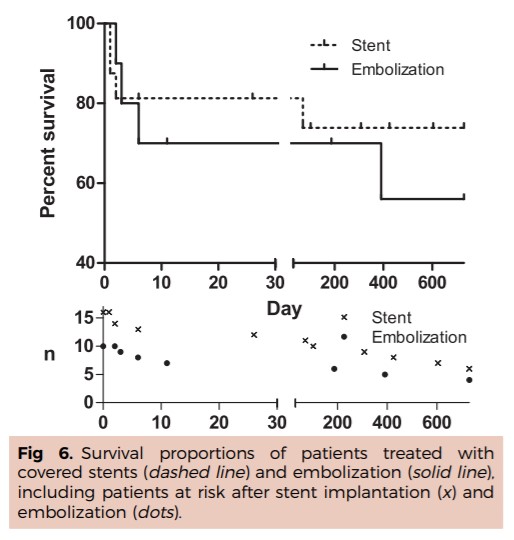
Fig 6 stent vs emobliz

RESULTS: Covered stent placement was successful in 14 of 16 patients (88%); embolization was successful in 10 of 11 (91%) patients. For the embolization group, the overall 30-day and 1-year survival rate was 70%, and the 1- and 2-year survival rate was 56%; for the covered stent group, these rates were 81% and 74%, respectively. The 30-day patency of the covered stent was 84%, and 1-year patency was 42%; clinically relevant ischemia was observed in two patients. Infarction distal to the embolized vessel occurred in 6 of 11 patients (55%).

Continue reading

Effect of inflow and outflow sites on the results of tibioperoneal vein grafts.

Sidawy AN, Menzoian JO, Cantelmo NL, LoGerfo FW. Effect of inflow and outflow
sites on the results of tibioperoneal vein grafts. Am J Surg. 1986 Aug;152(2):211-4.

Full-text for Emory users.

“We have reviewed our experience with the tibial vessel bypass operation and have found the overall patency and limb salvage rates to be acceptable. Patients were divided into two groups based on the site of the proximal anastomosis. In Group I, the proximal anastomosis was at the common femoral artery and in Group II, the proximal anastomosis was at the distal superficial femoral artery or the popliteal artery. The patients in the two groups were similar with regard to indications for operation, age, and sex. However, in Group I, 35 percent of the patients were diabetic and in Group II, 74 percent of the patients were diabetic. In the Group I patients, the 72 month graft patency rate was 65 percent with a limb salvage rate of 75 percent. In the Group II patients, the 72 month patency rate was 81 percent with a limb salvage rate of 89 percent. Continue reading