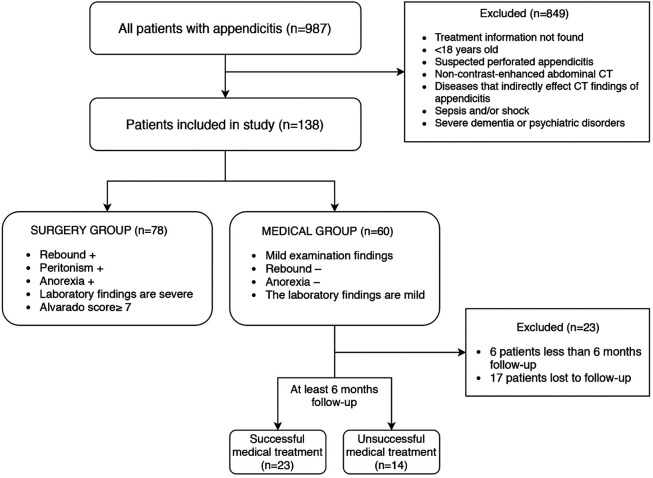
Article of interest: A randomized trial comparing antibiotics with appendectomy for appendicitis.

CODA Collaborative, Flum DR, et al. A randomized trial comparing antibiotics with appendectomy for appendicitis. N Engl J Med. 2020 Oct 5. [Epub ahead of print.]

Full-text for Emory users.

Results: In total, 1552 adults (414 with an appendicolith) underwent randomization; 776 were assigned to receive antibiotics (47% of whom were not hospitalized for the index treatment) and 776 to undergo appendectomy (96% of whom underwent a laparoscopic procedure). Antibiotics were noninferior to appendectomy on the basis of 30-day EQ-5D scores (mean difference, 0.01 points; 95% confidence interval [CI], -0.001 to 0.03). In the antibiotics group, 29% had undergone appendectomy by 90 days, including 41% of those with an appendicolith and 25% of those without an appendicolith. Complications were more common in the antibiotics group than in the appendectomy group (8.1 vs. 3.5 per 100 participants; rate ratio, 2.28; 95% CI, 1.30 to 3.98); the higher rate in the antibiotics group could be attributed to those with an appendicolith (20.2 vs. 3.6 per 100 participants; rate ratio, 5.69; 95% CI, 2.11 to 15.38) and not to those without an appendicolith (3.7 vs. 3.5 per 100 participants; rate ratio, 1.05; 95% CI, 0.45 to 2.43). The rate of serious adverse events was 4.0 per 100 participants in the antibiotics group and 3.0 per 100 participants in the appendectomy group (rate ratio, 1.29; 95% CI, 0.67 to 2.50).

Continue reading

Negative appendectomy rate over 18 years of technological advances

One discussion this week included the rate of negative appendectomy.

Reference: Raja AS, et al. Negative appendectomy rate in the era of CT: an 18-year perspective. Radiology. 2010 Aug;256(2):460-465. doi: 10.1148/radiol.10091570.

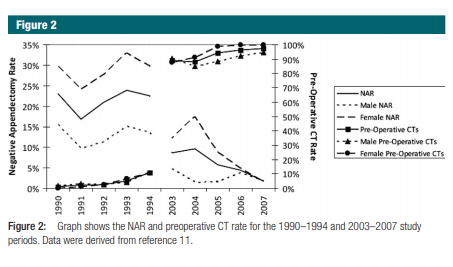
Summary: In a retrospective study of records from 1990-2007, researchers from Harvard sought to estimate the correlation between the negative appendectomy rate (NAR) and the rate of preoperative computed tomography (CT) in patients suspected of having acute appendicitis who presented to the emergency department.

The findings showed NAR decreased significantly from 23.0% to 1.7% (P < .0001), the annual number of appendectomies decreased significantly from 217 per year to 119 per year (P = .0003), and the proportion of patients undergoing appendectomy who underwent preoperative CT increased significantly from 1% to 97.5% (P < .0001).

Data from this study also suggest that the use of preoperative CT has been associated with a decrease in the female-to-male NAR ratio from 1.9:1 in 1990 to 0.9:1 in 2007, implying that the use of CT may have been helpful in decreasing the number
of negative appendectomies in women.

NAR

(Raja et al, 2010, p.464)

The negative appendectomy rate: who benefits from preoperative CT?

“Preoperative CT quite consistently has been shown to lower the negative appendectomy rate among women. Relatively few studies, however, have shown a lower negative appendectomy rate with preoperative CT for both sexes. Furthermore, any suggested utility of preoperative CT in men is contradicted by a number of studies that have shown that men derive no benefit from preoperative CT when there is clinical suspicion of acute appendicitis. Nevertheless, CT is used routinely among men with suspected appendicitis at our institution and has been assumed by both surgeons and radiologists to be a useful practice. Therefore, we performed this study to determine the negative appendectomy rates of patients who did and did not undergo preoperative CT and to determine, more specifically, whether men benefit from preoperative CT.”

Negative Appendectomy Rates for Patients Who Did and Did Not Undergo Preoperative Imaging
Continue reading

The Society for Vascular Surgery clinical practice guidelines on the management of visceral aneurysms

“Although not directed by randomized prospective trials, general principles of management of visceral artery aneurysms do exist. Because of their potential for rupture, most visceral artery pseudoaneurysms, mycotic aneurysms, and many larger true aneurysms warrant intervention. Treatment can generally be accomplished by either open surgical or endovascular approaches. The treatment goal is to prevent aneurysm expansion and potential rupture by exclusion from the arterial circulation while maintaining necessary distal or collateral bed perfusion. Depending on the location of the aneurysm, this can be accomplished in a variety of ways. In areas of the visceral circulation with an abundance of collateral flow, for example, in the splenic artery, proximal and distal ligation of the aneurysm segment is a viable surgical option. This can also be accomplished with endovascular isolation of the aneurysmal segment, either by placement of a stent graft or by coil embolization of the proximal and distal arterial segment. The preferred treatment of an individual patient and aneurysm must be carefully based on the particular anatomy and any associated clinical conditions as well as the underlying condition of the patient. The purpose of these guidelines is to inform the diagnosis, treatment options, screening, and follow-up of visceral aneurysms based on the available published literature and the Grading of Recommendations Assessment, Development, and Evaluation (GRADE) approach”

Graphical Abstract
Continue reading

Laparoscopic Entry Techniques and Injuries

“Recent reports by the Australian Safety and Efficacy Register for New interventions and Procedures (ASERNIP-S) and the Royal Australian and New Zealand College of Obstetricians and Gynaecologists (RANZCOG) concluded that insufficient evidence is available to assess the safety of the open versus closed laparoscopy in regard to major vascular and visceral injuries.” (Larobina & Nottle)

Major Vascular Injuries in Closed vs. Open Laparoscopy (Larobina & Nottle)

“Our case series shows that open laparoscopy can vastly reduce the incidence of access-related morbidity and mortality. Only a single visceral injury occurred in 5900 cases, and no major vascular injuries were reported.These figures are consistent with those of other reported series of open laparoscopy, which also show a zero rate of vascular injury and low rates of visceral injury.The literature review showed a rate of 1 injury to major retroperitoneal vessels per 2272 cases of closed laparoscopy procedures. This compares with a major vascular injury rate of 0 for the open technique. This difference is both statistically significant ( P = 0.003) and highly clinically significant.” (Larobina & Nottle)

Continue reading

Management of pancreatic pseudocysts

“Operative internal drainage has been standard treatment for chronic unresolved pancreatic pseudocysts (PPs). Recently, percutaneous external drainage (PED) has become the primary mode of treatment at many medical centers.”

“ Operative management for PPs appears to be superior to CT-guided PED. Although the later was often successful, it required major salvage procedures in one third of the patients. An expectant management protocol may be suitable for selected patients.”

Continue reading

Pancreatic necrosis

“Pancreatic necrosis is the most devastating complication of acute pancreatitis. Management of this complex disease has improved dramatically over the past decade, and mortality rates are regularly reported in the range of 20% instead of the 50% to 70% range reported in the 1970s. Despite this improvement, 80% of deaths from acute pancreatitis evolve from infectious complications of pancreatic and peripancreatic necrosis.”

Continue reading