Regional anesthesia for arteriovenous fistula surgery

Cole NM, et al. Regional Anesthesia for Arteriovenous Fistula Surgery May Reduce Hospital Length of Stay and Reoperation Rates. Vasc Endovascular Surg. 2018 Aug; 52(6):418-426.

Full-text for Emory users.

Results: Patients who received regional anesthesia had the shortest postoperative length of stay (0.67 [standard deviation: 2.0] days) compared to monitored anesthesia care/intravenous (IV) sedation (0.77 [1.8] days) and general anesthesia (1.44 [2.8] days). Administration of regional anesthesia was associated with a shorter length of stay compared to general anesthesia (odds ratio [OR]: 0.55, P = .001). Patients who received monitored anesthesia care/IV sedation had a lower risk of reoperation compared to general anesthesia (OR: 0.65, P = .012) but not compared to regional anesthesia (OR: 0.89, P = .759). Anesthesia type had no significant effects on other measured postoperative complications. Predictors of the type of anesthesia were age and surgical procedure as defined by Current Procedural Terminology code ( P < .001).

Continue reading

Article of interest: Frailty and cancer: Implications for oncology surgery, medical oncology, and radiation oncology.

Ethun CG, Bilen MA, Jani AB, Maithel SK, Ogan K, Master VA. Frailty and cancer: Implications for oncology surgery, medical oncology, and radiation oncology. CA Cancer J Clin. 2017 Sep;67(5):362-377.

Free full-text. 

  • The concept of frailty has become increasingly recognized as one of the most important issues in health care and health outcomes and is of particular importance in patients with cancer who are undergoing surgery, chemotherapy,and radiotherapy. However, defining frailty can be challenging.
  • Frailty is a complex, multidimensional, and cyclical state of diminished physiologic reserve that results in decreased resiliency and adaptive capacity and increased vulnerability to stressors.
  • It has been demonstrated that frail patients are at increased risk of postoperative complications, chemotherapy intolerance, disease progression, and death. Although international standardization of frailty cutoff points is needed, continued efforts by oncology physicians and surgeons to identify frailty and promote multidisciplinary decision making will help to develop more individualized management strategies and optimize care for patients with cancer.

Continue reading

Obstructive jaundice and coagulation disturbances

Pavlidis ET, Pavlidis TE. Pathophysiological consequences of obstructive jaundice and perioperative management. Hepatobiliary Pancreat Dis Int. 2018 Feb;17(1):17-21.

Full-text for Emory users.

“Proper management includes full replacement of water and electrolyte deficiency, prophylactic antibiotics, lactulose, vitamin K and fresh frozen plasma, albumin and dopamine. The preoperative biliary drainage has not been indicated in overall, but only in a few selected cases.”

“The coagulation disorders and the resulting hemostasis impairment have been attributed to the complement activation by endotoxin as well as to the reduced synthesis of prothrombin (factor II) in the liver and the other vitamin K depended coagulation factors i.e. VII, IX, X and proteins C, S, Z. The absence of bile salts in the gut prevents the absorption of vitamin K, which is a fat-soluble vitamin. In addition, the endogenous microbial flora produces small amounts of vitamin K. Subsequently the reduced vitamin K absorption results in its deficiency. The latter predisposes to bleeding diathesis, despite the normal laboratory indices such as prothrombin time (PTT) and international normalized ratio (INR). Likewise, the other fat-soluble vitamin D and lipids absorption is diminished resulting in their deficiency and calcium reduction.” (Pavlidis, et al., p. 19.)

Continue reading

Surgical management of ruptured abdominal aortic aneurysms

Powell JT, Wanhainen A. Analysis of the Differences Between the ESVS 2019 and NICE 2020 Guidelines for Abdominal Aortic Aneurysm. Eur J Vasc Endovasc Surg. 2020 Jul;60(1):7-15.

Full-text for Emory users.

Click to enlarge.


See also: Surgical Grand Rounds: EVAR, FEVAR, and Open Repair: What to make of alphabet soup

Continue reading

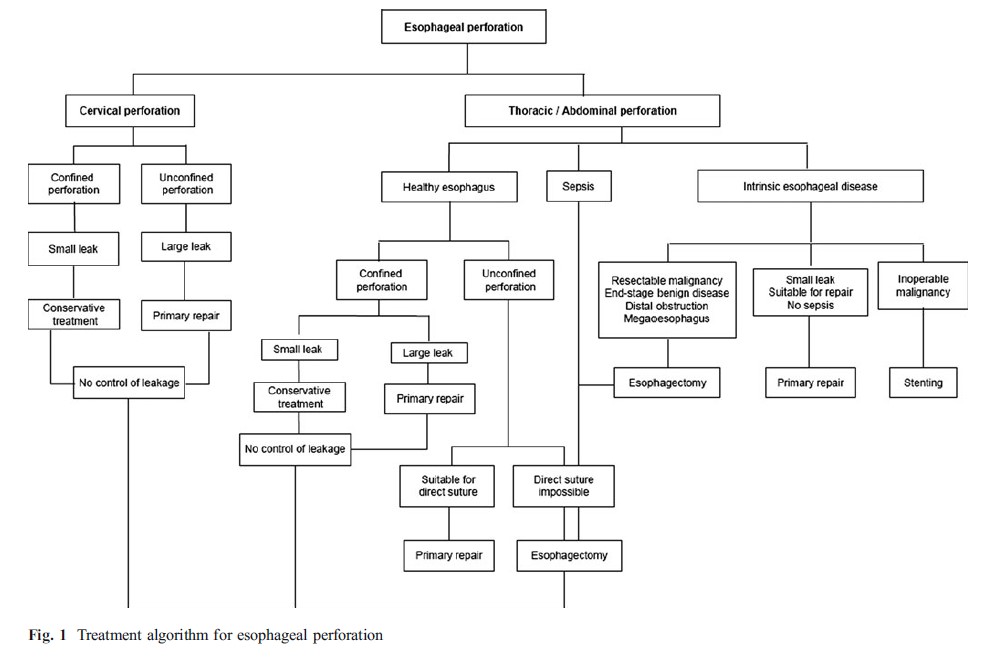
Management of Esophageal Perforation

Lindenmann J, Matzi V, Neuboeck N, et al. Management of esophageal perforation in 120 consecutive patients: clinical impact of a structured treatment algorithm. J Gastrointest Surg. 2013 Jun;17(6):1036-43.

Full-text for Emory users.

Click to enlarge.

Results: Iatrogenic perforation was the most frequent cause of esophageal perforation (58.3 %); Boerhaave’s syndrome was detected in 15 cases (6.8 %). Surgery was performed in 66 patients (55 %), 17 (14 %) patients received conservative treatment and 37 (31 %) patients underwent endoscopic stenting after tumorous perforation. Statistically significant impact on mean survival had Boerhaave’s syndrome (p = 0.005), initial sepsis (p = 0.002), pleural effusion/empyema (p = 0.001), mediastinitis (p = 0.003), peritonitis (p = 0.001), and redo-surgery (p = 0.000). Overall mortality rate was 11.7 %, in the esophagectomy group 17 % and in the patients with Boerhaave’s syndrome 33.3 %.

Continue reading

Iatrogenic bladder injury and prevention of catheter-related bacteriuria

Literature review conducted and presented by Dr. Clara Farley

EUA guidelines on iatrogenic bladder trauma:

  • Repair in two layers with absorbable sutures
  • Postop bladder drainage is required for 7-14 days
  • Cystoscopy is advised

Bacteriuria in patients with indwelling catheters occurs at a rate of approx. 3-10% per day of catheterization:

  • Of those with bacteriuria, approx. 10-25% develop UTI (GU or systemic symptoms)
  • 4% of less develop catheter related bacteremia

Association between the rate of UTI and duration of catheterization:

  • 15% at 3 days
  • 68% at 8 days

Continue reading

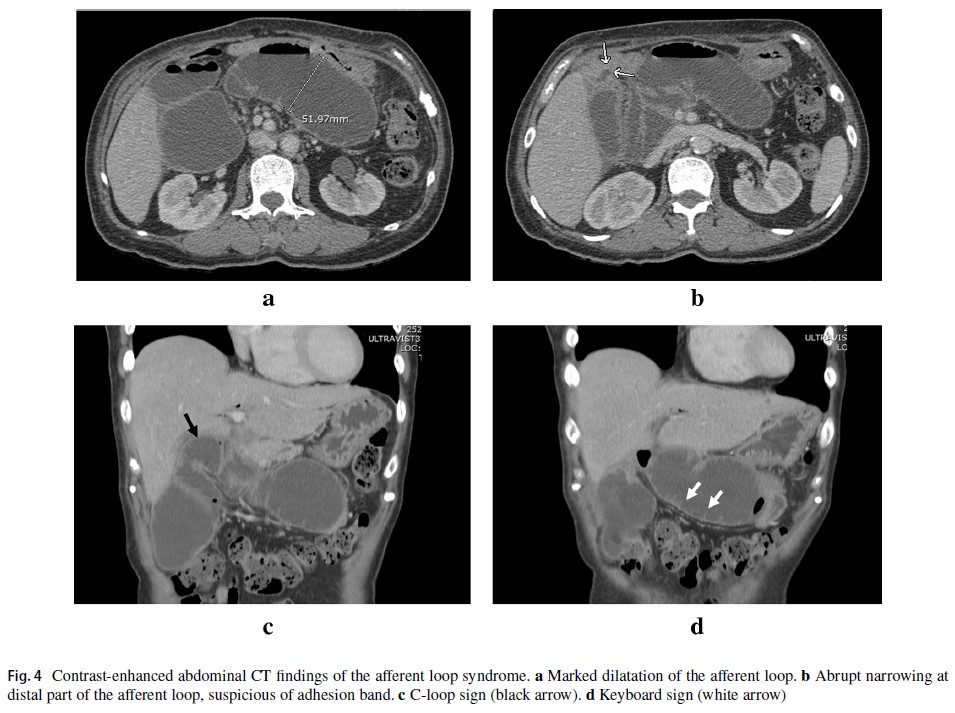
Afferent loop syndrome

Termsinsuk P, Chantarojanasiri T, Pausawasdi N. Diagnosis and treatment of the afferent loop syndrome. Clin J Gastroenterol. 2020 Oct;13(5):660-668.

“ALS is a rare condition with the incidence ranging from 0.2 to 1.0% depending on the type of operation and anastomotic limb reconstruction. ALS has been reported in 0.3–1.0% of patients after total gastrectomy with Billroth II or Roux-en-Y reconstruction, 1% after laparoscopic distal gastrectomy with Billroth II reconstruction, and 0.2% after distal gastrectomy with Roux-en-Y reconstruction [4–6]. Other operations of which ALS can occur include total gastrectomy with loop esophagojejunostomy with simple or pouch Roux-en-Y reconstruction and pancreaticoduodenectomy with conventional loop and Roux-en-Y reconstruction; nonetheless, the data on incidence were limited [7].”

Continue reading