Patient Complexity and Bile Duct Injury After Robotic-Assisted vs Laparoscopic Cholecystectomy

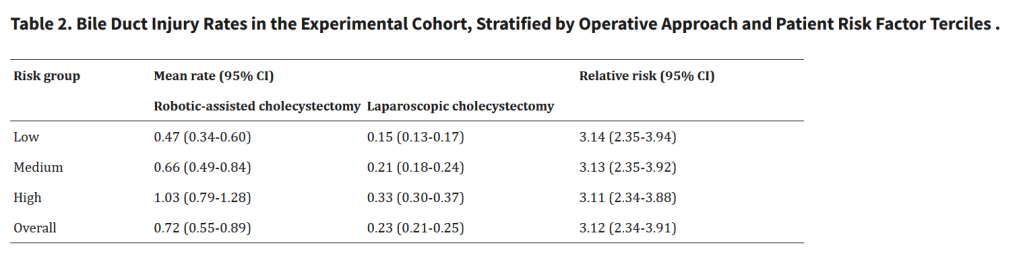
“Whether robotic-assisted cholecystectomy offers an advantage over laparoscopic cholecystectomy for higher-risk cases remains unclear. On one hand, there may be fundamental differences in the complexity of patients undergoing robotic-assisted cholecystectomy, which may be responsible for the higher observed rates of bile duct injury. On the other hand, differences in bile duct injury could be secondary to other factors, such as surgeons working their way up the learning curve using the robot, especially given the large number of robotic-assisted cholecystectomies surgeons must perform to achieve bile duct injury rates equivalent to those of laparoscopic approaches. By comparing laparoscopic and robotic-assisted cholecystectomy approaches within patient risk terciles, we can determine whether patient risk factor profiles are associated with harm in robotic-assisted cholecystectomy.”

Continue reading

Bismuth classification, detection, and management of Bile Duct Injury during laparoscopic cholecystectomy

“Bile duct injury (BDI) is a dangerous complication of cholecystectomy, with significant postoperative sequelae for the patient in terms of morbidity, mortality, and long-term quality of life. BDIs have an estimated incidence of 0.4–1.5%, but considering the number of cholecystectomies performed worldwide, mostly by laparoscopy, surgeons must be prepared to manage this surgical challenge. Most BDIs are recognized either during the procedure or in the immediate postoperative period. However, some BDIs may be discovered later during the postoperative period, and this may translate to delayed or inappropriate treatments. Providing a specific diagnosis and a precise description of the BDI will expedite the decision-making process and increase the chance of treatment success.”

Continue reading

Post-Cholecystectomy Biliary Complications

Pesce A, et al. Iatrogenic bile duct injury: impact and management challenges. Clin Exp Gastroenterol. 2019 Mar 6;12:121-128. Free full-text.

“Iatrogenic BDIs represent a serious complication which can be brought on by cholecystectomy. The errors leading to laparoscopic bile duct lesions stem principally from misperception of the biliary anatomy. Any effort toward the reduction of the risk profile of everyday cholecystectomy is appreciated. The key points to successful treatment are characterized by early recognition, control of any intra-abdominal fluid collection and infection, nutritional balance, multidisciplinary approach, and surgical repair by an experienced surgeon in biliary reconstruction.”


Pekolj J, et al. Intraoperative management and repair of bile duct injuries sustained during 10,123 laparoscopic cholecystectomies in a high-volume referral center. J Am Coll Surg. 2013 May;216(5):894-901. Full-text for Emory users.

Results: Among 10,123 LC performed during the study period, 19 patients had a BDI sustained during the procedure. Intraoperative cholangiography was routinely used. Bile duct injury was diagnosed intraoperatively in 17 patients (89.4%). Mean age was 56.4 years (range 18 to 81 years) and 15 patients were women (88%). According to the Strasberg classification of BDI, there were 3 type C lesions, 12 type D lesions, and 2 type E2 lesions. There were no associated vascular injuries. Twelve cases (71%) were converted to open surgery. The repairs included 10 primary biliary closures, 4 Roux-en-Y hepaticojejunostomies, 2 end to end anastomosis, and 1 laparoscopic transpapillary drainage. Postoperative complications occurred in 5 patients (29.4%). During the follow-up period, early biliary strictures developed in 2 patients (11.7%) and were treated by percutaneous dilation and a Roux-en-Y hepaticojejunostomy with satisfactory long-term results.

Continue reading

What is the utility of routine intraoperative cholangiography during laparoscopic cholecystectomy?

SAGES still recommends that practicing general surgeons learn how to do IOC (though once a surgeon is past their learning curve, it is not necessarily routinely recommended that it be done ‘routinely’).


Hope WW, et al. SAGES clinical spotlight review: intraoperative cholangiography. Surg Endosc. 2017 May;31(5): 2007-2016. Full-text for Emory users.

“The following clinical spotlight review regarding the intraoperative cholangiogram is intended for physicians who manage and treat gallbladder/biliary pathology and perform laparoscopic cholecystectomy. It is meant to critically review the technique of intraoperative cholangiography, alternatives for intraoperative biliary imaging, and the available evidence supporting their safety and efficacy.”

Continue reading

Article of interest: Biliary complications after pancreaticoduodenectomy: skinny bile ducts are surgeons’ enemies

Duconseil P, Turrini O, Ewald J, et al. Biliary complications after pancreaticoduodenectomy: skinny bile ducts are surgeons’ enemies. World J Surg. 2014 Nov;38(11):2946-51.

Full-text for Emory users.

Results: Thirty patients experienced a BC: 13 BLs (3.3 %) and 17 BSs (4.3 %). A thin bile duct (<5 mm), measured during surgery, was the only predisposing factor for developing a BL or a BS. The management of the BLs consisted of surveillance in six patients (46 %), percutaneous drainage of bilioma in four patients (31 %), and reintervention in three patients (23 %). No patient with a BS had surgery as the frontline treatment: the initial management consisted of an endoscopic procedure, a percutaneous procedure, or medical treatment. Four patients (23.5 %) underwent surgical treatment after failure of nonsurgical procedures.

Conclusions: The only identified predictive factor of BC, either a BS or a BL, was a thin bile duct. Although the noninvasive technique was the treatment of choice initially, reintervention was required in almost 25 % of the cases.

Continue reading