
The Society for Vascular Surgery clinical practice guidelines on the management of visceral aneurysms

“Although not directed by randomized prospective trials, general principles of management of visceral artery aneurysms do exist. Because of their potential for rupture, most visceral artery pseudoaneurysms, mycotic aneurysms, and many larger true aneurysms warrant intervention. Treatment can generally be accomplished by either open surgical or endovascular approaches. The treatment goal is to prevent aneurysm expansion and potential rupture by exclusion from the arterial circulation while maintaining necessary distal or collateral bed perfusion. Depending on the location of the aneurysm, this can be accomplished in a variety of ways. In areas of the visceral circulation with an abundance of collateral flow, for example, in the splenic artery, proximal and distal ligation of the aneurysm segment is a viable surgical option. This can also be accomplished with endovascular isolation of the aneurysmal segment, either by placement of a stent graft or by coil embolization of the proximal and distal arterial segment. The preferred treatment of an individual patient and aneurysm must be carefully based on the particular anatomy and any associated clinical conditions as well as the underlying condition of the patient. The purpose of these guidelines is to inform the diagnosis, treatment options, screening, and follow-up of visceral aneurysms based on the available published literature and the Grading of Recommendations Assessment, Development, and Evaluation (GRADE) approach”
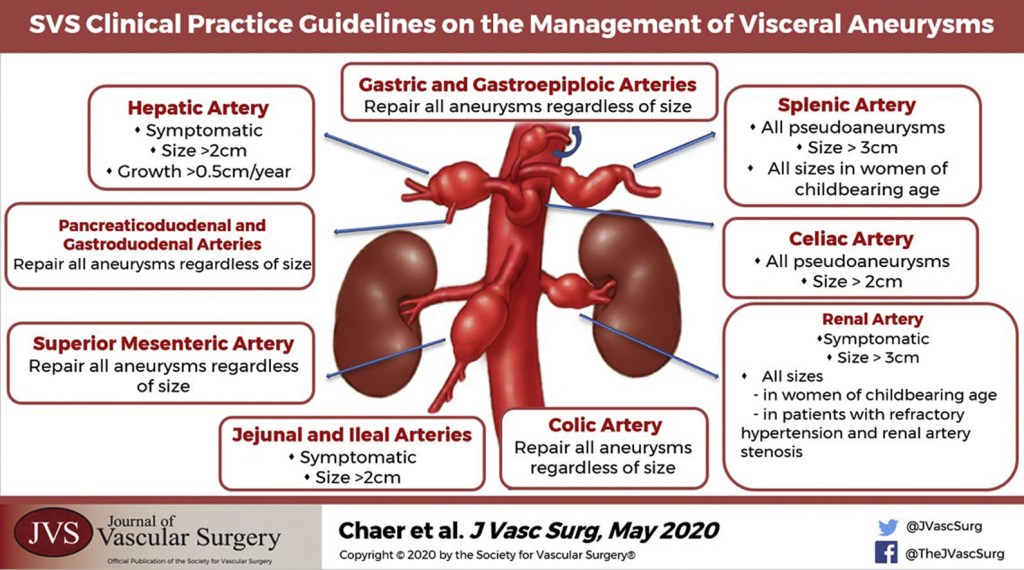
Graphical Abstract
Continue reading

Society for Vascular Surgery (SVS) Clinical Practice Guidelines on Popliteal Artery Aneurysms

“Popliteal artery aneurysms (PAAs) are the most common peripheral arterial aneurysms, defined as aneurysms outside the aortoiliac system or the brain, accounting for 70% of all peripheral arterial aneurysms. They are more common in men (95%) and tend to occur in the sixth and seventh decades of life. Few modern studies have been performed on the natural history of PAAs, and many of these were retrospective reviews of surgical patients. As such, the timing and details of PAA management remain nuanced.”

“These guidelines focus on PAA screening, indications for intervention, choice of repair strategy, management of asymptomatic and symptomatic PAAs (including those presenting with acute limb ischemia), and follow-up of both untreated and treated PAAs. They offer long-awaited evidence-based recommendations for physicians taking care of these patients.”

Continue reading

The surgical management and outcomes of dialysis access-associated steal syndrome (DASS)

Al Shakarchi J, et al. Surgical techniques for haemodialysis access-induced distal ischaemia. J Vasc Access. 2016 Jan-Feb;17(1):40-6.

Results: Following strict inclusion/exclusion criteria by two reviewers, twenty-seven studies of surgical interventions were included and divided into subgroups for banding, DRIL, PAI and RUDI procedures. Both DRIL and banding procedures were found to have high rates of symptomatic relief. In addition, the DRIL has a significantly lower rate of early thrombosis than banding although the more recent papers seem to suggest that early thrombosis is less of a problem in banding. PAI and RUDI showed some promise but there were too few studies to be able to make any clear conclusions.
Continue reading

Phlegmasia alba dolens and phlegmasia cerulea dolens

Shackford SR. (2018). Venous Disease. In: Abernathy’s Surgical Secrets, 7th ed.: p. 357.

What is the difference between phlegmasia alba dolens and phlegmasia cerulea dolens? 

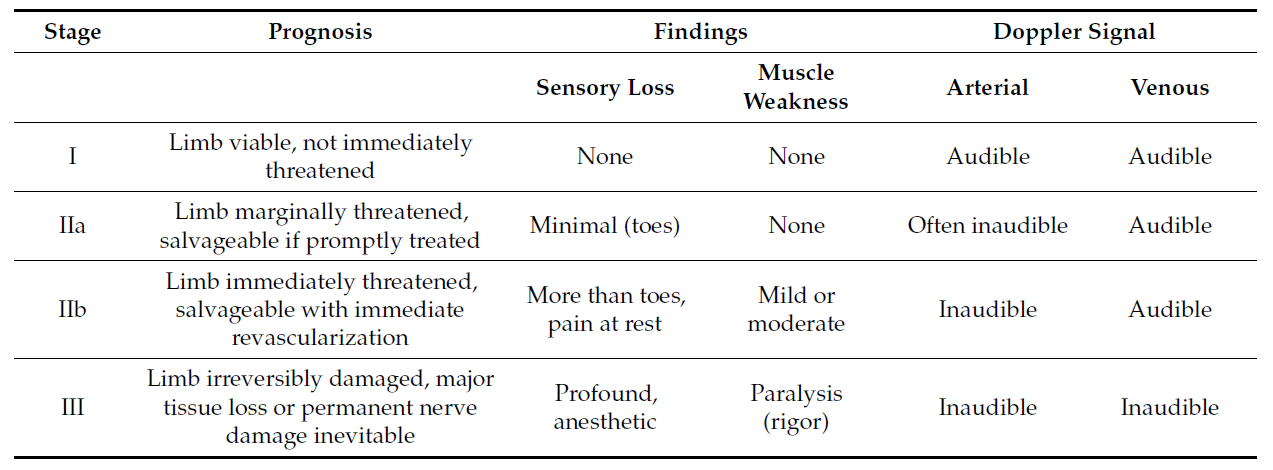
“These two entities occur following iliofemoral venous thrombosis, 75% of which occur on the left side presumably because of compression of the left common iliac vein by the overlying right common iliac artery (May-Thurner syndrome). Iliofemoral venous thrombosis is characterized by unilateral pain and edema of an entire lower extremity, discoloration, and groin tenderness. In phlegmasia alba dolens (literally, painful white swelling), the leg becomes pale. Arterial pulses remain normal. Progressive thrombosis may occur with propagation proximally or distally and into neighboring tributaries. The entire leg becomes both edematous and mottled or cyanotic. This stage is called phlegmasia cerulea dolens (literally, painful purple swelling). When venous outflow is seriously impeded, arterial inflow may be reduced secondarily by as much as 30%. Limb loss is a serious concern and aggressive management (i.e., venous thrombectomy, catheter-directed lytic therapy, or both) is necessary.”


Chinsakchai K, et al. Trends in management of phlegmasia cerulea dolens. Vasc Endovascular Surg. 2011 Jan;45(1):5-14. Full-text for Emory users.

PCD screenshot
Continue reading

Bypass versus Angioplasty in Severe Ischaemia of the Leg

Bradbury AW, Adam DJ, Bell J, et al.; BASIL trial Participants. Bypass versus Angioplasty in Severe Ischaemia of the Leg (BASIL) trial: An intention-to-treat analysis of amputation-free and overall survival in patients randomized to a bypass surgery-first or a balloon angioplasty-first revascularization strategy. J Vasc Surg. 2010 May;51(5 Suppl):5S-17S.

Free full-text.

Summary of BASIL trial recommendations: The BASIL trial suggests that those SLI patients who are likely to live ≥2 years are probably better served by a BSX-first strategy, preferably with vein. [37] Those SLI patients who are unlikely to live 2 years, and possibly those in whom vein is not available for bypass, are probably better served by a BAP-first strategy because they are unlikely to survive to reap the longer-term benefits of surgery, they may be more likely to suffer surgical morbidity and mortality, and because angioplasty is significantly less expensive than surgery in the short-term.

Continue reading

Regional anesthesia for arteriovenous fistula surgery

Cole NM, et al. Regional Anesthesia for Arteriovenous Fistula Surgery May Reduce Hospital Length of Stay and Reoperation Rates. Vasc Endovascular Surg. 2018 Aug; 52(6):418-426.

Full-text for Emory users.

Results: Patients who received regional anesthesia had the shortest postoperative length of stay (0.67 [standard deviation: 2.0] days) compared to monitored anesthesia care/intravenous (IV) sedation (0.77 [1.8] days) and general anesthesia (1.44 [2.8] days). Administration of regional anesthesia was associated with a shorter length of stay compared to general anesthesia (odds ratio [OR]: 0.55, P = .001). Patients who received monitored anesthesia care/IV sedation had a lower risk of reoperation compared to general anesthesia (OR: 0.65, P = .012) but not compared to regional anesthesia (OR: 0.89, P = .759). Anesthesia type had no significant effects on other measured postoperative complications. Predictors of the type of anesthesia were age and surgical procedure as defined by Current Procedural Terminology code ( P < .001).

Continue reading