
Preoperative portal vein embolization for major liver resection

Rassam F, et al. Functional and volumetric assessment of liver segments after portal
vein embolization: Differences in hypertrophy response. Surgery. 2019 Apr;165(4):686-695.

Full-text for Emory users.

RESULTS: A total of 90 patients underwent portal vein embolization of the right liver. After 3 weeks, there was a significant increase in both volumetric and functional share of the future remnant liver (both P < .01). The increase in functional share exceeded the increase in volumetric share (P < .01). The median functional contribution of segment 4 after portal vein embolization was 41.5% (31.7%-48.7%) of the nonembolized lobe. Preoperative chemotherapy was not a significant predictor of the increase in function or volume. Compared with benign lesions, malignant diseases were significant negative predictors of the functional response.
Continue reading

The use of risk stratification tools for perioperative and postoperative morbidity and mortality

Havens JM, Columbus AB, Seshadri AJ, et al. Risk stratification tools in emergency general surgery. Trauma Surg Acute Care Open. 2018 Apr 29;3(1):e000160.

Free full-text.

The use of risk stratification tools (RST) aids in clinical triage, decision making and quality assessment in a wide variety of medical fields. Although emergency general surgery (EGS) is characterized by a comorbid, physiologically acute patient population with disparately high rates of perioperative morbidity and mortality, few RST have been explicitly examined in this setting. We examined the available RST with the intent of identifying a tool that comprehensively reflects an EGS patients perioperative risk for death or complication.

Continue reading

Considerations in stoma reversal

Sherman KL, Wexner SD. Considerations in Stoma Reversal. Clin Colon Rectal Surg. 2017 Jul;30(3):172-177.

Free full-text.

Temporary stomas are frequently used in the management of diverticulitis, colorectal cancer, and inflammatory bowel disease. These temporary stomas are used to try to mitigate septic complications from anastomotic leaks and to avoid the need for reoperation. Once acute medical conditions have improved and after the anastomosis has been proven to be healed, stomas can be reversed. Contrast enemas, digital rectal examination, and endoscopic evaluation are used to evaluate the anastomosis prior to reversal. Stoma reversal is associated with complications including anastomotic leak, postoperative ileus, bowel obstruction, enterocutaneous fistula, and, most commonly, surgical site infection. Furthermore, many stomas, which were intended to be temporary, may not be reversed due to postoperative complications, adjuvant therapy, or prohibitive comorbidities.

The impact of abdominal incisional closure techniques on rates of fascial dehiscence

Tolstrup MB, Watt SK, Gögenur I. Reduced Rate of Dehiscence After Implementation of a Standardized Fascial Closure Technique in Patients Undergoing Emergency Laparotomy. Ann Surg. 2017 Apr;265(4):821-826.

Full-text for Emory users.

RESULTS: We included 494 patients from 2014 to 2015 and 1079 patients from our historical cohort for comparison. All patients had a midline laparotomy in an emergency setting. The rate of dehiscence was reduced from 6.6% to 3.8%, P = 0.03 comparing year 2009 to 2013 with 2014 to 2015. Factors associated with dehiscence were male gender [hazard ratio (HR) 2.8, 95% confidence interval (95% CI) (1.8-4.4), P < 0.001], performance status ≥3 [HR 2.1, 95% CI (1.2-3.7), P = 0.006], cirrhosis [HR 3.8, 95% CI (1.5-9.5), P = 0.004], and retention sutures [HR 2.8, 95% CI (1.6-4.9), P < 0.000]. The 30-day mortality rate was 18.4% in the standardized group vs 22.4% in 2009 to 2013, P = 0.057 and 90-day mortality 24.2% vs 30.4%, P = 0.008.

CONCLUSION: The standardized procedure of closing the midline laparotomy by using a “small steps” technique of continuous suturing with a slowly absorbable (polydioxanone) suture material reduces the rate of fascial dehiscence.

Continue reading

WARC Journal Club: STITCH Trial

Deerenberg EB, Harlaar JJ, Steyerberg EW, et al. Small bites versus large bites for closure of abdominal midline incisions (STITCH): a double-blind, multicentre, randomised controlled trial. Lancet. 2015 Sep 26;386(10000):1254-1260.

Full-text for Emory users.

FINDINGS: Between Oct 20, 2009, and March 12, 2012, we randomly assigned 560 patients to the large bites group (n=284) or the small bites group (n=276). Follow-up ended on Aug 30, 2013; 545 (97%) patients completed follow-up and were included in the primary outcome analysis. Patients in the small bites group had fascial closures sutured with more stitches than those in the large bites group (mean number of stitches 45 [SD 12] vs 25 [10]; p<0·0001), a higher ratio of suture length to wound length (5·0 [1·5] vs 4·3 [1·4]; p<0·0001) and a longer closure time (14 [6] vs 10 [4] min; p<0·0001). At 1 year follow-up, 57 (21%) of 277 patients in the large bites group and 35 (13%) of 268 patients in the small bites group had incisional hernia (p=0·0220, covariate adjusted odds ratio 0·52, 95% CI 0·31-0·87; p=0·0131). Rates of adverse events did not differ significantly between groups.

Continue reading

Shoulder positioning for subclavian venous catheterization

Jeong HH, et al. A quantitative analysis of the relation between the clavicular tilt angle and subclavian central venous catheter misplacement. Clin Exp Emerg Med. 2014 Dec 31; 1(2):114-119.

Free full-text.

RESULTS: Among all central venous catheterizations (n=1,599), the subclavian route was used 981 times (61.4%). There were 51 misplacements of SCV catheters (5.2%) during the study period. There were no differences in the sex, age, blood pressure, and diagnosis between the two groups. The CTA values were 28.5°±7.3° and 22.6°±6.3° in the misplacement group and control group, respectively (95% confidence interval, 3.6 to 8.1; P<0.001).

CONCLUSION: In this study, the CTA was found to be 5.9° larger in the misplacement group than in the control group. Assuming that CTA indicates the shoulder position, our findings suggest that the chance of SCV catheter misplacement may be reduced by avoiding the shoulder elevated.

Continue reading

Covered stents and coil embolization for treatment of postpancreatectomy hemorrhage

Hassold N, et al. Effectiveness and outcome of endovascular therapy for late-onset postpancreatectomy hemorrhage using covered stents and embolization. J Vasc Surg. 2016 Nov;64(5):1373-1383.

Free full-text.

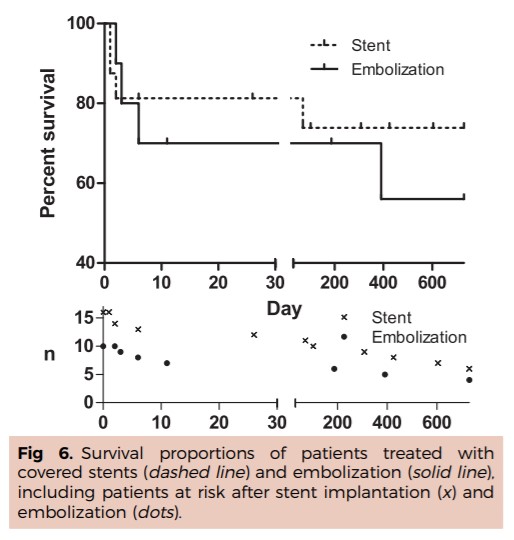
Fig 6 stent vs emobliz

RESULTS: Covered stent placement was successful in 14 of 16 patients (88%); embolization was successful in 10 of 11 (91%) patients. For the embolization group, the overall 30-day and 1-year survival rate was 70%, and the 1- and 2-year survival rate was 56%; for the covered stent group, these rates were 81% and 74%, respectively. The 30-day patency of the covered stent was 84%, and 1-year patency was 42%; clinically relevant ischemia was observed in two patients. Infarction distal to the embolized vessel occurred in 6 of 11 patients (55%).

Continue reading