
Totally Extra Peritoneal (e-TEP) Approach for Ventral Hernias

Bui NH, Jørgensen LN, Jensen KK. Laparoscopic intraperitoneal versus enhanced-view totally extraperitoneal retromuscular mesh repair for ventral hernia: a retrospective cohort study. Surg Endosc. 2021 Mar 15.

Full-text for Emory users.

Results: A total of 72 patients were included in the study, 43 and 29 of whom underwent IPOM and eTEP-RM repair, respectively. Patient demographics showed no differences in terms of gender, age, smoking and comorbidity. The median age was 57 years and body mass index 30.5 kg/m2. The rate of patients with incisional hernia was higher in the IPOM group (39.5% vs. 20.7%, p = 0.154). There was no difference in horizontal and vertical hernia size defect. The duration of surgery was significantly shorter for IPOM (mean 82.4 vs. 103.4 min, p = 0.010), whereas the length of stay was significantly longer after IPOM (median 1 days vs. 0 days (p < 0.001). The rate of patients requiring postoperative transversus abdominis plane (TAP) block or epidural analgesia was significantly higher after IPOM (33% vs. 0%, p = 0.002). A subgroup analysis on patients undergoing primary ventral hernia showed similar results.

Conclusion: The study found laparoscopic eTEP-RM safe and effective compared to traditional laparoscopic IPOM. The patients undergoing eTEP-RM had significantly reduced need for additional analgesic treatment and length of stay.

Continue reading
Article of interest: Resuscitative Endovascular Balloon Occlusion of Aaorta Use in Nontrauma Emergency General Surgery: A Multi-institutional Experience.

Hatchimonji JS, Chipman AM, McGreevy DT, et al. Resuscitative Endovascular Balloon Occlusion of Aaorta Use in Nontrauma Emergency General Surgery: A Multi-institutional Experience. J Surg Res. 2020 Dec;256:149-155.

Full-text for Emory users.

Background: The aim of this study was to determine the current utilization patterns of resuscitative endovascular balloon occlusion of aorta (REBOA) for hemorrhage control in nontrauma patients.

Methods: Data on REBOA use in nontrauma emergency general surgery patients from six centers, 2014-2019, was pooled for analysis. We performed descriptive analyses using Fisher’s exact, Student’s t, chi-squared, or Mann-Whitney U tests as appropriate.

Continue reading

Article of interest: Bleeding complications after pancreatic surgery: interventional radiology management

Biondetti P, Fumarola EM, Ierardi AM, Carrafiello G. Bleeding complications after pancreatic surgery: interventional radiology management. Gland Surg. 2019 Apr;8(2):150-163. doi: 10.21037/gs.2019.01.06.

Surgical intervention in the pancreas region is complex and carries the risk of complications, also of vascular nature. Bleeding after pancreatic surgery is rare but characterized by high mortality. This review reports epidemiology, classification, diagnosis and treatment strategies of hemorrhage occurring after pancreatic surgery, focusing on the techniques, roles and outcomes of interventional radiology (IR) in this setting. We then describe the roles and techniques of IR in the treatment of other less common types of vascular complications after pancreatic surgery, such as portal vein (PV) stenosis, portal hypertension and bleeding of varices.

Article of interest: Spinal cord protection practices used during endovascular repair of complex aortic aneurysms by the U.S. Aortic Research Consortium.

Aucoin VJ, Eagleton MJ, Farber MA, et al. Spinal cord protection practices used during endovascular repair of complex aortic aneurysms by the U.S. Aortic Research Consortium. J Vasc Surg. 2021 Jan;73(1):323-330. doi: 10.1016/j.jvs.2020.07.107.

Full-text for Emory users.

Results: The most common practices routinely included blood pressure elevation (7 of 8; 87.5%), with most having a mean arterial pressure goal of not less than 90 mm Hg in the perioperative period (5 of 7; 71%), a hemoglobin goal intra- and postoperatively of not less than 10 mg/dL (6 of 8; 75%), and the use of prophylactic spinal drains in high-risk patients (6 of 8; 75%). Significant variation was found among the group for the timing of the resumption of antihypertensive medications, duration of hemoglobin goals after the procedure, and management of spinal drains. Many methods described in reported studies were not routinely used by most of the group, including a perioperative steroid bolus (1 of 8; 12.5%), mannitol (2 of 8; 25%), and naloxone infusion (1 of 8; 12.5%). Rescue maneuvers included placement of a cerebrospinal fluid (CSF) drain if not already present (8 of 8; 100%), decreasing the target CSF drain pop-off pressure (6 of 8; 75%), increasing the CSF drainage volume (5 of 8; 62.5%), increasing the mean arterial pressure goal (8 of 8; 100%), increasing the hemoglobin goal (8 of 8; 100%), and imaging the spine using computed tomography or magnetic resonance imaging (7 of 8; 87.5).

Continue reading

Janeway Gastrostomy

Gastrostomy. Ellison E, & Zollinger R.M., Jr.(Eds.), (2016). Zollinger’s Atlas of Surgical Operations, 10e. McGraw-Hill. Emory login required.

“As a temporary gastrostomy, the Witzel or the Stamm procedure is used frequently and is easily performed. A permanent type of gastrostomy, such as the Janeway and its variations, is best adapted to patients in whom it is essential to have an opening into the stomach for a prolonged period of time. Under these circumstances, the gastric mucosa must be anchored to the skin to ensure long-term patency of the opening. Furthermore, the construction of a mucosa-lined tube with valve-like control at the gastric end tends to prevent the regurgitation of the irritating gastric contents. This allows periodic intubation and frees the patient from the irritation of a constant indwelling tube.”

Continue reading

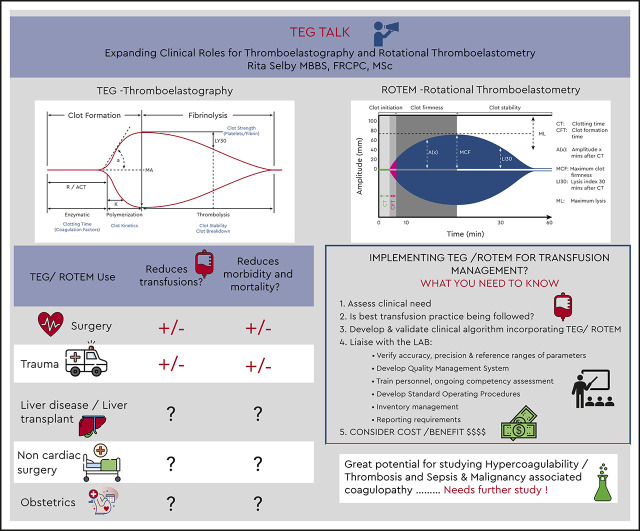
Utility of thromboelastography to guide blood product transfusion in surgical settings.

Selby R. “TEG talk”: expanding clinical roles for thromboelastography and rotational thromboelastometry. Hematology Am Soc Hematol Educ Program. 2020 Dec 4;2020(1): 67-75.

Free full-text.

Click to enlarge. 

“Viscoelastic assays (VEAs) that include thromboelastography and rotational thromboelastometry add value to the investigation of coagulopathies and goal-directed management of bleeding by providing a complete picture of clot formation, strength, and lysis in whole blood that includes the contribution of platelets, fibrinogen, and coagulation factors. Conventional coagulation assays have several limitations, such as their lack of correlation with bleeding and hypercoagulability; their inability to reflect the contribution of platelets, factor XIII, and plasmin during clot formation and lysis; and their slow turnaround times. VEA-guided transfusion algorithms may reduce allogeneic blood exposure during and after cardiac surgery and in the emergency management of trauma-induced coagulopathy and hemorrhage. However, the popularity of VEAs for other indications is driven largely by extrapolation of evidence from cardiac surgery, by the drawbacks of conventional coagulation assays, and by institution-specific preferences. Robust diagnostic studies validating and standardizing diagnostic cutoffs for VEA parameters and randomized trials comparing VEA-guided algorithms with standard care on clinical outcomes are urgently needed. Lack of such studies represents the biggest barrier to defining the role and impact of VEA in clinical care.”

Continue reading

Announcement: Thomas F. Dodson Surgical History Society Lecture Series

The 5th meeting of the Thomas F. Dodson Surgical History Society will take place on Monday, March 15th @ 6:30pm via Zoom. The mission of the Society is to foster interest and collaboration centered on the rich, meaningful, and colorful history of our field.

The topics to be discussed are:

Continue reading