Article of Interest: Development of a Surgical Evidence Blog at Morbidity and Mortality Conferences: Integrating Clinical Librarians to Enhance Resident Education

Lovasik BP, Rutledge H, Lawson E, Maithel SK, Delman KA. (2020). Development of a Surgical Evidence Blog at Morbidity and Mortality Conferences: Integrating Clinical Librarians to Enhance Resident Education. Journal of Surgical Education. [In Press, Available online 15 June 2020.]

Full-text for Emory users.

Continue reading

Lance-Adams syndrome

Marcellino C, Wijdicks EF. Posthypoxic action myoclonus (the Lance Adams syndrome). BMJ Case Rep. 2020 Apr 16;13(4):e234332.

Free full-text. (Includes video.)

  • Action myoclonus is exceptionally rare (less than 0.5% in a series of patients who have a cardiac arrest).
  • Myoclonus occurring after hypoxic brain injury from cardiac arrest, characterised by abrupt irregular muscle contractions. (1)
    • Acute: starting within 48 hours after the arrest (when isolated, sometimes terms acute Lance-Adams syndrome). (2)
    • Chronic: Lance-Adams syndrome, which may start from days to weeks after arrest and progressively worsen, with or without other neurological symptoms.
  • Potentially confused with myoclonus status in a comatose patient, yet the examination, imaging, degree of disability and prognosis are very divergent.
  • Typically, no EEG seizure correlates.

Continue reading

Laparoscopic Cholecystectomy Versus Percutaneous Catheter Drainage for Acute Cholecystitis in High Risk Patients (CHOCOLATE): Multicentre Randomised Clinical Trial

Loozen CS, et al. Laparoscopic cholecystectomy versus percutaneous catheter drainage for acute cholecystitis in high risk patients (CHOCOLATE): multicentre randomised clinical trial. BMJ. 2018 Oct 8; 363:k3965.

Free full-text.

what this study adds

Continue reading

The value of a cross-discipline team-based approach for resection of renal cell carcinoma with IVC tumor thrombus: A report of a large, contemporary, single-institution experience.

Master VA, Ethun CG, Kooby DA, Staley CA 3rd, Maithel SK. The value of a cross-discipline team-based approach for resection of renal cell carcinoma with IVC tumor thrombus: A report of a large, contemporary, single-institution experience. J Surg Oncol. 2018 Dec; 118(8):1219-1226.

Full-text for Emory users.

Introduction: We report the evolution of the largest, contemporary, single-institution experience with this complex procedure to highlight the value of a cross-discipline, team-based approach.

Methods: Patients from a prospectively maintained database who underwent resection of renal cell carcinoma (RCC) with inferior vena cava (IVC) tumor thrombus from 2005 to 2016 at a single-institution were included for analysis.

Continue reading

Article of interest: COVID-19 associated hyperviscosity: a link between inflammation and thrombophilia?

Maier CL, Truong AD, Auld SC, Polly DM, Tanksley CL, Duncan A. COVID-19 associated hyperviscosity: a link between inflammation and thrombophilia? Lancet. 2020 May 25:S0140-6736(20)31209-5. Epub ahead of print.

Free full-text.

“The 15 patients had plasma viscosity exceeding 95% of normal, as determined by traditional capillary viscometry, ranging from 1·9–4·2 centipoise (cP; normal range 1·4–1·8). Notably, the four patients with plasma viscosity above 3·5 cP had a documented thrombotic complication: one patient had pulmonary embolism, one patient had limb ischaemia and suspected pulmonary embolism, and two patients had CRRT-related clotting. Plasma viscosity and Sequential Organ Failure Assessment scores, a measure of illness severity, were strongly correlated (Pearson’s r=0·841, R2=0·7072, p<0·001; appendix).”


Emory doctors study link between thickness of blood, clotting and inflammation in COVID-19 patients.

Smoking and pancreatic disease

Yadav D, Hawes RH, Brand RE, et al. Alcohol consumption, cigarette smoking, and the risk of recurrent acute and chronic pancreatitis. Arch Intern Med. 2009 Jun 8; 169(11):1035-45.

Free full-text.

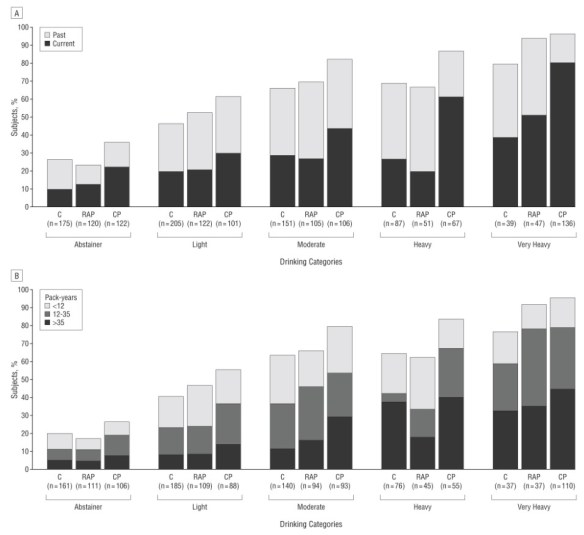
Chronic pancreatitis_smoking

Figure 3. Distribution of self-reported smoking status (A) and amount (B) stratified by drinking categories. All proportions are based on effective numbers, and never smokers account for the proportions not reflected in the graphs. C indicates control group; CP, chronic pancreatitis group; RAP, recurrent acute pancreatitis group.

Continue reading