Surgical management of Crohn’s Disease

One discussion this week involved the surgical management of Crohn’s Disease.

Reference: Strong S, et al. Clinical practice guideline for the surgical management of Crohn’s Disease. Diseases of the Colon and Rectum. 2015 Nov;58(11):1021-1036. doi:10.1097/DCR.0000000000000450

Summary: The authors state “these guidelines should not be deemed inclusive of all proper methods of care or exclusive of methods of care reasonably directed to obtaining the same results. The ultimate judgment regarding the propriety of any specific procedure must be made by the physician in light of all the circumstances presented by the individual patient” (p.1021).

OPERATIVE INDICATIONS

Failed Medical Therapy

  1. Patients who demonstrate an inadequate response to, develop complications from, or are noncompliant with medical therapy should be considered for surgery. Grade of Recommendation: Strong  based on low-or very low-quality evidence, 1C.
  2. Patients receiving therapy with anti-TNFs, high-dose glucocorticoids and/or cyclosporine may warrant staged procedures because of concerns about postoperative complications; however, decisions should be individualized based on the patient’s risk stratification, overall clinical status, and surgeon judgment. Grady of Recommendation: Weak based on low- or very low-quality evidence, 2C.

Inflammation

  1. Patient with acute colitis who have symptoms or signs of impending or actual perforation should typically undergo surgery. Grade of Recommendation: Strong based on low- or very low-quality evidence, 1C.

Stricture

  1. Endoscopic dilation may be considered for patients with symptomatic small-bowel or anastomotic strictures that are not amenable to medical therapy. Grade of Recommendation: Strong based on low- or very low-quality evidence, 1C.
  2. Surgery is indicated for patients with symptomatic small-bowel or anastomotic strictures that are not amenable to medical therapy and/or dilation. Grade of Recommendation: Strong based on low- or very low-quality evidence, 1C.
  3. Patients with strictures of the colon that cannot be adequately surveyed endoscopically should be considered for resection. Grade of Recommendation: Strong based on low- or very-low quality evidence, 1C.

Penetrating Disease

  1. Patients with a free perforation should undergo surgery. Grade of Recommendation: Strong based on moderate-quality evidence, 1B.
  2. Patients with enteroparietal, interloop, intramesenteric, or retroperitoneal abscesses may be managed by antibiotics with or without percutaneous drainage. Surgical drainage with or without resection should be considered when this is not successful. Grade of Recommendation: Weak based on moderate-quality evidence, 2B.
  3. Patients with enteric fistulas and symptoms or signs of localized or systemic sepsis that persist despite appropriate medical therapy should be considered for surgery. Grade of Recommendation: Strong based on low- or very low-quality evidence, 1C.

Hemorrhage

  1. Stable patients with significant GI heomrrhage may be evaluated and treated by endoscopic and/or interventional radiological techniques. Unstable patients should typically undergo operative exploration. Grade of Recommendation: STrong based on low- or very low-quality evidence, 1C.

Growth Retardation

  1. Prepubertal patients with significant growth retardation despite appropriate medical therapy should be considered for surgery. Grade of Recommendation: STrong based on moderate-quality evidence, 1B.

Neoplasia

  1. Patients with long-standing Crohn’s disease of the ileocolic region or colon should have endoscopic surveillance of the large bowel. Grade of Recommendation: Strong based on moderate-quality evidence, 1B.
  2. Total proctocolectomy should be considered for patients with carcinoma, a nonadenoma-like dysplasi-associated lesion or mass (DALM), high-grade dysplasia, or multifocal low-grade dysplasia of the colon or rectum. Grade of Recommendation: Strong based on moderate-quality evidence, 1B.
  3. Suspicious lesions (mass, ulcer) identified in patients with Crohn’s should typically be biopsied, especially when considering a small-bowel strictureplasty. Grade of Recommendation: Strong based on low- or very low-quality evidence.

For complete guidelines (site-specific operations, technical considerations), methodologies, and definition of GRADE system-grading recommendations, see full text article.

Simultaneous vs staged colorectal and hepatic resections

One discussion this week involved the comparison of simultaneous and staged resections of colorectal cancer and synchronous colorectal liver metastases (SCRLM).


Reference: Reddy SK, et al. Simultaneous resections of colorectal cancer and synchronous liver metastases: a multi-institutional analysis. Annals of Surgical Oncology. 2007 Dec;14(12):3481-3491. doi:10.1245/s10434-007-9522-5

Summary: In a retrospective study of 610 patients at three institutions between 1985 and 2006, the authors compared postoperative morbidity and mortality after simultaneous and staged resections of colorectal cancer and SCRLM.

Continue reading

Lynch Syndrome: Surgical Management

One discussion this week included the surgical management of lynch syndrome.

Reference: DynaMed Plus [Internet]. Ipswich (MA): EBSCO Information Services. 1995 – . Record No. 115317, Lynch syndrome – Surgery and procedures; [updated 2018 Sept 26, cited 2018 Nov 16];. Emory login required. (Click on link and search for “lynch syndrome”).

Summary: Surgery considerations for Lynch syndrome patients with colorectal cancer (DynaMed Plus, 2018):

  • full colectomy with ileorectal anastomosis recommended rather than segmental/partial colonic resection due to increased risk for metachronous cancers
  • National Comprehensive Cancer Network (NCCN) recommends considering segmental vs. extended colectomy for colorectal adenocarcinoma based on clinical scenario, individual considerations, and discussion of risk
  • European Society for Medical Oncology (ESMO) recommends discussing option of extended colectomy vs. intensive surveillance after standard surgery at time of colorectal cancer diagnosis, particularly in young patients
  • American College of Gastroenterology (ACG) recommends
    • colectomy with ileorectal anastomosis as preferred treatment option for Lynch syndrome patients with colon cancer or colonic neoplasia not controllable by endoscopy
    • segmental colectomy with regular surveillance after surgery as an option in patients not suitable for total colectomy
  • United States Multi-Society Task Force (USMSTF) on Colorectal Cancer recommends colectomy with ileorectal anastomosis for Lynch syndrome patients with colon cancer or colorectal neoplasia not removable by endoscopy
  • segmental colectomy may increase risk of metachronous colorectal cancer compared to extended colectomy in patients with Lynch syndrome
    • based on systematic review of observational studies
    • systematic review of 6 observational studies comparing segmental vs. extended colectomy in 871 patients with Lynch syndrome being treated for colorectal cancer
    • 705 patients (81%) had segmental colectomy and 166 patients (19%) had extended colectomy
    • mean follow-up 91 months
    • 161 patients (22.8%) receiving segmental colectomy and 10 patients (6%) receiving extended colectomy had metachronous colorectal cancer during mean follow-up of 91 months
    • compared to extended colectomy, segmental colectomy associated with increased metachronous colorectal cancer in analysis of 5 studies with 792 patients
      • odds ratio 4.02, 95% CI 2.01-8.04
      • NNH 3-18 with metachronous colorectal cancer in 6% of extended colectomy group
    • adverse events not reported

What is the operative management of diverticulitis?

One discussion this week included the operative management of diverticulitis.

Reference: Nally DM and Kavanagh DO. Current controversies in the management of diverticulitis: a review. Digestive Surgery. 2018 Apr 19. doi:10.1159/000488216.

Summary: A treatment algorithm is illustrated below (Nally and Kavanagh, 2018, p.7).

fig2

Laparoscopic Lavage

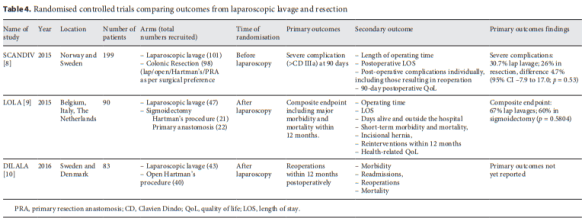
Nally and Kavanagh highlight three RCTs comparing laparoscopic lavage and resection (Table 4, p.8): SCANDIV (2015), LOLA (2015), and DILALA (2016).  The main differences in the RCTs were the re-intervention rate, which varied according to when results were reports (prior to the time of expected stoma closure) or if stoma closure is specifically excluded. Surgical reinterventions accounted for a majority of adverse events.

table4

Surgical Resection

Originally a 3-stage operation, it was condensed into a 2-stage Harman’s procuedure in which the diseased segment was removed during initial laparotomy. This became the standard of care, yet the mortality rate is cited as 15% according to the SCANDIV study. Additionally, a Hartman’s procedure is limited by the morbidity and mortality of colostomy reversal or lifestyle implications of a permanent stoma for up to 60% of patients (p.8). A one-stage resection with restoration of continuity avoids some challenges but also creates concern about performing an anastomosis in a contaminated environment for a critically unwell patient.

A 2004 systematic review found an overall mortality rate of 9.9% for primary anastomosis  (n=568) and 18.8% for Hartman’s (n=1,051), with overall anastomotic leak rate for a primary anastomosis of 13.9% (p.8).

Elective Surgery for Diverticulitis

Approximately 15-30% of patients have recurrent episodes of diverticulities. Up to 30% have ongoing pain. There are 2 indications for elective surgery:

  1. Prophylaxis against recurrent attacks and complications
  2. Surgery for ongoing symptoms that impact quality of life.

Guidelines from the American Society of Surgeons of Colon and Rectal surgeons from 2000 recommended an elective resection after one or two episodes of acute uncomplicated diverticulitis (p.9). Currently, professional bodies included the AGA advise again routine resection and instead propose an individualized approach (p.9). Morbidity and mortality of elective procedures for diverticulitis can be significant.

Conversely, elective surgery to improve quality of life is coming more to the fore (p.9). A systematic review of 21 studies and more than 1,800 patients and an RCT – the DIRECT trial – with 109 patients seem to provide evidence in favor of resection. It must be noted that the RCT was terminated early.

Nally and Kavanagh (2018) conclude that diverticulitis is a common yet challenging topic that demands clinicians to provide an individualized yet evidence-based approach (p.1).

Sclerosing encapsulating peritonitis

One discussion this week involved small bowel obstruction and sclerosing encapsulating peritonitis (SEP).


Reference: Liberale G, Sugarbaker PH. Sclerosing encapsulating peritonitis as a potential complication of cytoreductive surgery and HIPEC: clinical features and results of treatment in 4 patients. Surgical Oncology. 2018 Dec;27(4):657-662.

Summary: Liberale and Sugarbaker (2018) define SEP as “a rare entity characterized by encapsulation of the small bowel and/or the colon by fibrous tissue forming a shell” (p.657). It is iatrogenic, idiopathic, or secondardy, and its pathophysiology is uncertain. The most common symptoms are abdominal pain, discomfort, and partial or complete obstruction.

In this article, the authors present 4 cases of SEP, all of which required additional surgery to alleviate recurrent episodes of small bowel obstruction.

In discussion, they provide some advice (p.661):

  • An adverse event to avoid is small bowel fistula following surgery.
  • The prevention of fistulization which results in enteric contamination of the peritoneal space is of utmost importance in reoperative surgery.
  • Careful marking of seromuscular tears and their repair prior to closing the abdomen is important.
  • A major problem that may occur in follow-up is the difficulty of distinguishing recurrence of peritoneal metastases from benign causes of bowel obstruction.

There are two types of SEP (p.661):

  • Type I: a fibrous membrane sheathing the bowel loops together without a clearly separated dissection plane. Surgery is challenging and the surgeon needs to open the plane between bowel loops while avoiding causing serosal tears.
  • Type II: a fibrous membrane forming an enterocele or ‘pseudocyst-like’ structure. These are easier to manage as, once the pouch is open, the small bowel can be dissected and separated easily from the surrounding sheath.

Cytoreductive surgery (CRS) with hyperthermic intraperitoneal chemotherapy (HIPEC) for colorectal cancer

One discussion this week involved the PCI cutoff for CRS/HIPEC for colorectal cancers.

References: Faron M, et al. Linear relationship of Peritoneal Cancer Index and survival in patients with peritoneal metastases from colorectal cancer. Annals of Surgical Oncology. 2016 Jan;23(1):114-119. doi:10.1245/s10434-015-4627-8.

Klaver CEL, et al. Recommendations and consensus on the treatment of peritoneal metastases of colorectal origin: a systematic review of national and international guidelines. Colorectal Disease. 2017 Mar;19(3):224-236. doi:10.1111/codi.13593

Summary: A diagnosis of peritoneal metastases (PM) is generally poor, approximately 5 months if untreated; however, CRS/HIPEC has been shown to increase median survival up to 22 months (Klaver et al, 2017).

Faron et al (2016) explored the relationship between the peritoneal cancer index (PCI) and overall survival in the setting of complete cytoreductive surgery (CCRS) with hyperthermic intraperitoneal chemotherapy (HIPEC). In reviewing the literature, they found that CCRS/HIPEC is indicated for a PCI <12 and not appropriate for a PCI >17. There is an area of indecision in PCIs 12-17.

To bridge this PCI indecision gap, Faron et al (2016) recommend considering the following parameters (p.118):

  1. Presence of other site of metastases besides peritoneum
  2. General performance status and patient age, linked to morbidity and mortality
  3. Response to neoadjuvant chemotherapy, because progression of disease while receiving systemic chemotherapy reflects aggressive tumor behavior

In a systematic review of 21 guidelines, Klaver et al (2017) found a 71% consensus that CRS/HIPEC is the recommended treatment for PM. There is a need not only for additional evidence, but also an international platform for more trials on CRS/HIPEC and the overall treatment of PM (Klaver et al, 2017).

To drain or not to drain…the GRECCAR 5 randomized trial

One discussion this week focused on pelvic drains.

Reference: Denost Q, et al. To drain or not to drain infraperitoneal anastomosis after rectal excision for Cancer: The GRECCAR 5 randomized trial. Annals of Surgery. 2017 Mar;265(3):474-480. doi:10.1097/SLA.0000000000001991.

Summary: The GRECCAR 5 randomized trial sought to explore the benefit of a drain for postoperative pelvic sepsis, overall morbidity and mortality, rate of re-operation, length of stay, and rate of stoma closure at 6 months (p.474). It involved 469 patients (236 with drains, 233 without) between 2011 and 2014.

Ultimately, the trial did not find any benefit of the pelvic drain after low anterior resection for rectal cancer. Thus, the authors “recommend not using pelvic drain after rectal excision for cancer, except in case of operative bleeding or beyond TME surgery” (p.480).

The drain did not contribute to an efficient diagnosis of sepsis, for the time to diagnosis of pelvic sepsis was an average of 7.8 days, yet the drain was removed at 5.5 days postop (see figure below; p.1478).

pelvic sepsis

There was no significant difference between the two groups for any of the noted measurements. Pelvic sepsis occurred in 16.1% of those with the drain and 18.0% of those without drain. Re-operation for pelvic sepsis was done in 10.2% of those with drain and 12.0% of those without drain.

Additional reading: Placer C. To drain or not to drain infraperitoneal anastomosis after rectal excision for cancer: an unclosed debate [Letter to the Editor]. Annals of Surgery. 2018. doi:10.1097/SLA.0000000000003005. [Epub ahead of print]