Clinical Practice Guidelines: The American Society of Colon and Rectal Surgeons Clinical Practice Guidelines for the Management of Hemorrhoids

Davis BR, Lee-Kong SA, Migaly J, Feingold DL, Steele SR. The American Society of Colon and Rectal Surgeons Clinical Practice Guidelines for the Management of Hemorrhoids. Dis Colon Rectum. 2018 Mar;61(3):284-292.

Full-text for Emory users.

“Symptoms related to hemorrhoids are very common in the Western hemisphere and other industrialized societies. Although published estimates of prevalence are varied,1,2 it represents one of the most common medical and surgical disease processes encountered in the United States, resulting in >2.2-million outpatient evaluations per year.3 A large number of diverse symptoms may be, correctly or incorrectly, attributed to hemorrhoids by both patients and referring physicians. As a result, it is important to identify symptomatic hemorrhoids as the underlying source of the anorectal symptom and to have a clear understanding of the evaluation and management of this disease process.These guidelines address both diagnostic and therapeutic modalities in the management of hemorrhoidal disease.”

Continue reading

Article of interest: Laparoscopic Lavage vs Primary Resection for Acute Perforated Diverticulitis: Long-term Outcomes From the Scandinavian Diverticulitis (SCANDIV) Randomized Clinical Trial.

Azhar N, Johanssen A, Sundström T, et al. Laparoscopic Lavage vs Primary Resection for Acute Perforated Diverticulitis: Long-term Outcomes From the Scandinavian Diverticulitis (SCANDIV) Randomized Clinical Trial. JAMA Surg. 2021 Feb 1;156(2):121-127.

Full-text for Emory users.

Results: Of 199 randomized patients, 101 were assigned to undergo laparoscopic peritoneal lavage and 98 were assigned to colon resection. At the time of surgery, perforated purulent diverticulitis was confirmed in 145 patients randomized to lavage (n = 74) and resection (n = 71). The median follow-up was 59 (interquartile range, 51-78; full range, 0-110) months, and 3 patients were lost to follow-up, leaving a final analysis of 73 patients who had had laparoscopic lavage (mean [SD] age, 66.4 [13] years; 39 men [53%]) and 69 who had received a resection (mean [SD] age, 63.5 [14] years; 36 men [52%]). Severe complications occurred in 36% (n = 26) in the laparoscopic lavage group and 35% (n = 24) in the resection group (P = .92). Overall mortality was 32% (n = 23) in the laparoscopic lavage group and 25% (n = 17) in the resection group (P = .36). The stoma prevalence was 8% (n = 4) in the laparoscopic lavage group vs 33% (n = 17; P = .002) in the resection group among patients who remained alive, and secondary operations, including stoma reversal, were performed in 36% (n = 26) vs 35% (n = 24; P = .92), respectively. Recurrence of diverticulitis was higher following laparoscopic lavage (21% [n = 15] vs 4% [n = 3]; P = .004). In the laparoscopic lavage group, 30% (n = 21) underwent a sigmoid resection. There were no significant differences in the EuroQoL-5D questionnaire or Cleveland Global Quality of Life scores between the groups.

Continue reading

Cancer risk in Peutz-Jeghers syndrome

Peutz-Jeghers syndrome (PJS) is an autosomally dominant disorder associated with mutations in tumor suppressor gene STK11, and characterized by gastrointestinal polyposis, mucocutaneous pigmentation, and cancer predisposition:

  • up to 93% lifetime risk of any cancer in affected individuals, and cancer often develops around age 40-49 years; associated cancers include cancers of the small bowel, stomach, pancreas, breast, ovary, cervix, lung, and testes
  • colon cancer risk is reported at 39%, and typical age of colorectal cancer diagnosis is 42-46 years in affected patients
  • rarely, PJS may be idiopathic and not associated with STK11 mutations

Continue reading

Article of interest: Management of the difficult duodenal stump in penetrating duodenal ulcer disease: a comparative analysis of duodenojejunostomy with “classical” stump closure (Nissen-Bsteh)

Vashist YK, et al. Management of the difficult duodenal stump in penetrating duodenal ulcer disease: a comparative analysis of duodenojejunostomy with “classical” stump closure (Nissen-Bsteh). Langenbecks Arch Surg. 2012 Dec;397(8):1243-9.

Full-text for Emory users.

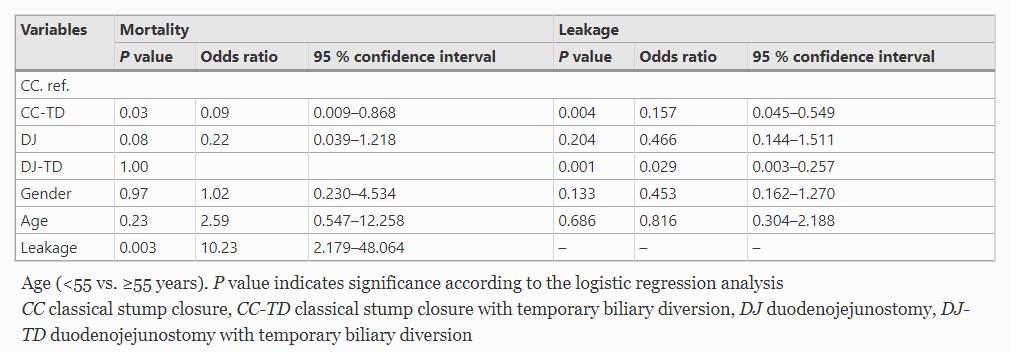
Table 4. Multivariable Analysis for Perioperative Mortality and Leakage in All 124 Patients

Background: Duodenal stump insufficiency after surgery for penetrating gastroduodenal ulcer is associated with substantial mortality. “Classical” technique of closing a difficult duodenal stump (Nissen-Bsteh) has, up to now, not been compared with duodenojejunostomy (DJ) in larger patient sets. This also refers to the potential benefit of a gastric and biliary diversion under such conditions. The aim of the present study was to compare classical duodenal closure (CC) with DJ and to evaluate the impact of gastric and biliary diversion on postoperative outcome after surgery for penetrating, high-risk duodenal ulcer in a matched control study.

Continue reading

The surgical management of purulent peritonitis from perforated diverticulitis

Oberkofler CE, et al. A multicenter randomized clinical trial of primary anastomosis or Hartmann’s procedure for perforated left colonic diverticulitis with purulent or fecal peritonitis. Ann Surg. 2012 Nov; 256(5):819-26; discussion 826-7.

Full-text for Emory users.

Results: Patient demographics were equally distributed in both groups (Hinchey III: 76% vs 75% and Hinchey IV: 24% vs 25%, for HP vs PA, respectively). The overall complication rate for both resection and stoma reversal operations was comparable (80% vs 84%, P = 0.813). Although the outcome after the initial colon resection did not show any significant differences (mortality 13% vs 9% and morbidity 67% vs 75% in HP vs PA), the stoma reversal rate after PA with diverting ileostomy was higher (90% vs 57%, P = 0.005) and serious complications (Grades IIIb-IV: 0% vs 20%, P = 0.046), operating time (73 minutes vs 183 minutes, P < 0.001), hospital stay (6 days vs 9 days, P = 0.016), and lower in-hospital costs (US $16,717 vs US $24,014) were significantly reduced in the PA group.

Conclusions: This is the first randomized clinical trial favoring PA with diverting ileostomy over HP in patients with perforated diverticulitis.


Thornell A, et al. Laparoscopic Lavage for Perforated Diverticulitis With Purulent Peritonitis: A Randomized Trial. Ann Intern Med. 2016 Feb 2;164(3):137-45.

Full-text for Emory users.

LL vs Hartmann

Continue reading

Article of interest: Oncological Outcomes After Anastomotic Leakage After Surgery for Colon or Rectal Cancer: Increased Risk of Local Recurrence

Koedam TWA, et al.; COLOR COLOR II study group. Oncological Outcomes After Anastomotic Leakage After Surgery for Colon or Rectal Cancer: Increased Risk of Local Recurrence. Ann Surg. 2020 Mar 27. [Epub ahead of print]

Results: For colon cancer, anastomotic leakage was not associated with increased percentage of local recurrence or decreased disease-free-survival. For rectal cancer, an increase of local recurrences (13.3% vs 4.6%; hazard ratio 2.96; 95% confidence interval 1.38-6.34; P = 0.005) and a decrease of disease-free survival (53.6% vs 70.9%; hazard ratio 1.67; 95% confidence interval 1.16-2.41; P = 0.006) at 5-year follow-up were found in patients with anastomotic leakage.

Conclusion: Short-term morbidity, mortality, and long-term oncological outcomes are negatively influenced by the occurrence of anastomotic leakage after rectal cancer surgery. For colon cancer, no significant effect was observed; however, due to low power, no conclusions on the influence of anastomotic leakage on outcomes after colon surgery could be reached. Clinical awareness of increased risk of local recurrence after anastomotic leakage throughout the follow-up is mandatory.