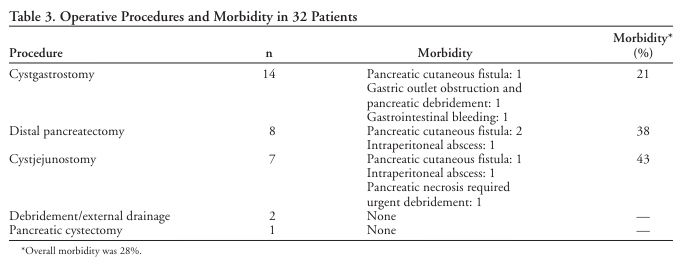
Post-op GI bleed after Frey procedure for chronic pancreatitis. 

“Chronic pancreatitis (CP) is a progressive fibro-inflammatory disease of the pancreas leading to irreversible parenchymal damage with gradual loss of exocrine and endocrine functions. The most common and debilitating manifestation of this disease is intractable pain which may lead to loss of work, unemployment, narcotic dependence, and impairment of the quality of life (QOL). About 30–50% of patients with CP will require surgery during their life time.2,3 Several surgical procedures have been described in the literature, and these are broadly classified as drainage, resectional or a combination of the two. Each respective
procedure is chosen based on the degree of pancreatic ductal dilatation, glandular morphology, local complications, and to some extent on the experience and preference of the surgeon. The Frey procedure (FP) has emerged over the past 30 years as one of the most commonly performed operations for painful CP associated with enlarged pancreatic head. The procedure results in substantial and sustained pain relief in the majority of patients. Like other major operations, FP also is associated with several post operative complications.”

Continue reading

Splenectomy and gastric devascularization in patient with chronic pancreatitis sequelae leading to splenic vein thrombosis

“Patients with extrahepatic portal vein thrombosis may present from infancy through adulthood with variceal bleeding. Physiologically, such patients differ from patient s with cirrhosis and variceal bleeding in that they have a normal liver and maintain good portal perfusion through hepatopedal collaterals.”
“Therapeutic options range from noninterventive, through ablative procedures, to shunt operations. The goal should be definitive control of bleeding and return to a normal lifestyle. Distal splenorenal shunt offers the best option if technically feasible, but if no shuntable veins are patent, ablative procedures and sclerotherapy may be required. A noninterventive, noninvestigational approach is inappropriate in patients who can be offered definitive
therapy. Splenectomy for hypersplenism should not be done in these patients.” (Galloway)

Galloway
Continue reading

Emergency transarterial embolization for mesenteric bleeding – Safety and efficacy

“Mesenteric bleeding (MB) occurs rarely and its frequency is not well known. It corresponds to bleeding from mesenteric vessels in the abdominal cavity, without intra-luminal digestive bleeding. Although relatively rare, this pathology can be life-threatening if left undiagnosed and untreated. Clinically, MB are characterized by non-systematised abdominal pain and sudden blood loss. MB has many causes such as a post operative complication (especially after pancreaticoduodenectomy), traumatism, tumour, or may be idiopathic with no cause found. CT-scan is the gold standard of diagnostic imaging to identify the cause of MB. While the management of upper and lower gastrointestinal bleeding has been well established, the management of active mesenteric bleeding is less defined in the medical literature.”

Continue reading

Pancreas-sparing duodenectomy for duodenal polyposis

“Pancreas-sparing duodenectomy, although technically demanding, eliminates the need for pancreatic resection. Pancreas-sparing duodenectomy is associated with good absorptive capacity, weight gain, and quality of life. Furthermore, it may reduce the risk of subsequent malignancy. Long-term surveillance, however, is still required. Pancreas-sparing duodenectomy is contraindicated in the setting of malignancy.”

Continue reading

Primary Bile Reflux Gastritis: Which Treatment is Better, Roux-en-Y or Biliary Diversion?

“Various treatments for [Primary Bile Reflux Gastritis] have been proposed since its recognition. Operations that have been utilized are the Roux-en-Y procedure, the Braun enteroenterostomy, the Henley jejunal interposition, and several modifications of each of these operations. These procedures produce relief from bile reflux, but all have particular side effects of their own. Before the utilization of vagotomy for ulcer disease, stomal ulceration at the gastrojejunal anastomosis was the most frequent postoperative problem. Currently, the most commonly applied operation is the Roux-en-Y gastrojejunostomy, which requires vagotomy and antrectomy and results in the equally disabling Roux stasis syndrome in about one-half of patients.”

“Because of these difficulties, a new procedure is proposed wherein only bile is diverted by means of a Roux-en-Y limb and no gastric procedure is done. This allows minimal disturbance of gastric motility and totally diverts bile away from the gastric lumen.”

Continue reading

Society for Vascular Surgery (SVS) Clinical Practice Guidelines on Popliteal Artery Aneurysms

“Popliteal artery aneurysms (PAAs) are the most common peripheral arterial aneurysms, defined as aneurysms outside the aortoiliac system or the brain, accounting for 70% of all peripheral arterial aneurysms. They are more common in men (95%) and tend to occur in the sixth and seventh decades of life. Few modern studies have been performed on the natural history of PAAs, and many of these were retrospective reviews of surgical patients. As such, the timing and details of PAA management remain nuanced.”

“These guidelines focus on PAA screening, indications for intervention, choice of repair strategy, management of asymptomatic and symptomatic PAAs (including those presenting with acute limb ischemia), and follow-up of both untreated and treated PAAs. They offer long-awaited evidence-based recommendations for physicians taking care of these patients.”

Continue reading