ASCRS Clinical Practice Guidelines for the Treatment of Left-Sided Colonic Diverticulitis

Hall J, Hardiman K, Lee S, et al. The American Society of Colon and Rectal Surgeons Clinical Practice Guidelines for the Treatment of Left-Sided Colonic Diverticulitis. Dis Colon Rectum. 2020 Jun;63(6):728-747.

Full-text for Emory users.

“This publication summarizes the changing treatment paradigm for patients with left-sided diverticulitis. Although diverticular disease can affect any segment of the large intestine, we will focus on left-sided disease. Bowel preparation, enhanced recovery pathways, and prevention of thromboembolic disease, while relevant to the management of patients with diverticulitis, are beyond the scope of these guidelines and are addressed in other ASCRS clinical practice guidelines.”
Continue reading

Trocar injuries in laparoscopy

Nishimura M, et al. Complications Related to the Initial Trocar Insertion of 3 Different Techniques: A Systematic Review and Meta-analysis. J Minim Invasive Gynecol. 2019 Jan;26(1):63-70.

Emory users, request article via ILLiad.

This systematic review aimed to investigate complications related to initial trocar insertion among 3 different laparoscopic techniques: Veress needle (VN) entry, direct trocar entry (DTE), and open entry (OE). A literature search was completed, and complications were assessed. Major vessel injury, gastrointestinal injury, and solid organ injury were defined as major complications. Minor complications were defined as subcutaneous emphysema, extraperitoneal insufflation, omental emphysema, trocar site bleeding, and trocar site infection. Arm-based network meta-analyses were performed to identify the differences in complications among the 3 techniques. Seventeen studies were included in the quantitative analysis. DTE resulted in fewer major complications when compared with VN entry although the difference was not significant (p = .23) as well as significantly fewer minor complications (p < .001). There were no significant differences in minor complications when comparing OE and DTE (p = .74). Fewer major complications were observed with OE compared with VN entry although the difference was not significant (p = .31). There were significantly fewer minor complications for patients who underwent OE (p = .01). DTE patients experienced the least number of minor complications followed by VN entry and OE. In conclusion, major complications are extremely rare, and all 3 insertion methods can be performed without mortality.

Continue reading

Surgical management of mycotic aortic aneurysms

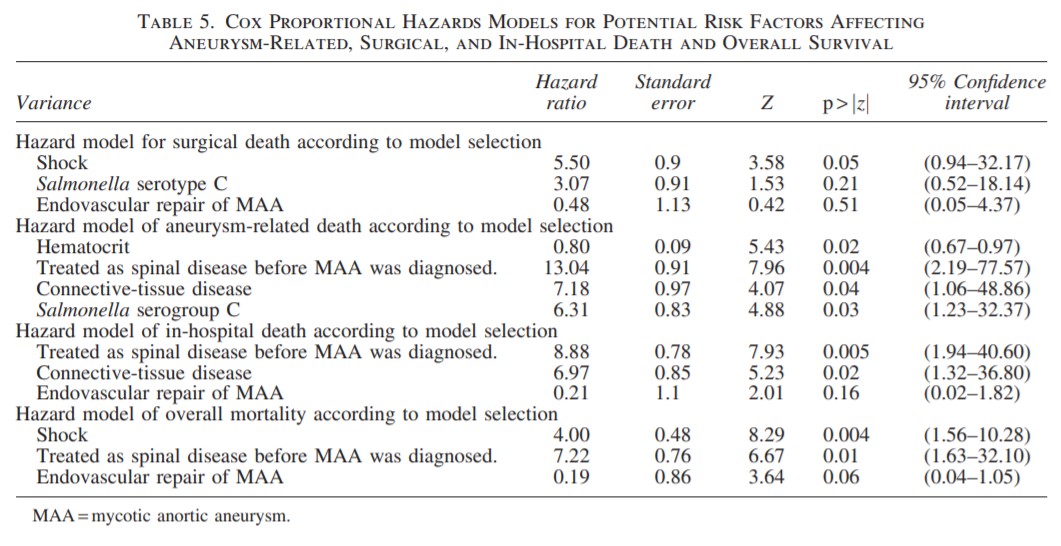
Huang YK, et al. Clinical, microbiologic, and outcome analysis of mycotic aortic aneurysm: the role of endovascular repair. Surg Infect (Larchmt). 2014 Jun;15(3): 290-8.

Free full-text.

Click to enlarge.

Results: All of the patients had positive blood cultures, radiologic findings typical of MAA, and clinical signs of infection (leukocytosis, fever, and elevated C-reactive protein). The mean age of the patients was 63.8±10.6 y and the mean period of their follow up was 35.7±39.3 mo. Twenty-nine patients with MAAs underwent traditional open surgery, 11 others received endovascular stent grafts, and four MAAs were managed conservatively. The most frequent causative pathogens were Salmonella (36/44 patients [81.8%]), in whom organisms of Salmonella serogroup C (consisting mainly of S. choleraesuis) were identified in 14 patients, organisms of Salmonella serogroup D were identified in 13 patients, and species without serogroup information were identified in nine patients. The overall mortality in the study population was 43.2% (with an aneurysm-related mortality of 18.2%, surgically related mortality of 13.6%, and in-hospital mortality of 22.7%).

Continue reading

Visceral Hypersensitivity

Zhou Q, Verne GN. New insights into visceral hypersensitivity–clinical implications in IBS. Nat Rev Gastroenterol Hepatol. 2011 Jun;8(6):349-55.

Key points

  • Visceral and somatic hypersensitivity are present in some patients with functional gastrointestinal disorders
  • Injury to visceral afferents is the most common underlying cause of visceral hypersensitivity that is maintained by either peripheral and/or central nervous system mechanisms
  • Animal models of hypersensitivity have been used to examine the neural mechanisms of hypersensitivity following inflammatory injury, such as alterations in the N-methyl, D-aspartate receptor, dorsal horn neurons or c-Fos
  • Increased intestinal permeability might lead to hypersensitivity and abdominal pain in patients with functional gastrointestinal disorders
  • Functional gastrointestinal disorders are similar to other chronic pain disorders in which persistent nociceptive mechanisms are activated

Continue reading

Pancreaticoduodenectomy in patients with previous Roux-en-Y gastric bypass

Shah MM, Martin BM, Stetler JL, Patel AD, Davis SS, Sarmiento JM, Lin E. Reconstruction Options for Pancreaticoduodenectomy in Patients with Prior Roux-en-Y Gastric Bypass. J Laparoendosc Adv Surg Tech A. 2017 Nov;27(11):1185-1191.

Full-text for Emory users.

“In summary, of the 13 patients that have been described in the literature who underwent PD after RYGB, 7 (54%) of these patients underwent reconstruction, similar to our preferred approach (Fig. 2), which involved remnant gastrectomy with the BP limb forming the BP anastomoses. Overall, 8 (61.5%) of the 13 patients had remnant gastrectomy. Five patients did not have a remnant gastrectomy. There are 10 patients in the literature where the surgeon attempted resecting the gastric remnant, and 8 (80%) of these patients had successful remnant gastrectomy. However, based on the published literature, this is clearly a small sampling of what might have actually been performed. We have had three such patients where we performed PD in patients with prior RYGB (similar to Fig. 2a). In all patients, we had adequate BP limb length for the anastomoses. The patients had early recovery of bowel function and were discharged from the hospital on or before postoperative day 5 without any significant complications. Continue reading

Iatrogenic ureteral injury in colorectal cancer surgery

Andersen P, et al. Iatrogenic ureteral injury in colorectal cancer surgery: a nationwide study comparing laparoscopic and open approaches. Surg Endosc. 2015 Jun;29(6): 1406-12.

Full-text for Emory users.

Results: A total of 18,474 patients had a resection for colorectal cancer. Eighty-two ureteral injuries were related to colorectal surgery. The rate of ureteral injuries in the entire cohort was 0.44 %, with 37 (0.59 %) injuries in the laparoscopic group (n = 6,291) and 45 (0.37 %) injuries in the open group (n = 12,183), (P = 0.03). No difference in ureteral injury was found in relation to surgical approach in colon cancer patients. In rectum cancer patients (n = 5,959), the laparoscopic approach was used in 1,899 patients, and 19 (1.00 %) had ureteral injuries, whereas 17 (0.42 %) of 4,060 patients who underwent an open resection had a ureteral injury. In multivariate analysis adjusted for age, gender, ASA score, BMI, tumor stage, preoperative chemo-radiation, calendar year, and specialty of the surgeon, the laparoscopic approach was associated with an increased risk of ureteral injury, OR = 2.67; 95 % CI 1.26-5.65.

Conclusion: In this nationwide study laparoscopic surgery for rectal cancer with curative intent was associated with a significantly increased risk of iatrogenic ureteral injury compared to open surgery.

Continue reading