Prophylactic cerebrospinal fluid drainage for thoracic endovascular aortic repair (TEVAR)

Mazzeffi M, et al. Contemporary Single-Center Experience With Prophylactic Cerebrospinal Fluid Drainage for Thoracic Endovascular Aortic Repair in Patients at High Risk for Ischemic Spinal Cord Injury. J Cardiothorac Vasc Anesth. 2018 Apr;32(2): 883-889.

Full-text for Emory users.

Flowchart TEVAR high risk ISCI outcomes_complications

Fig 2. Flowchart showing patient outcomes and complications in the cohort. SCI, spinal cord injury; SCPP, spinal cord perfusion pressure; TEVAR, thoracic endovascular aortic repair.

In summary, in a contemporary cohort of 102 patients undergoing TEVAR with a high risk for ischemic SCI, prophylactic CSF drainage was associated with a 2% paraplegia rate and 3.9% rate of drain-related complications. No patient with a drain-related complication had permanent injury, and only 1 patient required surgical intervention for spinal cord compression from epidural hematoma. Three patients with new paraplegia after surgery improved with targeted MAP increases and CSF drainage aimed to increase SCPP by 25%, whereas 1 patient’s symptoms never improved. These data further support the safety of prophylactic lumbar CSF drainage in patients undergoing TEVAR with a high risk for ischemic SCI.”

Continue reading

Heparin-induced thrombocytopenia (HIT): The use of platelet transfusion

One of the topics of discussion this week was the utilization of platelet transfusions in patients with heparin-induced thrombocytopenia.


Goel R, et al. Platelet transfusions in platelet consumptive disorders are associated with arterial thrombosis and in-hospital mortality. Blood. 2015 Feb 26;125(9):1470-6.

Free full-text.

While platelets are primary mediators of hemostasis, there is emerging evidence to show that they may also mediate pathologic thrombogenesis. Little data are available on risks and benefits associated with platelet transfusions in thrombotic thrombocytopenic purpura (TTP), heparin-induced thrombocytopenia (HIT) and immune thrombocytopenic purpura (ITP). This study utilized the Nationwide Inpatient Sample to evaluate the current in-hospital platelet transfusion practices and their association with arterial/venous thrombosis, acute myocardial infarction (AMI), stroke, and in-hospital mortality over 5 years (2007-2011). Age and gender-adjusted odds ratios (adjOR) associated with platelet transfusions were calculated. There were 10 624 hospitalizations with TTP; 6332 with HIT and 79 980 with ITP. Platelet transfusions were reported in 10.1% TTP, 7.1% HIT, and 25.8% ITP admissions. Platelet transfusions in TTP were associated with higher odds of arterial thrombosis (adjOR = 5.8, 95%CI = 1.3-26.6), AMI (adjOR = 2.0, 95%CI = 1.2-3.3) and mortality (adjOR = 2.0,95%CI = 1.3-3.0), but not venous thrombosis. Platelet transfusions in HIT were associated with higher odds of arterial thrombosis (adjOR = 3.4, 95%CI = 1.2-9.5) and mortality (adjOR = 5.2, 95%CI = 2.6-10.5) but not venous thrombosis. Except for AMI, all relationships remained significant after adjusting for clinical severity and acuity. No associations were significant for ITP. Platelet transfusions are associated with higher odds of arterial thrombosis and mortality among TTP and HIT patients.

Continue reading

Bile duct injuries: classification & repair

One discussion last week included classification of bile duct injuries.

Seeras K, Kalani AD. Bile Duct Repair. 2018 Nov 24. StatPearls [Internet]. Treasure Island (FL): StatPearls Publishing; 2019 Jan-.

Free full-text.

Clinical Significance: “Many major bile duct injuries will require surgical repair. There are many described techniques for complex biliary injury repairs including primary repair or primary end to end anastomosis of bile ducts, choledochoduodenostomy, and cholecystojejunostomy. The most popular surgical repair is the Roux-en-Y hepaticojejunostomy. This operation has been consistently superior to the other methods when considering long-term outcomes. There are many different techniques described to perform an RYHJ, and the operating surgeon should choose the method with which he or she is most comfortable or experienced.”

Continue reading

Signet-ring cell carcinoma: a look at the rare colorectal cancer

A discussion this week included signet ring cell carcinoma.


Reference: Nitsche U, et al. Mucinous and signet-ring cell colorectal cancers differ from classical adenocarcinomas in tumor biology and prognosis. Annals of Surgery. 2013 Nov;258(5):775-782; discussion 782-783. doi:10.1097/SLA.0b013e3182a69f7e

Additional Reading: Korphaisarn K, et al. Signet ring cell colorectal cancer: genomic insights into a rare subpopulation of colorectal adenocarcinoma. British Journal of Cancer. 2019 Sep;121(6):505-510. doi:10.1038/s41416-019-0548-9

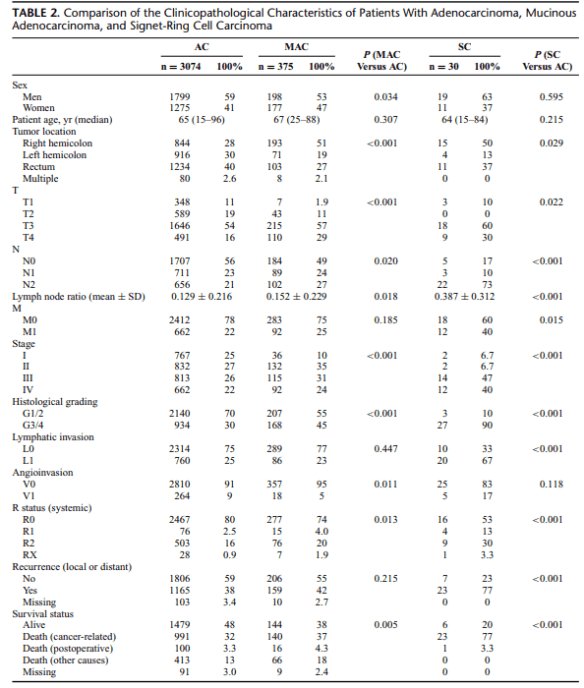
Summary: In a study analyzing clinical, histopathological, and survival data of 3479 patients undergoing surgery for primary colorectal cancer between 1982 and 2012, Nitsche et al (2013) compared the characteristics of classical adenocarcinomas (AC) to the less common mucinous adenocarcinomas (MAC) and to the rare signet-ring cell carcinomas (SC).
SC

Approximately 10% of all colorectal cancers are MAC, and about 1% are SC. Because of their relatively rare occurrence, in particular, the evaluation of the clinical impact of SC is difficult. However, compared with AC, both MAC and SC have been shown to be associated with young age, advanced tumor stage, accumulation in female patients, and distinct molecular patterns, such as microsatellite instability and activating mutations of the BRAF gene. Although ambiguous, recent data and meta-analyses suggest that the
histological subtype MAC may be associated with worse outcome compared with AC. Poor prognosis of SC is more evident, mainly due to high rates of synchronous and metachronous distant organ metastasis associated with this histological subtype.

In describing SC, the authors state: “SC have been described as being positive for intestinal trefoil factor and MUC2, 2 peptides that are usually produced only by goblet cells. Thus, SC could arise from different cells of origin than AC. Although they can be localized in the colorectum, SC may be genetically more related to signet-ring cell cancers of other organs (eg, gastric cancer) than to AC or MAC of the colorectum. The
absence of E-cadherin/β-catenin and amplification of Bcl-2 are features typically shared with signet-ring cell cancer of the stomach but not with classical colorectal adenocarcinomas” (p.781).

The authors conclude that patients with MAC and SC could profit from closer follow-up or even intensified adjuvant therapy because of their high rates of local and distant recurrence. The biological behavior of SC differs in specific, and these patients require special awareness, despite the relatively rare prevalence.

AAA repair: retroperitoneal vs transperitoneal approach

One discussion this week included transperitoneal vs retroperitoneal  approach following AAA repair.


Reference: Buck DB, et al. Transperitoneal vs retroperitoneal approach for open abdominal aortic aneurysm repair in the targeted vascular NSQIP. Journal of Vascular Surgery. 2016 Sept;64(3):585-591. doi:10/1016/j.jvs.2016.01.055.

Summary: This study aims to identify the demographic and anatomical differences between patients currently selected for elective transperitoneal versus retroperitoneal AAA repair and to assess differences in intra-operative details, and perioperative mortality and complications.

Continue reading

The PAUSE study: Safety of perioperative DOAC management in patients with atrial fibrillation

A discussion during a previous conference included the perioperative management of patients with atrial fibrillation receiving a direct oral anticoagulant (DOAC).


Reference: Douketis JD, et al. Perioperative management of patients with atrial fibrillation receiving a direct oral anticoagulant. JAMA Internal Medicine. 2019 Aug 5; doi:10/1001/jamainternmed.2019.2431

Summary: Each year, 1 in 6 patients with AF, or an estimated 6 million patients worldwide, will require perioperative anticoagulant management. When DOAC regimens became available for clinical use in AF, starting in 2010, no studies had been conducted to inform the timing of perioperative DOAC therapy interruption and resumption, whether heparin bridging should be given, and whether preoperative coagulation function testing was needed. Uncertainty about the perioperative management of DOACs may be associated with unsubstantiated practices and increased harm to patients.

Continue reading

Open vs endovascular revascularization for acute limb ischemia: a review of major trials

One discussion this week involved open surgical versus endovascular revascularization for acute limb ischemia (ALI).


Reference: Wang JC, Kim AH, Kashyap VS. Open surgical or endovascular revascularization for acute limb ischemia. Journal of Vascular Surgery. 2016 Jan;63(1):270-278. doi:10/1016/j.jvs.2015.09.055.

Summary: Peripheral arterial disease affects approximately 10 million Americans. It can lead to lower extremity ischemic rest pain or tissue loss (Rutherford classification 4 to 6, or Fontaine classification III and IV). Acute limb ischemia (ALI) is defined as the presence of symptoms within 2 weeks of onset. ALI pathogenesis includes vascular stenoses with subsequent in situ thrombosis or thromboembolism from a cardiac or aortoiliac source. Stenotic lesions may indicate untreated comorbidities (eg, hypertension, hypercholesterolemia, diabetes, or tobacco use), whereas thromboembolisms implicate undiagnosed cardiac arrhythmias, myocardial infarction (MI), or mural thrombus. Limb loss risk due to ALI can be as high as 40% with an attendant mortality rate of 15% to 20% (p.270).

Continue reading