
Coronary-artery revascularization before elective major vascular surgery

McFalls EO, Ward HB, Moritz TE, et al. Coronary-artery revascularization before elective major vascular surgery. N Engl J Med. 2004 Dec 30;351(27):2795-804.

Full-text for Emory users.

Results: Of 5859 patients scheduled for vascular operations at 18 Veterans Affairs Medical centers, 510 (9 percent) were eligible for the study and were randomly assigned to either coronary-artery revascularization before surgery or no revascularization before surgery. The indications for a vascular operation were an expanding abdominal aortic aneurysm (33 percent) or arterial occlusive disease of the legs (67 percent). Among the patients assigned to preoperative coronary-artery revascularization, percutaneous coronary intervention was performed in 59 percent, and bypass surgery was performed in 41 percent. The median time from randomization to vascular surgery was 54 days in the revascularization group and 18 days in the group not undergoing revascularization (P<0.001). At 2.7 years after randomization, mortality in the revascularization group was 22 percent and in the no-revascularization group 23 percent (relative risk, 0.98; 95 percent confidence interval, 0.70 to 1.37; P=0.92). Within 30 days after the vascular operation, a postoperative myocardial infarction, defined by elevated troponin levels, occurred in 12 percent of the revascularization group and 14 percent of the no-revascularization group (P=0.37). Continue reading

Aortic stenosis and noncardiac surgery: risks and postoperative outcomes

Pislaru SV, et al. Aortic stenosis and noncardiac surgery: managing the risk. Curr Probl Cardiol. 2015 Nov;40(11):483-503.

Full-text for Emory users. 

“In summary, the mortality risk at contemporary noncardiac surgery has followed the general trend of decreasing surgical mortality rate, and is currently at 1.5%-4% for elective procedures, significantly lower than those in the early reports (Fig 1). Presence of severe AS does not result in increased mortality rates, but rather in excess cardiovascular morbidity (most notably myocardial infarction [13] or new or worsening heart failure [14]). Symptomatic patients have worse outcomes.” (pg. 488) Continue reading

The safety of enteral and parenteral nutrition in ICU patients receiving vasopressors

Patel JJ, et al. Phase 3 Pilot Randomized Controlled Trial Comparing Early Trophic Enteral Nutrition With “No Enteral Nutrition” in Mechanically Ventilated Patients With Septic Shock. JPEN J Parenter Enteral Nutr. 2020 Jul;44(5):866-873.

Full-text for Emory users.

Results: One hundred thirty-one patients were eligible for enrollment, and 49 were available for consent. Thirty-one (86%) consented and were randomized and 100% of patients in the early EN arm and 94% in the “no EN” arm completed their protocols. While on vasopressors, early EN group received median 384 kcal, and the “no EN” group received median 0 kcal. Contamination rate was 0 in the early trophic EN arm and 6% in the “no EN” arm. The early EN group had median 25 intensive care unit-free days, as compared with 12 in the “no EN” arm (P = .014). The early EN arm had median 27 ventilator-free days, compared with 14 in “no EN” arm (P = .009).

Conclusion: Our protocol comparing early trophic EN with “no EN” in septic shock was feasible. Early trophic EN may be beneficial, but a larger multicenter trial is warranted to confirm the observed clinical benefits seen in this trial.

Continue reading

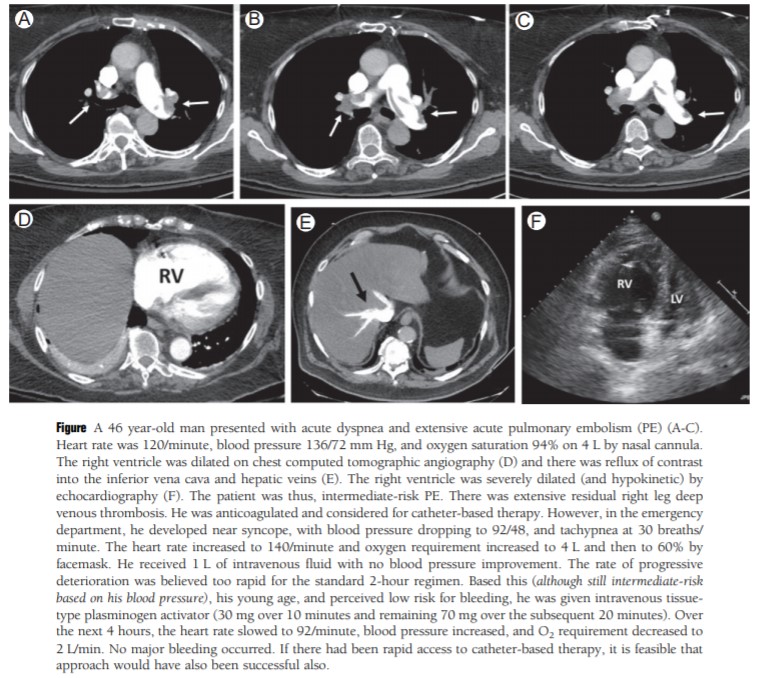
Systemic Thrombolysis for Pulmonary Embolism

Tapson VF, Friedman O. Systemic Thrombolysis for Pulmonary Embolism: Who and How. Tech Vasc Interv Radiol. 2017 Sep;20(3):162-174.

Full-text for Emory users.

PE screenshot

“For several decades, clinicians and clinical trialists have worked toward a more aggressive, yet safe solution for patients with intermediate-risk PE. Standard-dose thrombolysis, low-dose systemic thrombolysis, and catheter-based therapy which includes a number of devices and techniques, with or without low-dose thrombolytic therapy, have offered potential solutions and this area has continued to evolve. On the basis of heterogeneity within the category of intermediate-risk as well as within the high-risk group of patients, we will focus on the use of systemic thrombolysis in carefully selected high- and intermediate-risk patients. In certain circumstances when the need for aggressive therapy is urgent and the bleeding risk is acceptable, this is an appropriate approach, and often the best one.”


More PubMed results on systemic thrombolysis.

Perioperative morbidity in patients randomized to epidural or general anesthesia for lower extremity vascular surgery.

Christopherson R, Beattie C, Frank SM, Norris EJ, Meinert CL, Gottlieb SO, Yates H, Rock P, Parker SD, Perler BA, et al. Perioperative morbidity in patients randomized to epidural or general anesthesia for lower extremity vascular surgery. Anesthesiology. 1993 Sep;79(3): 422-34.

Full-text for Emory users.

Background: Perioperative morbidity may be modifiable in high risk patients by the anesthesiologist’s choice of either regional or general anesthesia. This clinical trial compared outcomes between epidural (EA) and general (GA) anesthesia/analgesia regimens in a group of patients at high risk for cardiac and other morbidity who were undergoing similarly stressful surgical procedures.

Continue reading

The surgical management of purulent peritonitis from perforated diverticulitis

Oberkofler CE, et al. A multicenter randomized clinical trial of primary anastomosis or Hartmann’s procedure for perforated left colonic diverticulitis with purulent or fecal peritonitis. Ann Surg. 2012 Nov; 256(5):819-26; discussion 826-7.

Full-text for Emory users.

Results: Patient demographics were equally distributed in both groups (Hinchey III: 76% vs 75% and Hinchey IV: 24% vs 25%, for HP vs PA, respectively). The overall complication rate for both resection and stoma reversal operations was comparable (80% vs 84%, P = 0.813). Although the outcome after the initial colon resection did not show any significant differences (mortality 13% vs 9% and morbidity 67% vs 75% in HP vs PA), the stoma reversal rate after PA with diverting ileostomy was higher (90% vs 57%, P = 0.005) and serious complications (Grades IIIb-IV: 0% vs 20%, P = 0.046), operating time (73 minutes vs 183 minutes, P < 0.001), hospital stay (6 days vs 9 days, P = 0.016), and lower in-hospital costs (US $16,717 vs US $24,014) were significantly reduced in the PA group.

Conclusions: This is the first randomized clinical trial favoring PA with diverting ileostomy over HP in patients with perforated diverticulitis.


Thornell A, et al. Laparoscopic Lavage for Perforated Diverticulitis With Purulent Peritonitis: A Randomized Trial. Ann Intern Med. 2016 Feb 2;164(3):137-45.

Full-text for Emory users.

LL vs Hartmann

Continue reading