T-Tubes

Dageforde LA, Lillemoe KD. (2020). Management of Acute Cholangitis. In: Cameron JL, Cameron AM (Eds), Current Surgical Therapy, 13th ed. Elsevier: Philadelphia.

“Recent literature advocates for primary closure of the common bile duct after elective CBDE because of complications from T-tube placement. But in patients with cholangitis, placement of a T-tube is necessary for biliary decompression and allows easy access for future cholangiogram if the obstruction does not resolve. T-tube drainage has been associated with bile leak and requires externalization of the tube for several days until postoperative cholangiography demonstrates resolution of obstruction. Primary closure can lead to stricture and bile leak and result in no direct access to the biliary tree for future investigations.”

Fig. 2. Insertion of a T-tube in the common bile duct with subsequent closure using absorbable monofilament suture (4-0 or 5-0). The T-tube is prepared in one of the ways shown. From: Zollinger RM, Jr, Zollinger RM. Atlas of Surgical Operations. 7th ed. New York: McGraw-Hill; 1993.

Continue reading

The management of breast abscesses

Lam E, Chan T, Wiseman SM. Breast abscess: evidence based management recommendations. Expert Rev Anti Infect Ther. 2014 Jul;12(7):753-62.

Full-text for Emory users.

Key issues:

  • All breast abscesses should be treated with abscess drainage and concurrent empiric antibiotic therapy.
  • Needle aspiration either with or without ultrasound guidance should be employed as first-line treatment of breast abscesses. However, multiple aspiration sessions may be required.
  • Ultrasound-guided percutaneous catheter placement may be considered as an alternative approach for drainage of larger (>3 cm) abscesses.
  • Surgical incision and drainage is required if needle aspiration or catheter drainage is unsuccessful and there is progression of infection.
  • Surgical incision and drainage should be considered for first-line therapy of large (>5 cm), multiloculated or long-standing breast abscesses.
  • Cultures should be obtained at the time of abscess drainage and antibiotic management tailored to the infecting organism’s susceptibility profile.
  • Empiric antibiotics targeting methicillin-resistant S. aureus may be required for patients who are known to be colonized or considered to be at high risk.
  • For breastfeeding women, the infant should not nurse from the breast with the abscess but may continue nursing from the contralateral, uninfected breast.
  • Future research should prospectively evaluate the utilization of aspiration or percutaneous catheter drainage techniques in terms of frequency of progression of infection requiring surgical management in order to limit selection biases. The optimal frequency of aspirations, time interval between aspirations and duration of catheter placement also requires further study.

Continue reading

Article of interest: Using the greater omental flap to cover the cut surface of the liver for prevention of delayed gastric emptying after left-sided hepatobiliary resection: a prospective RCT.

Igami T, et al. Using the greater omental flap to cover the cut surface of the liver for prevention of delayed gastric emptying after left-sided hepatobiliary resection: a prospective randomized controlled trial. J Hepatobiliary Pancreat Sci. 2011 Mar; 18(2):176-83.

Full-text for Emory users.

Continue reading

Vancomycin-Related Acute Kidney Injury

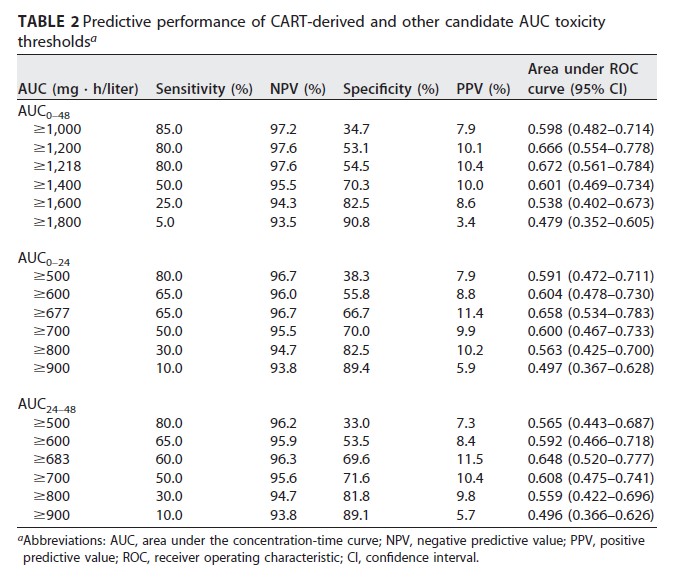
Zasowski EJ, et al. Identification of Vancomycin Exposure-Toxicity Thresholds in Hospitalized Patients Receiving Intravenous Vancomycin. Antimicrob Agents Chemother. 2017 Dec 21;62(1):e01684-17.

Evidence supports vancomycin therapeutic-drug monitoring by area under the concentration-time curve (AUC), but data to establish an AUC upper limit are limited and published nephrotoxicity thresholds range widely. The objective of this analysis was to examine the association between initial vancomycin AUC and nephrotoxicity. This was a multicenter, retrospective cohort study of adult patients receiving intravenous vancomycin from 2014 to 2015. Nephrotoxicity was defined as a serum creatinine increase of 0.5 mg/liter and 50% from baseline on consecutive measurements. Vancomycin exposure profile during the initial 48 h of therapy was estimated using maximum a posteriori probability Bayesian estimation. Vancomycin AUC and minimum-concentration (Cmin) thresholds most strongly associated with nephrotoxicity were identified via classification and regression tree (CART) analysis. Predictive performances of CART-derived and other candidate AUC thresholds was assessed through positive and negative predictive value and receiver operating characteristic curves. Poisson regression was used to quantify the association between exposure thresholds and nephrotoxicity while adjusting for confounders. Among 323 patients included, nephrotoxicity was significantly higher in patients with AUCs from 0 to 48 h (AUC0-48) of ≥1,218 mg · h/liter, AUC0-24 of ≥677 mg · h/liter, AUC24-48 of ≥683 mg · h/liter, and day 1 Cmin (Cmin24) of ≥18.8 mg/liter. Vancomycin exposure in excess of these thresholds was associated with a 3- to 4-fold-increased risk of nephrotoxicity in Poisson regression. The predictive performance of AUC for nephrotoxicity was maximized at daily AUC values between 600 and 800 mg · h/liter. Although these data support an AUC range for vancomycin-associated nephrotoxity rather than a single threshold, available evidence suggests that a daily AUC limit of 700 mg · h/liter is reasonable.

Continue reading

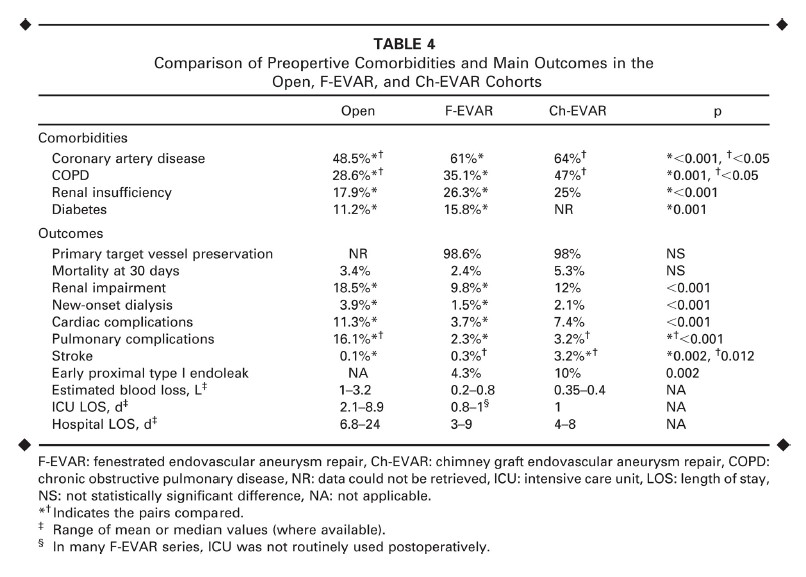
Article of interest: Comparison of outcomes with open, fenestrated, and chimney graft repair of juxtarenal aneurysms: are we ready for a paradigm shift?

Katsargyris A, et al. Comparison of outcomes with open, fenestrated, and chimney graft repair of juxtarenal aneurysms: are we ready for a paradigm shift? J Endovasc Ther. 2013 Apr;20(2):159-69.

Full-text for Emory users.

Results: A total of 2465 vessels were targeted with fenestrations and 151 with chimney grafts (CG); intraoperative target vessel preservation was 98.6% and 98.0%, respectively. Cumulative 30-day mortality was 3.4%, 2.4%, and 5.3% for open surgery, F-EVAR and Ch-EVAR, respectively (p=NS). Impaired renal function was noted in 18.5%, 9.8%, and 12% following open surgery, F-EVAR, and Ch-EVAR, respectively (open vs. F-EVAR: p<0.001). New-onset dialysis was required postoperatively in 3.9%, 1.5%, and 2.1%, respectively (open vs. F-EVAR: p<0.001). Postoperative cardiac complications were noted in 11.3%, 3.7%, and 7.4%, respectively (open vs. F-EVAR: p<0.001). The incidence of ischemic stroke was 0.1% and 0.3% following open surgery and F-EVAR, but 3.2% after Ch-EVAR (open vs. Ch-EVAR: p=0.002; F-EVAR vs. Ch-EVAR: p=0.012). Early proximal type I endoleak was lower after F-EVAR compared to Ch-EVAR (4.3% vs. 10%, respectively, p=0.002).

Continue reading

Ileal pouch-anal anastomosis (IPAA) for familial adenomatous polyposis (FAP) patients

Xie M, et al. Does ileoanal pouch surgery increase the risk of desmoid in patients with familial adenomatous polyposis? Int J Colorectal Dis. 2020 Aug;35(8):1599-1605.

Full-text for Emory users.

Results: Eight retrospective studies with a total of 1072 patients were identified: 491 underwent IPAA and 581 IRA. There was no significant difference in the incidence of DTs between IPAA and IRA (11.81% vs. 9.47%, OR 0.95, P = 0.85). Meanwhile, the overall complication (42.97% vs. 36.76%, OR 1.32, P = 0.11), incidence of cancer (4.88% vs. 8.37%, OR 0.28, P = 0.26), and overall mortality (0.33% vs. 5.20%, OR 0.49, P = 0.53) were comparable too.

Conclusion: Ileoanal pouch surgery is associated with similar risk of desmoid in patients with FAP after surgery.


Ng KS, Gonsalves SJ, Sagar PM. Ileal-anal pouches: A review of its history, indications, and complications. World J Gastroenterol. 2019 Aug 21;25(31):4320-4342.

As the IPAA celebrated its 40th anniversary in 2018, this review provides a timely outline of its history, indications, and complications. IPAA has undergone significant modification since 1978. For both UC and FAP, IPAA surgery aims to definitively cure disease and prevent malignant degeneration, while providing adequate continence and avoiding a permanent stoma. The majority of patients experience long-term success, but “early” and “late” complications are recognised. Pelvic sepsis is a common early complication with far-reaching consequences of long-term pouch dysfunction, but prompt intervention (either radiological or surgical) reduces the risk of pouch failure. Even in the absence of sepsis, pouch dysfunction is a long-term complication that may have a myriad of causes. Pouchitis is a common cause that remains incompletely understood and difficult to manage at times. 10% of patients succumb to the diagnosis of pouch failure, which is traditionally associated with the need for pouch excision. This review provides a timely outline of the history, indications, and complications associated with IPAA. Patient selection remains key, and contraindications exist for this surgery. A structured management plan is vital to the successful management of complications following pouch surgery.

Continue reading

Rapid Sequence Intubation

Groth CM, Acquisto NM, Khadem T. Current practices and safety of medication use during rapid sequence intubation. J Crit Care. 2018 Jun;45:65-70.

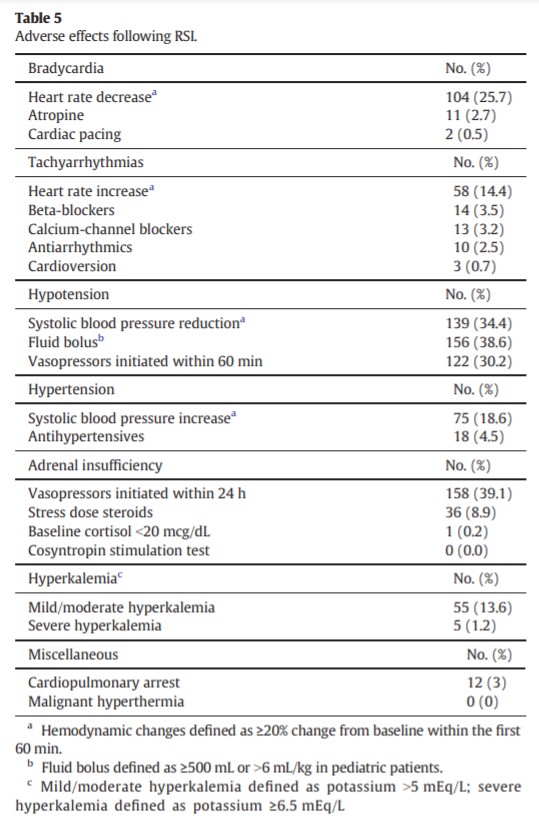
“A total of 404 patients from 34 geographically diverse institutions were included (mean age 58 ± 22 years, males 59%, pediatric 8%). During RSI, 21%, 87%, and 77% received pre-induction, induction, and paralysis, respectively. Significant differences in medication use by provider type were seen. Etomidate was administered to 58% with sepsis, but was not associated with adrenal insufficiencyKetamine was associated with hypotension post-RSI [RR = 1.78 (1.36–2.35)] and use was low with traumatic brain injury/stroke (1.5%). Succinylcholine was given to 67% of patients with baseline bradycardia and was significantly associated with bradycardia post-RSI [RR = 1.81 (1.11–2.94)]. An additional 13% given succinylcholine had contraindications. Sedation practices post-RSI were not consistent with current practice guidelines and most receiving a non-depolarizing paralytic did not receive adequate sedation post-RSI.”

Continue reading