
Shoulder positioning for subclavian venous catheterization

Jeong HH, et al. A quantitative analysis of the relation between the clavicular tilt angle and subclavian central venous catheter misplacement. Clin Exp Emerg Med. 2014 Dec 31; 1(2):114-119.

Free full-text.

RESULTS: Among all central venous catheterizations (n=1,599), the subclavian route was used 981 times (61.4%). There were 51 misplacements of SCV catheters (5.2%) during the study period. There were no differences in the sex, age, blood pressure, and diagnosis between the two groups. The CTA values were 28.5°±7.3° and 22.6°±6.3° in the misplacement group and control group, respectively (95% confidence interval, 3.6 to 8.1; P<0.001).

CONCLUSION: In this study, the CTA was found to be 5.9° larger in the misplacement group than in the control group. Assuming that CTA indicates the shoulder position, our findings suggest that the chance of SCV catheter misplacement may be reduced by avoiding the shoulder elevated.
Continue reading

Covered stents and coil embolization for treatment of postpancreatectomy hemorrhage

Hassold N, et al. Effectiveness and outcome of endovascular therapy for late-onset postpancreatectomy hemorrhage using covered stents and embolization. J Vasc Surg. 2016 Nov;64(5):1373-1383.

Free full-text.

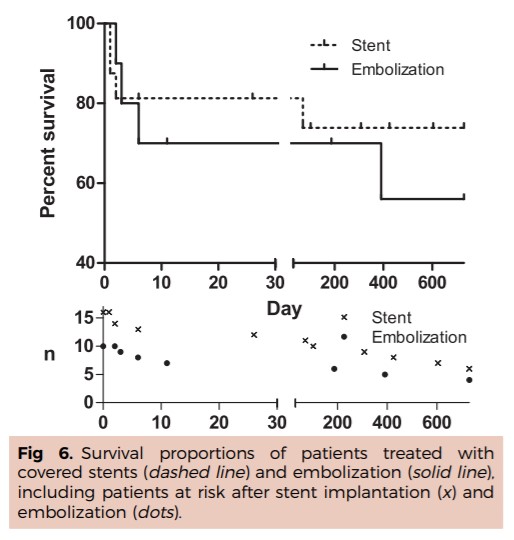
Fig 6 stent vs emobliz

RESULTS: Covered stent placement was successful in 14 of 16 patients (88%); embolization was successful in 10 of 11 (91%) patients. For the embolization group, the overall 30-day and 1-year survival rate was 70%, and the 1- and 2-year survival rate was 56%; for the covered stent group, these rates were 81% and 74%, respectively. The 30-day patency of the covered stent was 84%, and 1-year patency was 42%; clinically relevant ischemia was observed in two patients. Infarction distal to the embolized vessel occurred in 6 of 11 patients (55%).

Continue reading

WARC Journal Club: Inguinal Hernia

de Goede B, et al. Watchful Waiting Versus Surgery of Mildly Symptomatic or Asymptomatic Inguinal Hernia in Men Aged 50 Years and Older: A Randomized Controlled Trial. Ann Surg. 2018 Jan;267(1):42-49.

Full-text for Emory users.

RESULTS: Between January 2006 and August 2012, 528 patients were enrolled, of whom 496 met the inclusion criteria: 234 were assigned to elective repair and 262 to watchful waiting. The mean pain/discomfort score at 24 months was 0.35 [95% confidence interval (CI) 0.28-0.41)] in the elective repair group and 0.58 (95% CI 0.52-0.64) in the watchful waiting group. The difference of these means (MD) was -0.23 (95% CI -0.32 to -0.14). In the watchful waiting group, 93 patients (35·4%) eventually underwent elective surgery and 6 patients (2·3%) received emergent surgery for strangulation/incarceration. Postoperative complication rates and recurrence rates in these 99 operated individuals were comparable with individuals originally assigned to the elective repair group (8.1% vs 15.0%; P = 0.106, 7.1% vs 8.9%; P = 0.668, respectively).

Continue reading

Rate of postoperative biliary complications during major liver resection reduced by intraoperative air leak test

Zimmitti G, Vauthey JN, et al. Systematic use of an intraoperative air leak test
at the time of major liver resection reduces the rate of postoperative biliary
complications. J Am Coll Surg. 2013 Dec;217(6):1028-37.

Free full-text.

STUDY DESIGN: Rates of postoperative biliary complications were compared among 103 patients who underwent ALT and 120 matched patients operated on before ALT was used. All study patients underwent major hepatectomy without bile duct resection at 3 high-volume hepatobiliary centers between 2008 and 2012. The ALT was performed by placement of a transcystic cholangiogram catheter to inject air into the biliary tree, the upper abdomen was filled with saline, and the distal common bile duct was manually occluded. Uncontrolled bile ducts were identified by localization of air bubbles at the transection surface and were directly repaired.

RESULTS: The 2 groups were similar in diagnosis, chemotherapy use, tumor number and size, resection extent, surgery duration, and blood loss (all, p > 0.05). Single or multiple uncontrolled bile ducts were intraoperatively detected and repaired in 62.1% of ALT vs 8.3% of non-ALT patients (p < 0.001). This resulted in a lower rate of postoperative bile leaks in ALT (1.9%) vs non-ALT patients (10.8%; p = 0.008). Independent risk factors for postoperative bile leaks included extended hepatectomy (p = 0.031), caudate resection (p = 0.02), and not performing ALT (p = 0.002) (odds ratio = 3.8; 95% CI, 1.3-11.8; odds ratio = 4.0; 95% CI, 1.1-14.3; and odds ratio = 11.8; 95% CI, 2.4-58.8, respectively).


More forthcoming…

Preoperative cachexia

Mason MC, et al. Preoperative cancer cachexia and short-term outcomes following surgery. J Surg Res. 2016 Oct; 205(2):398-406.

Full-text for Emory users.

Results: Of 253 patients, 16.6% had preoperative cachexia, and 51.8% developed ≥ 1 postoperative complications. Complications were more common in cachectic patients (64.3% versus 49.3%, P = 0.07). This association varied by BMI category, and interaction analysis was significant for those with normal or underweight BMI (BMI < 25, P = 0.03). After multivariate modeling, in patients with normal or underweight BMI, preoperative cachexia was associated with higher odds of postoperative complications (odds ratios, 5.08 [95% confidence intervals, 1.18-21.88]; P = 0.029). Additional predictors of complications included major surgery (3.19 [1.24-8.21], P = 0.01), ostomy (4.43 [1.68-11.72], P = 0.003), and poor baseline performance status (2.31 [1.05-5.08], P = 0.03).

Continue reading

Article of interest: Does Atelectasis Cause Fever After Surgery? Putting a Damper on Dogma.

Crompton JG, Crompton PD, Matzinger P. Does Atelectasis Cause Fever After Surgery? Putting a Damper on Dogma. JAMA Surg. 2019 May 1;154(5):375-376.

Full-text for Emory users.

fever after an operationFigure. Damage-Associated Molecular Patterns (DAMPs) and Pathogen-Associated Molecular Patterns (PAMPs)

“The danger model of immunity challenges the premise of our current therapeutic approach in treating noninfectious causes of postoperative fever. The clinical benefit of interventions targeting atelectasis as a cause of postoperative fever, such as incentive spirometry, need to be reassessed. Continue reading

The utility of biomarkers in inflammatory bowel disease, with a focus on fecal calprotectin

Petryszyn P, et al. Faecal calprotectin as a diagnostic marker of inflammatory bowel disease in patients with gastrointestinal symptoms: meta-analysis. Eur J Gastroenterol Hepatol. 2019 Nov;31(11):1306-1312.

Full-text for Emory users.

“The study aimed to assess efficacy of faecal calprotectin as a diagnostic marker of IBD in patients with symptoms suggestive of such diagnosis. Inclusion criteria comprised experimental and observational studies, adults with gastrointestinal symptoms, calprotectin as index and colonoscopy as reference test, presence of data on/enabling the calculation of diagnostic accuracy parameters. For each study, sensitivity and specificity of faecal calprotectin were analysed as bivariate data. Nineteen studies were identified. The total number of patients was 5032. Calculated pooled sensitivity and specificity were 0.882 [95% confidence interval (CI), 0.827-0.921] and 0.799 (95% CI, 0.693-0.875), respectively. Following faecal calprotectin incorporation in the diagnostic work-up of 100 people with suspected IBD, 18 non-IBD patients will have a colonoscopy performed and one patient with the disease will not be referred for this examination. Faecal calprotectin concentration measurement is a useful screening test to rule out IBD, at the same time reducing the need for colonoscopy by 66.7%.”

Continue reading