Management of pancreatic pseudocysts

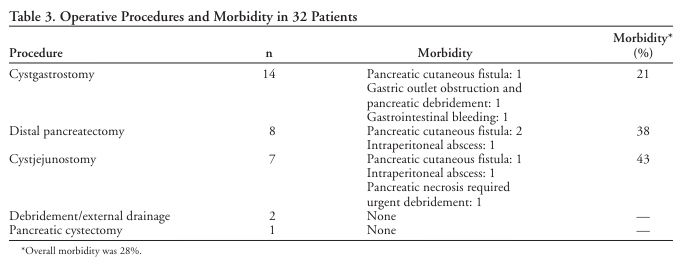
“Operative internal drainage has been standard treatment for chronic unresolved pancreatic pseudocysts (PPs). Recently, percutaneous external drainage (PED) has become the primary mode of treatment at many medical centers.”

“ Operative management for PPs appears to be superior to CT-guided PED. Although the later was often successful, it required major salvage procedures in one third of the patients. An expectant management protocol may be suitable for selected patients.”

Continue reading

Post-op GI bleed after Frey procedure for chronic pancreatitis. 

“Chronic pancreatitis (CP) is a progressive fibro-inflammatory disease of the pancreas leading to irreversible parenchymal damage with gradual loss of exocrine and endocrine functions. The most common and debilitating manifestation of this disease is intractable pain which may lead to loss of work, unemployment, narcotic dependence, and impairment of the quality of life (QOL). About 30–50% of patients with CP will require surgery during their life time.2,3 Several surgical procedures have been described in the literature, and these are broadly classified as drainage, resectional or a combination of the two. Each respective
procedure is chosen based on the degree of pancreatic ductal dilatation, glandular morphology, local complications, and to some extent on the experience and preference of the surgeon. The Frey procedure (FP) has emerged over the past 30 years as one of the most commonly performed operations for painful CP associated with enlarged pancreatic head. The procedure results in substantial and sustained pain relief in the majority of patients. Like other major operations, FP also is associated with several post operative complications.”

Continue reading

Postpancreatectomy hemorrhages: risk factors and outcomes

One discussion this week involved etiologies of postpancreatectomy hemorrhage.


Reference: Yekebas EF, et al. Postpancreatectomy hemorrhage: diagnosis and treatment: an analysis in 1669 consecutive pancreatic resections. Annals of Surgery. 2007 Aug;246(2):269-280. doi:10.1097/01.sla.0000262953.77735.db

Summary: With the purpose of creating algorithms for managing postpancreatectomy hemorrhage (PPH), Yekebas et al (2007) restrospectively analyzed more than 1669 pancreatic resections conducted between 1992 and 2006.  They concluded that the prognosis of postpancreatectomy hemorrhage (PPH) is primarily dependent on the presence of “preceding pancreatic fistula” (p.269).

Continue reading

Distal pancreatectomy with en bloc celiac axis resection (DP-CAR) and arterial reconstruction: Techniques and outcomes

Addeo P, Guerra M, Bachellier P. Distal pancreatectomy with en bloc celiac axis resection (DP-CAR) and arterial reconstruction: Techniques and outcomes. J Surg Oncol. 2021 Jun;123(7):1592-1598.

Full-text for Emory users.

Results: Sixty consecutive DP-CARs were reviewed. Most patients underwent induction chemotherapy (85%) based on FOLFIRINOX protocol (80.3%). The hepatic artery was reconstructed in 50 patients (83.3%). The left gastric artery was reconstructed in 4 and preserved in 14 patients. A venous resection was associated during 44 DP-CARs (36 segmental venous resections/8 lateral venous resections). Ninety days mortality was 5.0% with 48.3% (n = 29) overall rate of morbidity. Postoperative outcomes in term of mortality, morbidity, and ischemic events between patients with and without arterial reconstruction were similar despite a higher rate of venous resection (81% vs. 40%; p = 0.005) and more complex cases (Mayo clinic DP-CARs class 1B, 2A, and 3A) in the reconstructed group.

Conclusion: Arterial reconstruction represents a safe surgical option during DP-CAR to lessen postoperative ischemic events. This technique, reserved to high volume centers expert in vascular resection during pancreatectomy, deserves further comparison with standard technique in a larger setting.

Continue reading

Solid pseudopapillary neoplasms (SPN) of the pancreas

Gandhi D, et al. Solid pseudopapillary Tumor of the Pancreas: Radiological and surgical review. Clin Imaging. 2020 Nov;67:101-107.

Full-text for Emory users.

Highlights:

  • Solid Pseudopapillary Neoplasms of the pancreas are rare pancreatic tumors with low grade malignant potential, typically affecting young females.
  • Small SPNs (< 3cm in diameter) usually appear as completely solid tumors with sharp margins and gradually enhancing, well encapsulated masses in the pancreas and may demonstrate varying amounts of hemorrhage.
  • Large lesions have mixed solid – cystic components showing early weak enhancement with gradual increase in enhancement in the hepatic venous phase.
  • Atypical features including extracapsular, as well as parenchymal invasion, simulation of islet cell tumors, calcifications, ductal obstruction, and metastasis are suspicious for malignant degradation.
  • The tumor is considered unresectable in the event that it invades or encases the aorta, encases >180 degree of the SMA regardless of tumor location in the pancreas, abuts the celiac artery (when the tumor is located in the pancreatic head) or encases >180 degree of the celiac artery (when the tumor is located in the body/tail of the pancreas).
Continue reading

Article of interest: Bleeding complications after pancreatic surgery: interventional radiology management

Biondetti P, Fumarola EM, Ierardi AM, Carrafiello G. Bleeding complications after pancreatic surgery: interventional radiology management. Gland Surg. 2019 Apr;8(2):150-163. doi: 10.21037/gs.2019.01.06.

Surgical intervention in the pancreas region is complex and carries the risk of complications, also of vascular nature. Bleeding after pancreatic surgery is rare but characterized by high mortality. This review reports epidemiology, classification, diagnosis and treatment strategies of hemorrhage occurring after pancreatic surgery, focusing on the techniques, roles and outcomes of interventional radiology (IR) in this setting. We then describe the roles and techniques of IR in the treatment of other less common types of vascular complications after pancreatic surgery, such as portal vein (PV) stenosis, portal hypertension and bleeding of varices.

Surgical management of insulinomas

Andreassen M, Ilett E, Wiese D, et al. Surgical Management, Preoperative Tumor Localization, and Histopathology of 80 Patients Operated on for Insulinoma. J Clin Endocrinol Metab. 2019 Dec 1;104(12):6129-6138.

Full-text for Emory users.

Results: Eighty patients were included. Seven had a malignant tumor. A total of 312 diagnostic examinations were performed: endoscopic ultrasonography (EUS; n = 59; sensitivity, 70%), MRI (n = 33; sensitivity, 58%), CT (n = 55; sensitivity, 47%), transabdominal ultrasonography (US; n = 45; sensitivity, 40%), somatostatin receptor imaging (n = 17; sensitivity, 29%), 18F-fluorodeoxyglucose positron emission tomography/CT (n = 1; negative), percutaneous transhepatic venous sampling (n = 10; sensitivity, 90%), arterial stimulation venous sampling (n = 20; sensitivity, 65%), and intraoperative US (n = 72; sensitivity, 89%). Fourteen tumors could not be visualized. Invasive methods were used in 7 of these 14 patients and localized the tumor in all cases. Median tumor size was 15 mm (range, 7 to 80 mm). Tumors with malignant vs benign behavior showed less staining for insulin (3 of 7 vs 66 of 73; P = 0.015) and for proinsulin (3 of 6 vs 58 of 59; P < 0.001). Staining for glucagon was seen in 2 of 6 malignant tumors and in no benign tumors (P < 0.001). Forty-three insulinomas stained negative for somatostatin receptor subtype 2a.

Conclusion: Localization of insulinomas requires many different diagnostic procedures. Most tumors can be localized by conventional imaging, including EUS. For nonvisible tumors, invasive methods may be a useful diagnostic tool. Malignant tumors showed reduced staining for insulin and proinsulin and increased staining for glucagon.

Continue reading