
Perioperative morbidity in patients randomized to epidural or general anesthesia for lower extremity vascular surgery.

Christopherson R, Beattie C, Frank SM, Norris EJ, Meinert CL, Gottlieb SO, Yates H, Rock P, Parker SD, Perler BA, et al. Perioperative morbidity in patients randomized to epidural or general anesthesia for lower extremity vascular surgery. Anesthesiology. 1993 Sep;79(3): 422-34.

Full-text for Emory users.

Background: Perioperative morbidity may be modifiable in high risk patients by the anesthesiologist’s choice of either regional or general anesthesia. This clinical trial compared outcomes between epidural (EA) and general (GA) anesthesia/analgesia regimens in a group of patients at high risk for cardiac and other morbidity who were undergoing similarly stressful surgical procedures.
Continue reading

The surgical management of purulent peritonitis from perforated diverticulitis

Oberkofler CE, et al. A multicenter randomized clinical trial of primary anastomosis or Hartmann’s procedure for perforated left colonic diverticulitis with purulent or fecal peritonitis. Ann Surg. 2012 Nov; 256(5):819-26; discussion 826-7.

Full-text for Emory users.

Results: Patient demographics were equally distributed in both groups (Hinchey III: 76% vs 75% and Hinchey IV: 24% vs 25%, for HP vs PA, respectively). The overall complication rate for both resection and stoma reversal operations was comparable (80% vs 84%, P = 0.813). Although the outcome after the initial colon resection did not show any significant differences (mortality 13% vs 9% and morbidity 67% vs 75% in HP vs PA), the stoma reversal rate after PA with diverting ileostomy was higher (90% vs 57%, P = 0.005) and serious complications (Grades IIIb-IV: 0% vs 20%, P = 0.046), operating time (73 minutes vs 183 minutes, P < 0.001), hospital stay (6 days vs 9 days, P = 0.016), and lower in-hospital costs (US $16,717 vs US $24,014) were significantly reduced in the PA group.

Conclusions: This is the first randomized clinical trial favoring PA with diverting ileostomy over HP in patients with perforated diverticulitis.


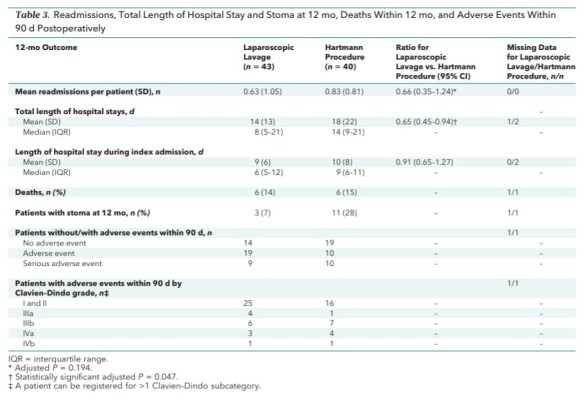
Thornell A, et al. Laparoscopic Lavage for Perforated Diverticulitis With Purulent Peritonitis: A Randomized Trial. Ann Intern Med. 2016 Feb 2;164(3):137-45.

Full-text for Emory users.

LL vs Hartmann

Continue reading

Preoperative splenic artery embolization for massive splenomegaly

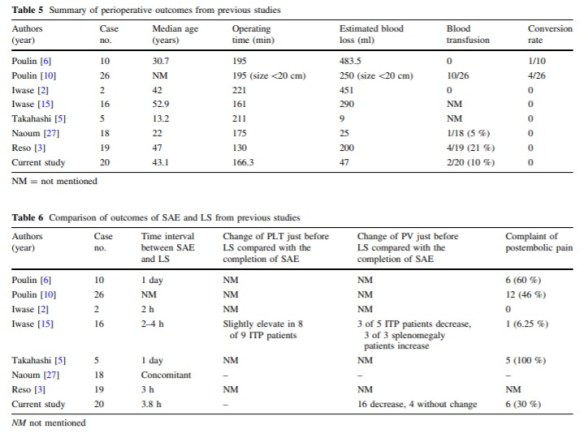
Wu Z, Zhou J, Pankaj P, Peng B. Comparative treatment and literature review for laparoscopic splenectomy alone versus preoperative splenic artery embolization splenectomy. Surg Endosc. 2012 Oct;26(10):2758-66.

Full-text for Emory users.

Surg Endo screenshot

Results: Preoperative splenic artery embolization plus laparoscopic splenectomy was successfully performed in all patients in group 1. One patient in group 2 required an intraoperative conversion to traditional open splenectomy because of severe blood loss. Compared with group 2, significantly shorter operating time, less intraoperative blood loss, and shorter postoperative hospital stay were noted in group 1. No marked significant differences in postoperative complications of either group were observed. Compared with group 3, group 1 had less intraoperative blood loss, shorter postoperative stay, and fewer complications. No significant differences were found in operating time. There was a marked increase in platelet count and white blood count in both groups during the follow-up period.

Conclusions: Preoperative splenic artery embolization with laparoscopic splenectomy reduced the operating time and decreased intraoperative blood loss when compared with laparoscopic splenectomy alone or open splenectomy. Splenic artery embolization is a useful intraoperative adjunctive procedure for patients with splenomegaly because of the benefit of perioperative outcomes.

Continue reading

The FOxTROT (Fluoropyrimidine, Oxaliplatin, and Targeted-Receptor pre-Operative Therapy [Panitumumab]) Trial

Seymour MT, Morton D. FOxTROT: an international randomised controlled trial in 1052 patients (pts) evaluating neoadjuvant chemotherapy (NAC) for colon cancer. J Clin Oncol. 2019 May;37(15 Suppl):3504-3504.

Conclusions: NAC was well tolerated and safe, with no increase in perioperative morbidity and a trend toward fewer serious postoperative complications. Evidence of histological regression was seen in 59% pts after NAC, including some pCRs. This resulted in marked histological downstaging and a halving of the rate of incomplete resections. We observed an improvement in 2-yr failure rate (HR=0.77), but this fell short of statistical significance (p=0.11). NAC for colon cancer improves surgical outcomes and can now be considered as a treatment option; longer follow-up and further trials are required to confirm the long-term benefits, refine its use and optimise case selection. ClinicalTrials.gov Identifier: NCT00647530


Foxtrot Collaborative Group. Feasibility of preoperative chemotherapy for locally advanced, operable colon cancer: the pilot phase of a randomised controlled trial. Lancet Oncol. 2012 Nov;13(11):1152-60.

The FOxTrOT website (University of Birmingham)

Bile Cultures are Poor Predictors of Antibiotic Resistance in Postoperative Infections Following Pancreaticoduodenectomy

Maxwell DW, Jajja MR, Ferez-Pinzon A, Pouch SM, Cardona K, Kooby DA, Maithel SK, Russell MC, Sarmiento JM. Bile cultures are poor predictors of antibiotic resistance in postoperative infections following pancreaticoduodenectomy.HPB (Oxford). 2019 Oct 26:S1365-182X(19)30756-7.

Results: Common patient characteristics of 522 included patients were 65-years-old, Caucasian (75.5%), male (54.2%), malignant indication (79.3%), and preoperative biliary stent (59.0%). Overall, 275 (89.6%) BCs matured identifiable isolates with 152 (55.2%) demonstrating polymicrobial growth. Ninety-two (17.6%) SOICs were obtained: 48 and 44 occurred in patients with and without intraoperative BCs. Stents were associated with bacteriobilia (85.7%, K = 0.947, p < 0.001; OR 22.727, p < 0.001), but not postoperative infections (15.2%; K = 0.302, p < 0.001; OR 1.428, p = 0.122). Forty-eight patients demonstrated paired BC/SOICs to evaluate. Pathogenic concordance of this group was 31.1% (K = 0.605, p < 0.001) while SRP concordance of matched pathogens was 46.7% (K = 0.167, p = 0.008).

Conclusion: Bile cultures demonstrate poor concordance with the susceptibility/resistance patterns of postoperative infections following pancreaticoduodenectomy and may lead to inappropriate antibiotic therapies.

Article of interest: Oncological Outcomes After Anastomotic Leakage After Surgery for Colon or Rectal Cancer: Increased Risk of Local Recurrence

Koedam TWA, et al.; COLOR COLOR II study group. Oncological Outcomes After Anastomotic Leakage After Surgery for Colon or Rectal Cancer: Increased Risk of Local Recurrence. Ann Surg. 2020 Mar 27. [Epub ahead of print]

Results: For colon cancer, anastomotic leakage was not associated with increased percentage of local recurrence or decreased disease-free-survival. For rectal cancer, an increase of local recurrences (13.3% vs 4.6%; hazard ratio 2.96; 95% confidence interval 1.38-6.34; P = 0.005) and a decrease of disease-free survival (53.6% vs 70.9%; hazard ratio 1.67; 95% confidence interval 1.16-2.41; P = 0.006) at 5-year follow-up were found in patients with anastomotic leakage.

Conclusion: Short-term morbidity, mortality, and long-term oncological outcomes are negatively influenced by the occurrence of anastomotic leakage after rectal cancer surgery. For colon cancer, no significant effect was observed; however, due to low power, no conclusions on the influence of anastomotic leakage on outcomes after colon surgery could be reached. Clinical awareness of increased risk of local recurrence after anastomotic leakage throughout the follow-up is mandatory.

Article of interest: LekCheck: A Prospective Study to Identify Perioperative Modifiable Risk Factors for Anastomotic Leakage in Colorectal Surgery

Huisman DE, Reudink M, van Rooijen SJ, et al. LekCheck: A Prospective Study to Identify Perioperative Modifiable Risk Factors for Anastomotic Leakage in Colorectal Surgery. Ann Surg. 2020 Jun 4. [Epub ahead of print]

Full-text for Emory users.

Objective: To assess potentially modifiable perioperative risk factors for anastomotic leakage in adult patients undergoing colorectal surgery.

Summary background data: Colorectal anastomotic leakage (CAL) is the single most important denominator of postoperative outcome after colorectal surgery. To lower the risk of CAL, the current research focused on the association of potentially modifiable risk factors, both surgical and anesthesiological.

Continue reading